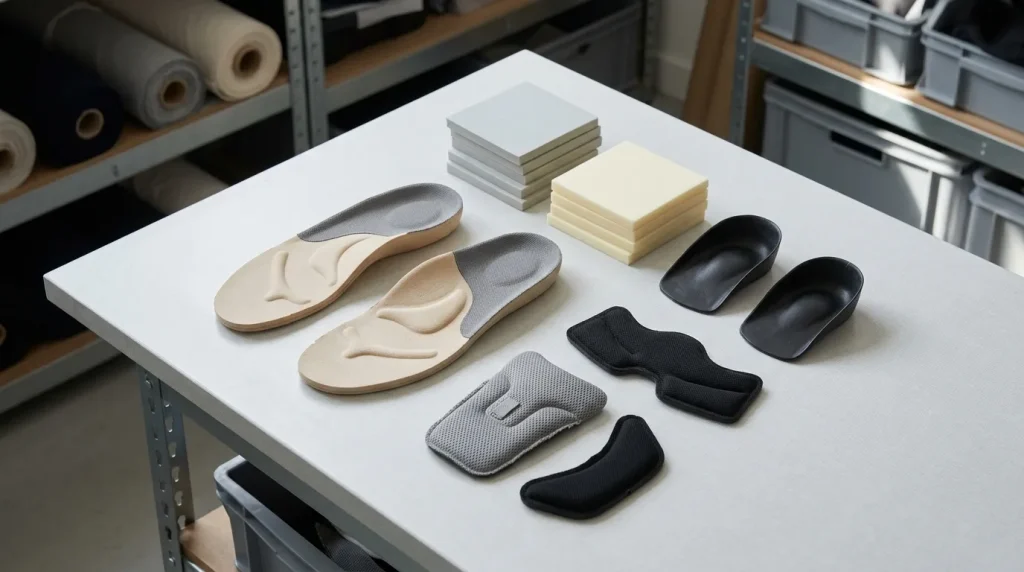
For footwear brands, product developers, and OEM buyers, the performance of an insole is not a question of consumer belief — it is a matter of measurable data, testable material properties, and defensible claims that can be used to differentiate products in a crowded market. Understanding the biomechanics, material science, and laboratory testing protocols that underpin insole performance is essential knowledge for anyone making specification decisions.
This guide covers what the science actually says about how insoles work at a mechanical and material level, how brands can use that data to substantiate product claims, what lab tests matter and why, and how the distinction between insole types should inform sourcing and development decisions. The goal is to give footwear professionals a working technical foundation — one that translates directly into better specifications, stronger marketing claims, and more defensible product positioning.
What Biomechanical Research Tells Us About Insole Performance
Decades of peer-reviewed research in biomechanics, sports medicine, and ergonomics have established that insoles meaningfully alter the distribution and magnitude of forces transmitted through the foot, ankle, knee, and lower back during normal gait. This is not a theoretical claim — it is a well-documented mechanical effect with measurable consequences for the shoe’s wearer.
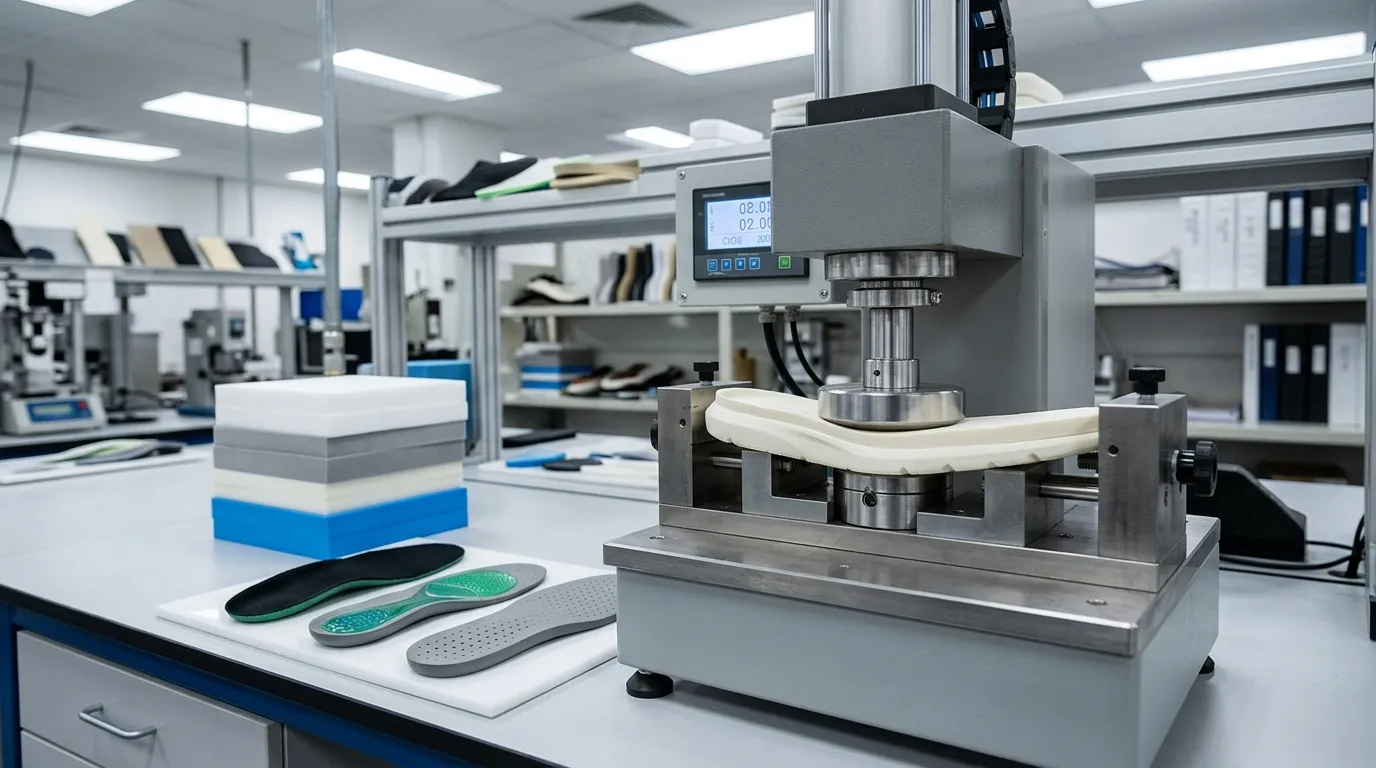
The fundamental mechanism is plantar pressure redistribution. An insole changes the contact geometry between the foot and the shoe’s interior surface. A well-engineered insole increases contact area under the arch and distributes load away from high-pressure zones at the heel pad and metatarsal heads. The result is measurably lower peak plantar pressure — a variable that can be captured with in-shoe pressure mapping technology and cited in product documentation.
Systematic reviews in journals such as the British Journal of Sports Medicine and Gait & Posture have documented that properly designed insoles reduce localized tissue loading, improve subtalar joint alignment, and reduce compensatory movement patterns in the knee and lumbar spine. These findings have direct implications for footwear brands: they mean that insole specification is not just about subjective comfort perception — it is about engineering a measurable biomechanical outcome that can be validated and communicated.
For brands building performance, occupational, or wellness-positioned footwear, this body of research provides the scientific basis for product claims. The key is to connect the research findings to the specific material and geometric properties of your insole specification — so that claims are substantiated rather than generic.
How Material Selection Drives Measurable Performance Claims
The performance properties of an insole are first determined by its material composition. Different materials have distinct mechanical behaviors that can be characterized in the laboratory and translated into product claims. Understanding the material-level science is essential for product teams making specification decisions.
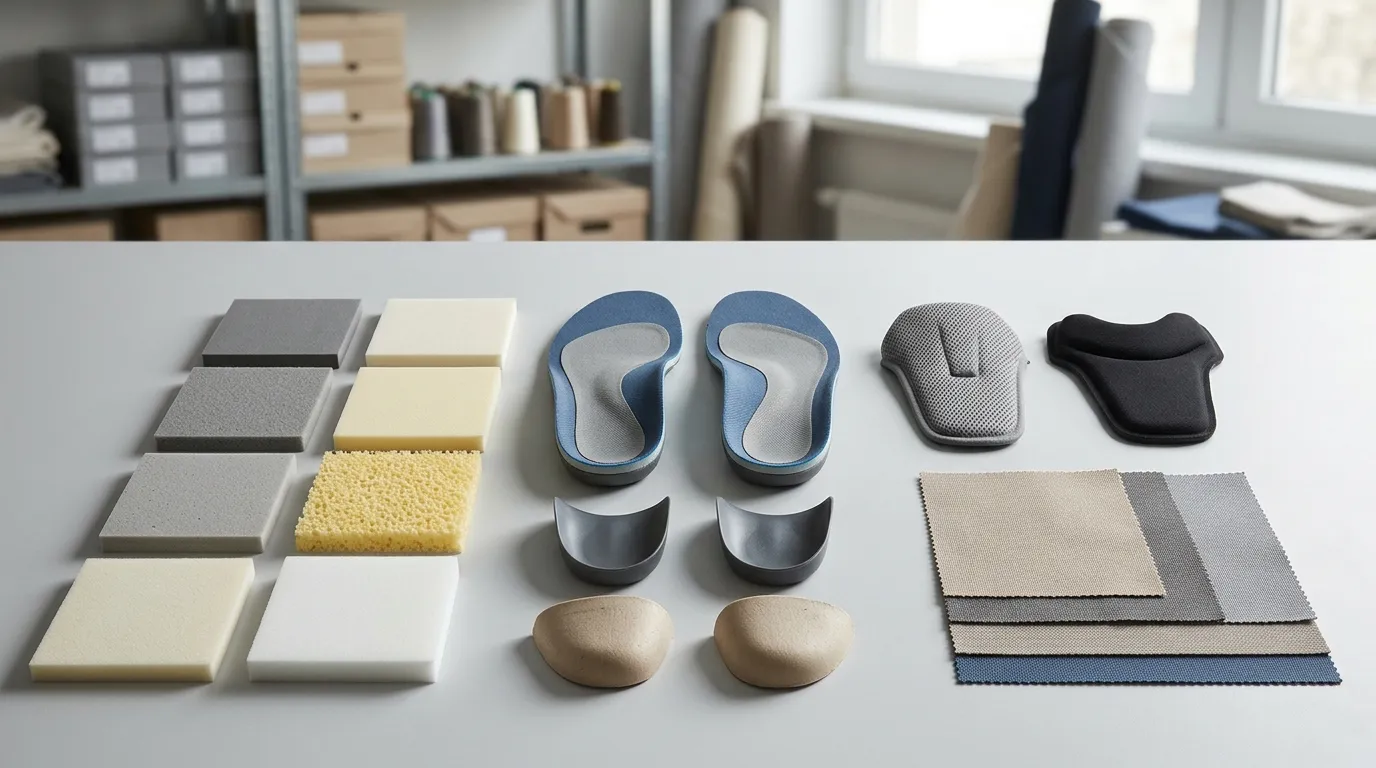
Cushioning and energy return are the most widely marketed insole properties, and also among the most measurable. Energy return is quantified as the percentage of energy released by the foam upon decompression relative to the energy absorbed on compression — a property measured by standardized rebound resilience testing. Higher energy return means the insole contributes to propulsion efficiency rather than simply absorbing energy as heat. Materials like supercritical CO2-blown foam consistently outperform conventional EVA in rebound resilience testing, which gives brands a testable basis for positioning these products at a performance tier.
Compression set resistance determines how well an insole maintains its geometry and cushioning properties over repeated use cycles. This is quantified as the percentage of original thickness lost after a defined number of compression cycles under standardized load. A low compression set value means the insole continues to perform at specification after months of use — a claim that has direct implications for product quality perception and return rates. Polyurethane consistently outperforms standard EVA in compression set resistance, which is why it is the preferred base material for occupational and high-duration use categories.
Hardness and density determine the firmness of the cushioning response and the degree of arch support provided. Shore A hardness is the standard measurement. A harder base layer (higher Shore A) provides structural support and resists deformation; a softer top layer (lower Shore A) manages pressure distribution and skin comfort. The ratio and thickness of these layers is an engineering decision with directly testable consequences for how the finished insole performs.
Abrasion resistance of the top cover determines how long the insole maintains its surface integrity under friction. Standard abrasion testing (Martindale or Taber abrasion methods) quantifies material durability. For brands making durability claims or offering products in heavy-use categories, top cover abrasion resistance is a specification that should be tested and documented.
For brands working with FX Footwear’s insole manufacturing platform, each of these material properties can be specified, prototyped, and validated before production commitment — giving development teams data-backed confidence in the performance specification.
Key Lab Tests for Insole Performance Validation
Footwear brands that want to make substantiated performance claims need to understand which laboratory tests generate the data that supports those claims. The following are the core testing protocols relevant to insole specification and validation.
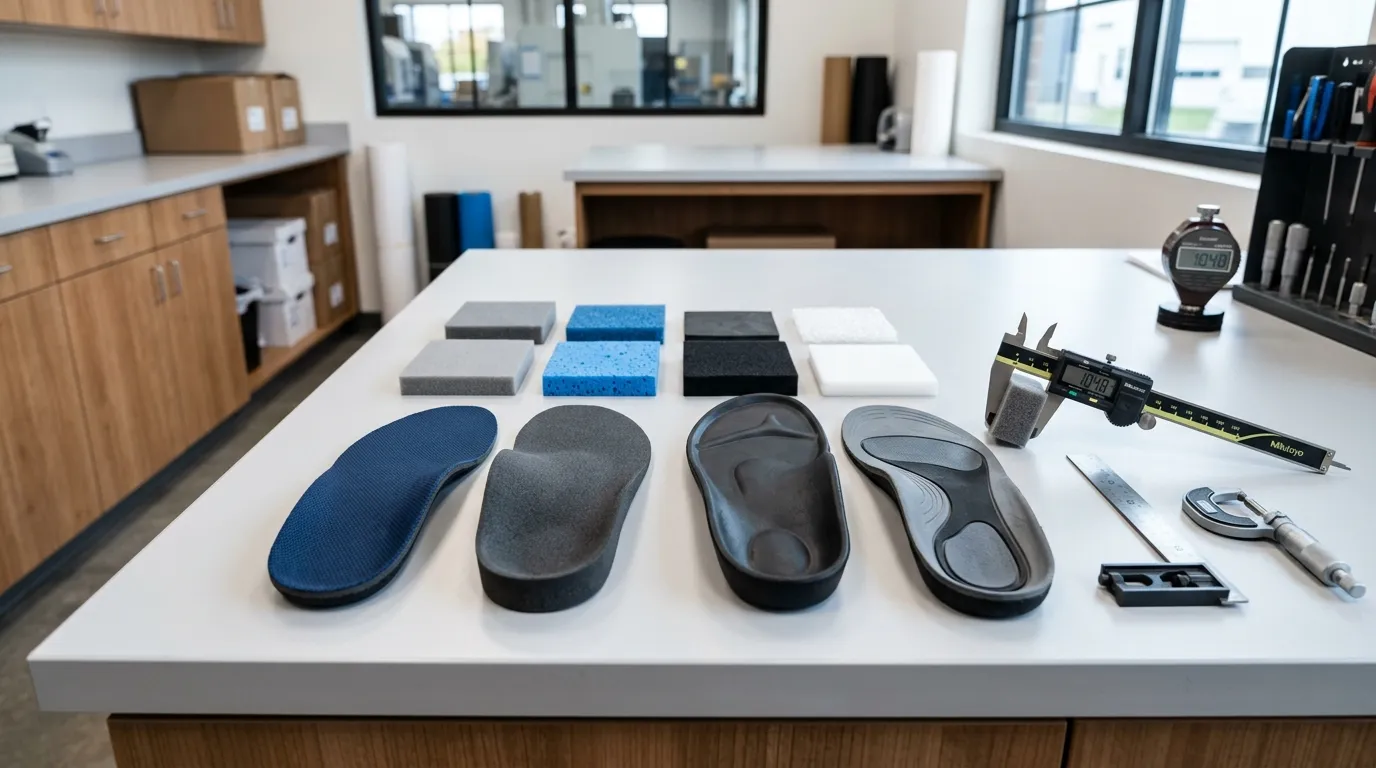
Compression set testing measures the permanent deformation of an insole material after sustained compression. The standard method (ISO 1856 or ASTM D395) compresses a sample to a defined percentage of its original thickness for a set duration, then measures how much of its original thickness it recovers after release. Lower compression set percentage indicates better long-term durability. This test directly supports claims about “lasting cushioning” or “maintains performance over time.”
Rebound resilience testing quantifies energy return as a percentage. ISO 4662 (ball rebound method) or ASTM D2632 are standard protocols. A foam with 65% rebound returns 65% of the energy input on compression — the rest is dissipated as heat. For brands making performance or energy-return claims, this is the test that generates the supporting data. High-performance insole materials typically achieve rebound resilience of 55–75%, while commodity EVA may fall in the 40–55% range.
Plantar pressure mapping is a dynamic in-shoe measurement that captures the distribution and magnitude of pressure under the foot during gait. Systems from providers like Novel or Tekscan allow development teams to compare pressure maps with and without a given insole, across different arch geometries and material densities. This is the primary validation tool for claims about pressure distribution, hotspot reduction, and comfort improvement.
Abrasion resistance testing (Martindale or Taber methods) evaluates top cover material durability. The test measures mass loss or surface degradation after a defined number of abrasion cycles under standardized load. This test supports claims about insole longevity and is particularly relevant for products marketed to high-wear environments.
Flexion fatigue testing simulates the repeated bending experienced by an insole in normal footwear use. After a defined number of flex cycles (typically 50,000–200,000), the insole is re-evaluated for cracking, delamination, or dimensional change. This test is particularly relevant for multi-layer constructions where layer adhesion is a quality concern.
Dimensional stability testing measures whether the insole maintains its geometry — arch height, heel cup depth, overall length and width — after exposure to heat, humidity, and use simulation. Dimensional instability under in-use conditions is a common source of comfort complaints and is preventable through specification and testing.
Brands that require independent validation should work with suppliers who have established relationships with accredited testing laboratories and can provide test reports as part of the supplier qualification process. A supplier with in-house testing capability and access to accredited external validation is a significantly lower-risk sourcing partner than one who cannot provide documented test data.
Prefabricated vs. Custom OEM Insoles: A Sourcing Framework
Understanding the performance science of insoles also requires understanding the spectrum between off-the-shelf stock insoles and fully custom OEM developments — because the sourcing decision has direct implications for what claims a brand can make.
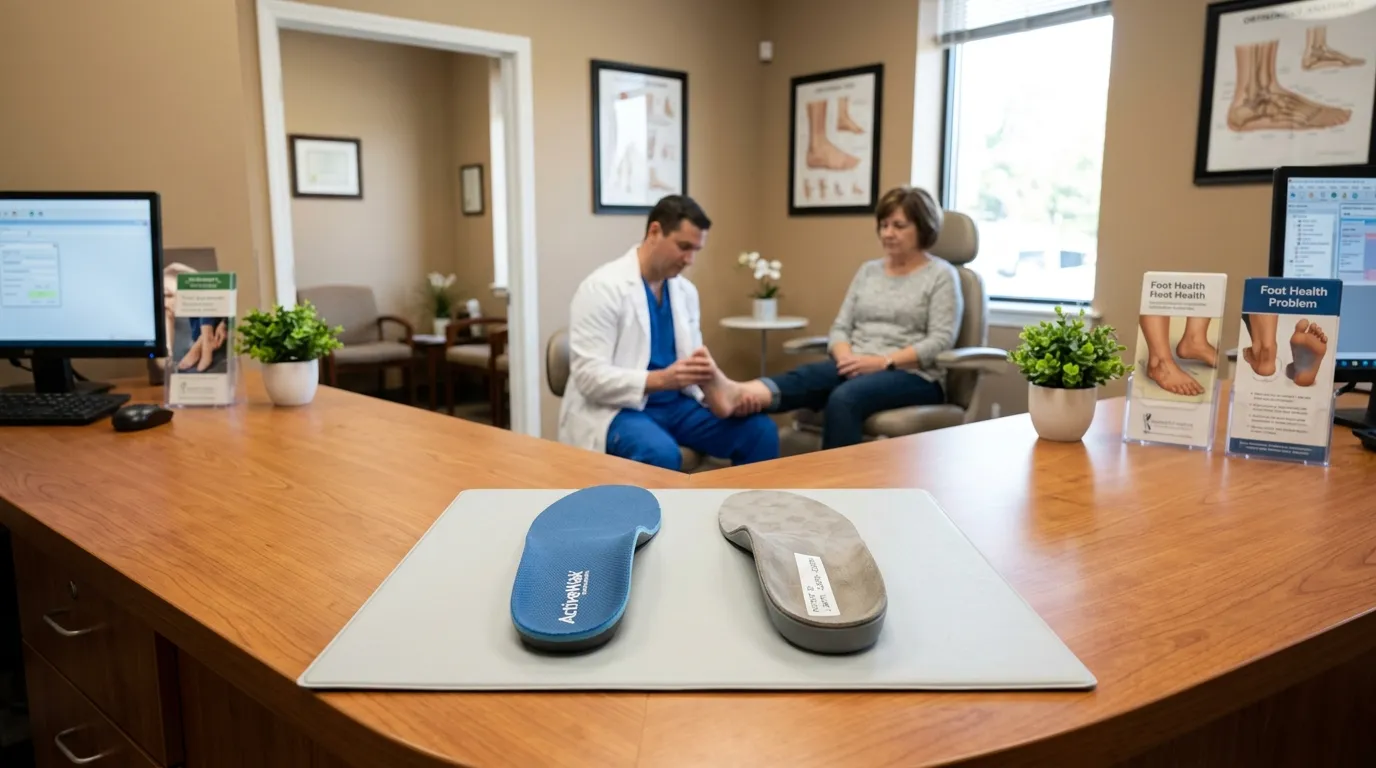
Stock insoles are standardized components produced at scale by a manufacturer and supplied as default footbed options. They are specified for a general-population foot profile and general-purpose performance targets. For brands using stock insoles, the available performance claims are limited to what the manufacturer’s standard documentation supports — and those claims are not exclusive to your product.
Custom OEM insoles are developed in partnership with a brand, with specifications driven by the brand’s product positioning, target consumer profile, and intended use environment. Custom development allows brands to specify and validate every relevant property: arch geometry tuned to the product’s last, density layering optimized for the intended use category, top cover material selected for the specific wear environment, and compression set resistance validated for the claimed product lifespan. Critically, custom development generates test data that is specific to your product specification — data you can use in marketing, retail training, and product documentation without it being equally applicable to a competitor’s shoe.
For footwear brands at sufficient volume to justify tooling investment, custom OEM development with a technically capable shoe insole manufacturer is the path to exclusive, substantiated performance claims. Brands that source stock insoles accept commodity performance — they cannot differentiate on insole properties because those properties are not theirs to own.
The practical threshold for custom OEM development varies by manufacturer, but most professional insole manufacturers can work with brands at volumes from 5,000–10,000 pairs per SKU to justify dedicated tooling. Below that threshold, working with a manufacturer that offers semi-custom options — modified geometry on existing tooling, custom compound, branded top cover — provides a middle path.
How Brands Validate and Communicate Insole Claims
Having test data is necessary but not sufficient — brands also need to know how to deploy it effectively in marketing, retail, and B2B sales contexts.
Internal validation begins in the product development phase: prototype insoles are tested against specification using the lab methods described above, and results are compared against defined performance targets before production commitment. Development teams should define minimum acceptable values for key metrics — compression set, rebound resilience, arch geometry accuracy — as go/no-go criteria.
Retail and marketing claim substantiation requires that performance claims be traceable to test results from the specific material and construction used in the production insole. A claim that your insole delivers “30% better energy return” needs to be based on comparative rebound resilience test data for your specific foam, not a general industry reference. Test reports from accredited laboratories provide the evidentiary basis for substantiated claims.
B2B sales documentation — particularly when selling to institutional buyers, procurement teams, or major retail chains — benefits from structured technical data sheets that present key insole specifications alongside supporting test data. Buyers in occupational and safety footwear categories often require this documentation as part of supplier qualification. Even in consumer footwear, major retailers increasingly ask for technical substantiation of performance marketing claims.
Comparative product positioning is strengthened when brands can reference the testing methodology that validates their claims. Rather than saying “superior cushioning,” specifying “65% rebound resilience per ISO 4662 testing” communicates a measurable, defensible, and differentiating property. This is the language that resonates with sophisticated buyers and provides a basis for premium price justification.
For brands wanting to review what lab-validated insole performance looks like in practice, FX Footwear’s testing documentation provides a reference point for how material properties translate into validated performance specifications.
Comfort Insoles vs. Orthotic Insoles: A Sourcing-Level Distinction
One of the most practically important distinctions for footwear brand sourcing teams is the difference between comfort insoles and orthotic insoles — because the specification requirements, supplier capabilities, and regulatory considerations are meaningfully different.
Comfort insoles are engineered to improve the subjective wear experience: cushioning, moisture management, odor control, and general foot-feel. They are appropriate for everyday, casual, lifestyle, and general athletic footwear. The design brief is typically driven by consumer panel feedback and measurable properties like cushioning thickness, compression set, and top cover performance. Most footwear insole manufacturers can produce comfort-focused insoles — the key differentiator is material quality, construction precision, and consistency at volume.
Orthotic insoles are designed to modify foot mechanics — correcting or controlling pronation, supination, arch collapse, or other movement patterns. They typically incorporate specific geometric elements (medial post, deep heel cup, metatarsal dome, lateral wedge) and may use semi-rigid or rigid structural components (polypropylene shell, carbon fiber plate) in addition to cushioning layers. Orthotic insoles require design input grounded in biomechanical science, and the specifications are validated against measurable gait outcomes rather than comfort perception alone.
For sourcing teams, the distinction matters in two ways. First, it determines what kind of supplier capability is needed: a comfort insole can be sourced from any competent foam fabricator with good quality control, while an orthotic-functional insole requires engineering capability, biomechanical expertise, and design validation tools. Second, it affects what claims can be made in marketing: comfort claims are relatively straightforward to substantiate; therapeutic or corrective claims may trigger regulatory requirements in some markets and need to be approached carefully.
Many of the most commercially successful insoles in performance and occupational categories occupy a middle ground: they incorporate functional geometry that provides meaningful biomechanical benefit without crossing into medical device territory. Working with a manufacturer that understands this boundary — and can design insoles that deliver real functional performance within appropriate claim parameters — is a significant competitive advantage.
FAQ: Insole Performance Science for Footwear Brands
What lab tests validate insole performance?
The core battery for insole performance validation includes: compression set testing (ISO 1856 or ASTM D395) for long-term cushioning durability; rebound resilience testing (ISO 4662 or ASTM D2632) for energy return; in-shoe plantar pressure mapping for pressure distribution validation; abrasion resistance testing (Martindale or Taber) for top cover durability; and flexion fatigue testing for construction integrity. For occupational and safety footwear, additional tests may be required to comply with EN ISO 20347 or ASTM F2413. Brands should request test reports from accredited laboratories as a standard part of supplier qualification.
How do brands substantiate cushioning claims?
Cushioning claims are most defensibly substantiated using rebound resilience data (ISO 4662) and compression set data (ISO 1856) from the specific foam compound used in the production insole, supplemented where possible by in-shoe plantar pressure mapping data showing measurable reduction in peak pressure versus a control condition. Claims should be specific: “X% rebound resilience” or “Y% reduction in peak heel pressure” are defensible; general terms like “superior cushioning” are not. Test reports from accredited laboratories provide the evidentiary basis. Brands should also ensure that claims are based on production-grade materials tested from the same compound batch as the manufactured product, not prototype samples that may differ from production.
What is the difference between comfort insoles and orthotic insoles for sourcing purposes?
For sourcing teams, the key differences are in supplier capability requirements, design validation methods, and regulatory exposure. Comfort insoles are primarily about material performance — cushioning, durability, moisture management — and can be sourced from any technically competent insole manufacturer with documented quality control. Orthotic insoles require biomechanical engineering input, geometric precision in arch and heel cup design, and validation against gait mechanics rather than comfort perception alone. They may also use semi-rigid structural components that require different tooling and material expertise. From a regulatory standpoint, insoles that make corrective or therapeutic claims may be classified as medical devices in some markets, requiring registration and compliance documentation. Most brands building performance footwear benefit from insoles that incorporate functional geometry without requiring medical device compliance — a design space that an experienced insole manufacturer can navigate effectively.
At FX Footwear (Fuxiang Group), we design and manufacture insoles built to perform under the scrutiny of the testing protocols described in this guide — engineered from the material up, validated in the lab, and optimized for the specific demands of global footwear brands. Whether you’re developing a performance athletic line that needs substantiated energy-return claims, a work boot program that demands documented anti-fatigue properties, or an everyday comfort insole that needs to hold its specification over thousands of wear cycles, our team brings the technical depth and production scale to deliver on the brief. Contact us to discuss your insole program requirements.