
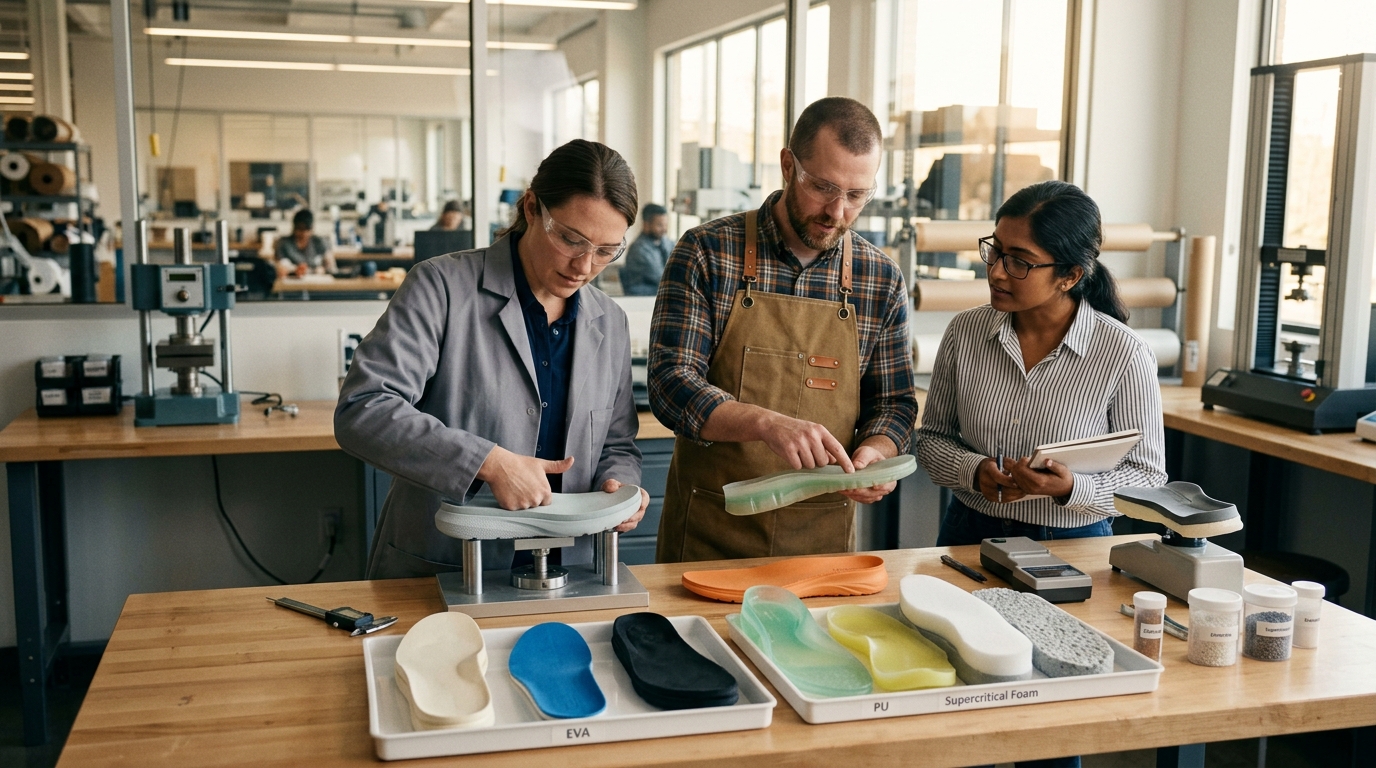
When picking foam for a footwear program, it’s all about what you’re trying to solve. Go with EVA to keep costs low and production easy. Choose PU if you want long-term comfort that won’t flatten out. And for high-performance bounce? The right choice depends on shoe category, target retail price, durability expectations, and whether the component is an insole, midsole, or both.
EVA PU Foam Decision
EVA is usually the safest OEM starting point, PU works better when compression set is the main worry, and supercritical foam is the performance choice when rebound matters more than unit cost. TPU, TPEE, and PEBA enter the discussion mostly through supercritical fluid foaming for midsoles and high-spec insole platforms.
| Buyer Question | Best Starting Material | Why It Fits |
|---|---|---|
| “We need a reliable athletic insole under tight cost targets.” | EVA | Mature supply chain, fast tooling, broad hardness range |
| “Retail returns mention flattening after wear.” | PU | Better compression resistance and long-term shape retention |
| “The shoe needs bounce for running or court use.” | Supercritical foam | Higher energy return and impact absorption |
| “We need a premium race midsole story.” | SCF PEBA blend | Lowest weight and highest rebound among common SCF resin options |
| “The upper, midsole, and insole must be coordinated.” | One-stop component sourcing | Fewer supplier handoffs and cleaner spec control |
A pattern we hear in OEM sourcing calls is simple: the buyer doesn’t ask for “the best foam.” The buyer asks why a size run felt good in pre-production, then felt different after 30,000 pairs shipped. That problem usually starts with a weak material spec: no target hardness, no compression set requirement, no density band, no aging test, and no clear top cloth or adhesive choice.
For teams comparing footwear material cost performance across 2026 shoe programs, foam selection should come before styling details. A great logo print won’t fix a PU insole that traps heat in a summer work shoe, and a high-rebound midsole won’t save a value sneaker if the insole pushes the BOM beyond the retailer’s price point.
If you’re working with a custom shoe insole manufacturer, ask for material data next to finished-sample feedback. You want both: lab numbers and the practical wear-test question of whether the insole still feels right after repeated use.
Insole Material Selection Table
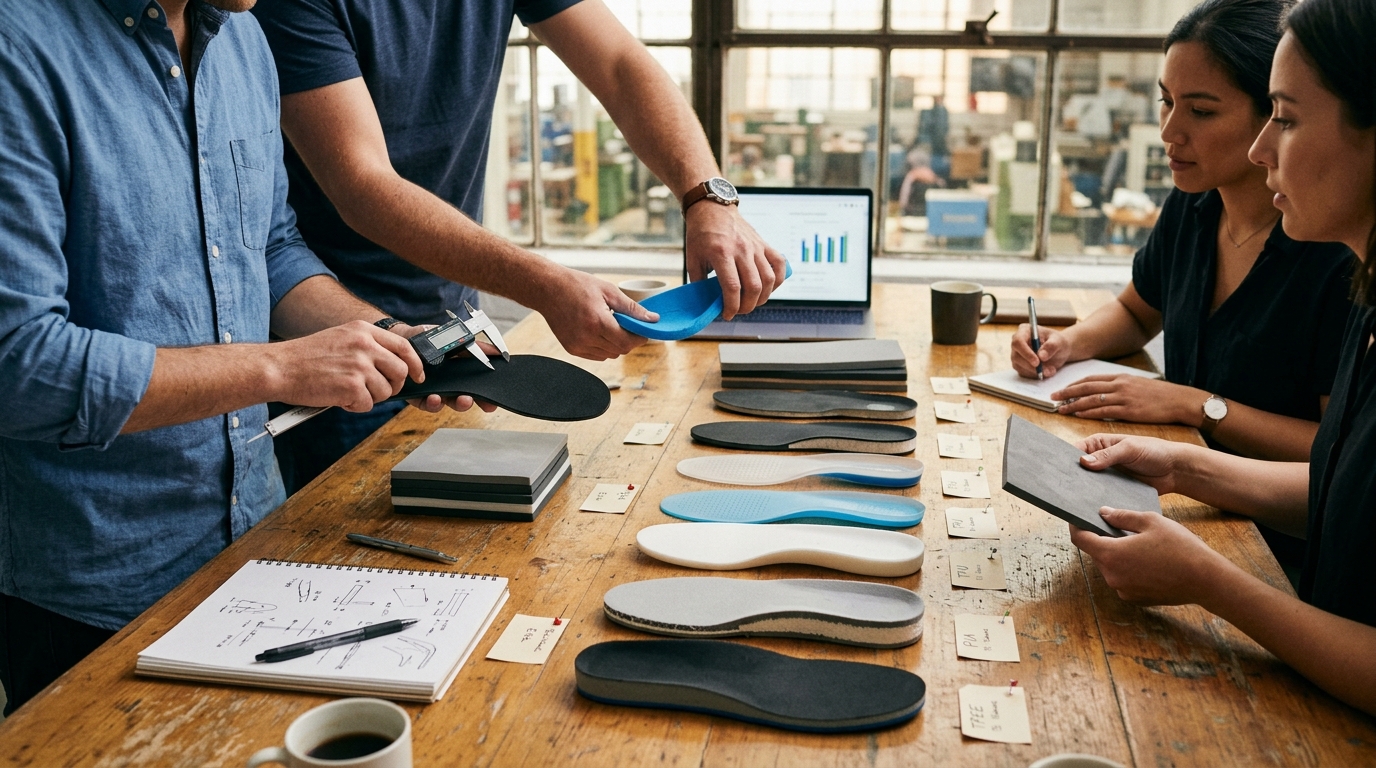
The table below is built for OEM sourcing teams that need a fast, citation-ready comparison of EVA PU supercritical foam insoles, including TPU, TPEE, and PEBA options used in supercritical foam platforms.
| Material | Typical OEM Use | Strengths | Tradeoff | Best Fit |
|---|---|---|---|---|
| EVA foam | Insoles, midsoles, casual cushioning | Low cost, low density, mature molding | Can lose feel faster than PU under long compression | Athletic, casual, workwear, value performance |
| PU foam | Comfort insoles, workwear, orthotic-style cushioning | Compression resistance, shape retention, soft feel | Lower rebound than EVA and supercritical foam | Comfort, standing work, long-wear footwear |
| SCF EVA | Insoles and midsoles | Cost-effective supercritical option, low density | Lower rebound than SCF TPU, TPEE, or PEBA | Everyday athletic and value-tier performance |
| SCF TPU blend | Premium midsoles, selected insole platforms | Elasticity, abrasion resistance, durability | Higher density than EVA, often blended to manage weight | Premium running, court, outdoor footwear |
| SCF TPEE | Outdoor soles, thermal-stress applications | Heat resistance, chemical resistance, good elasticity | Higher price than EVA or TPU | Outdoor performance soles and durable platforms |
| SCF PEBA blend | Elite racing midsoles, high-rebound inserts | Top rebound, very low weight | Highest price; rarely right for entry-level shoes | Race-day running and elite athletic footwear |
EVA and PU are both direct insole materials. Supercritical foam is a process family: it uses CO2 or N2 as the blowing agent to foam base resins such as EVA, TPU, TPEE, or PEBA. That distinction matters because “supercritical” doesn’t automatically mean PEBA, and PEBA doesn’t automatically mean the factory makes PEBA resin in-house.
Cost follows a clear order in supercritical fluid foaming: EVA < TPU < TPEE < PEBA. Rebound usually follows the reverse performance order: PEBA > TPEE > TPU-blend > EVA in SCF applications. That doesn’t mean every PEBA program is worth the cost. A $79 walking shoe with a PEBA midsole story is usually solving the wrong problem.
A buyer once described the problem perfectly during an RFQ review: “The prototype felt expensive, but the shoe isn’t supposed to be expensive.” That’s where EVA or PU still wins. Materials have jobs. Don’t hire a race foam to do a school-shoe job.
EVA Foam Sourcing
EVA is the most familiar OEM insole material because it is predictable, available, and easy to tune. FX Footwear supplies EVA insoles in compression-molded, injection-molded, and die-cut formats. Standard EVA hardness should be specified in Asker C, not Shore C, with a normal working range of 20-45 Asker C and a tolerance of ±3.

That range covers a lot of shoes. A soft 20-25 Asker C EVA can work for casual comfort, while a firmer 35-45 Asker C construction can support workwear or structural builds. Multi-density EVA also gives you a practical way to tune heel impact, arch support, and forefoot flex without turning the insole into a complicated science project.
| EVA Spec Item | OEM Guidance |
|---|---|
| Hardness unit | Asker C |
| Common range | 20-45 Asker C, ±3 tolerance |
| Formats | Compression-molded, injection-molded, die-cut |
| Constructions | Single-layer or multi-density |
| Main footwear uses | Athletic, casual, workwear |
| Sustainable options | Sugarcane-based EVA, algae-based EVA, recycled EVA compounds |
EVA is also where sustainable material choices are easiest to discuss without overpromising. Sugarcane-based EVA, algae-based foam that reduces reliance on petroleum-based materials, and recycled EVA compounds can be sourced under GRS-compliant supply chains with traceability documentation. Treat those as material options inside an EVA insole program, not as a separate finished-product category.
The drawback? Compression behavior. EVA can feel lively at first, then flatten depending on density, formulation, and use conditions. If your shoe is built for nurses, warehouse teams, retail staff, or anyone standing through long shifts, you need compression set data before you sign off. A showroom hand-feel test tells you almost nothing about month-three comfort.
For OEMs, EVA is the right first question when the target is speed, price control, and proven tooling. It is rarely the wrong starting point. It just needs numbers attached.
PU Foam Sourcing
PU feels different from EVA under the foot. It tends to feel soft and settled rather than springy. That is exactly why PU works in comfort insoles, standing-work footwear, and programs where the user judges quality after a full day instead of after three steps in a sample room.

PU’s main strengths are compression resistance, long-term shape retention, and a soft comfortable feel. Open-cell PU improves breathability, which matters in leather casual shoes, work boots, and comfort footwear where heat buildup becomes a real complaint. In energy return, PU sits below EVA and far below supercritical foam. Use it for comfort retention. Don’t sell it as a bounce material.
| PU Decision Factor | Practical Meaning |
|---|---|
| Compression resistance | Better for long standing and repeated load |
| Shape retention | Helps reduce early flattening complaints |
| Open-cell structure | Better breathability than denser closed structures |
| Energy return | Lower than EVA and supercritical foam |
| Sustainable option | Susterra-based bio-based PU formulations |
The wrong PU choice usually happens when a brand chases softness only. A sample insole can feel great at 2 p.m. in a conference room and still fail after six weeks inside a work shoe. Ask for density, compression set, breathability targets, and adhesive compatibility. Also check top cloth selection. A breathable PU core paired with the wrong cover textile can still feel hot.
PU is often the best answer when your customer says, “Our last insole packed out.” It may cost more than a simple EVA die-cut insole, and it won’t give you the snap of supercritical foam. Fine. For many comfort programs, snap isn’t the problem.
Supercritical Foam Sourcing
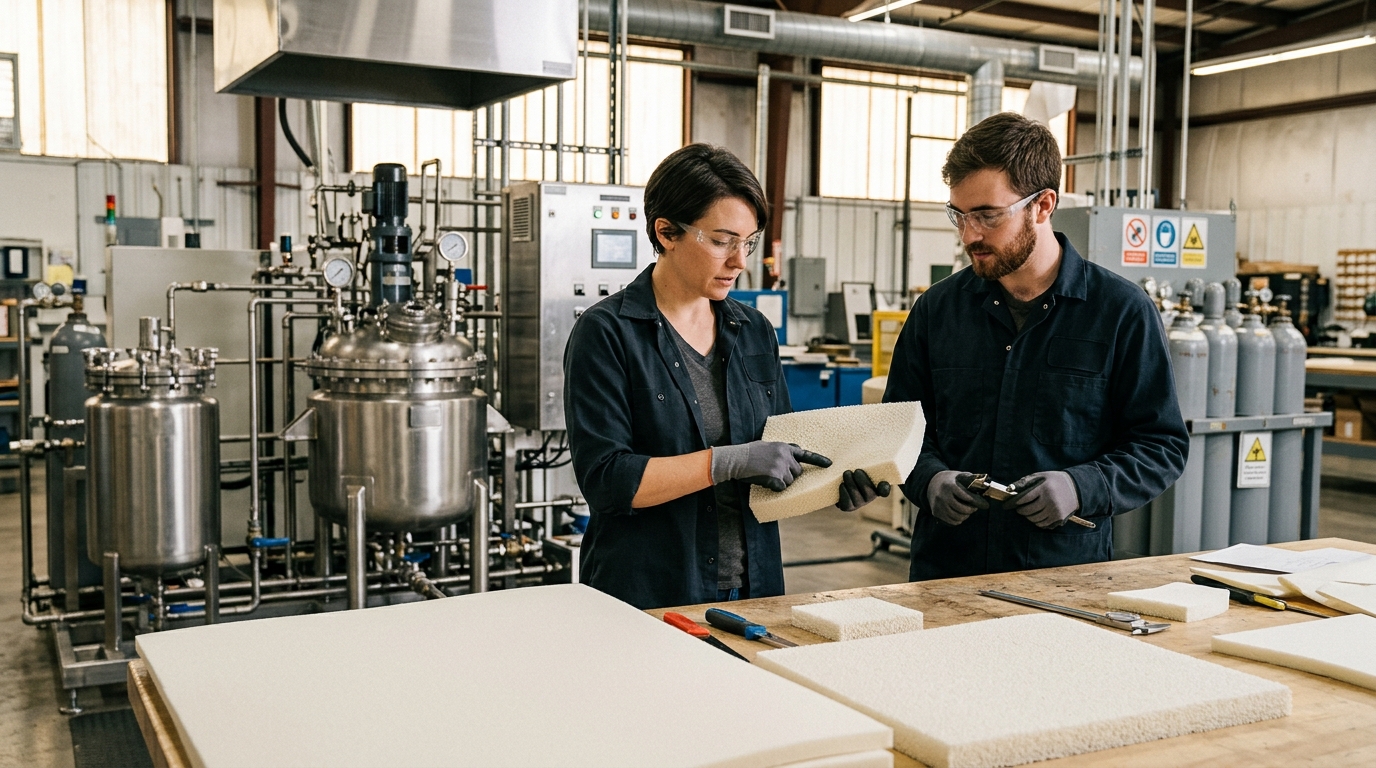
Supercritical fluid foaming uses CO2 or N2 as the blowing agent. The process creates a microcellular structure with predominantly closed cells, without traditional chemical blowing agents. In supplier specifications, achievable foam density can be as low as 0.07 g/cm3, with rebound rate of 80%+ depending on resin system and formulation.
This is where EVA PU supercritical foam insoles become a broader sourcing conversation. Supercritical foam can be used for performance-focused insoles, but it is also a major midsole technology. If your product team is building a running shoe, court shoe, or premium training model, the insole and midsole should be discussed together because underfoot feel comes from the stack, not one layer.
| SCF Base Resin | Cost Position | Performance Character | Typical Use |
|---|---|---|---|
| EVA | Lowest | Mature, light, cost-effective | Everyday athletic, casual, value performance |
| TPU | Mid | Elastic, durable, abrasion-resistant | Premium midsoles and durable cushioning |
| TPEE | High | Heat and chemical resistance | Outdoor soles and thermal-stress applications |
| PEBA | Highest | Highest rebound, very low weight | Elite running and racing footwear |
PEBA deserves special care. It is the newest and most premium of the four common SCF base resin choices, and it belongs mostly in elite-level athletic footwear. Shincell, a company based in Suzhou, Jiangsu Province, is known in the industry for PEBA foam supplied for Adidas ADIZERO ADIOS PRO EVO models. That example is useful because it shows where PEBA makes sense: race-day performance, not entry-level cost control.
FX Footwear’s PulseSport platform is performance-focused supercritical CO2 foam for consistent energy feedback and impact absorption across repeated use. For sourcing teams evaluating a supercritical CO2 foam insole, the key questions are density, rebound, compression fatigue, outsole or midsole pairing, and whether the shoe’s retail price can support the material.
TPU, TPEE, and PEBA should also be framed correctly. FX can process sourced resin systems through SCF equipment for the right project, but the resin identity and origin should be documented in the material file. If a spec sheet says “supercritical foam” with no resin family, no density, and no rebound test method, it isn’t ready for OEM costing.
Compliance And Production Timing
For US-destined footwear programs, start with CPSC and California Prop 65 before asking about EU requirements. The U.S. Consumer Product Safety Commission says children’s products for ages 12 and under need tracking information that can identify the maker, production timing, location, and batch details; see the CPSC guidance on tracking labels. California’s OEHHA states that Proposition 65 warnings are tied to exposure to listed chemicals, with business guidance available through the official Prop 65 warnings site.

For FX Footwear projects, documentation can include GRS, ISO 13485:2016, Higg Index records, Intertek and BETA verification or testing, SATRA/SGS/ASTM test reports, and social audit support such as BSCI or SMETA when required by the buyer. REACH is an EU chemical regulation, so materials can be sourced to meet REACH requirements for EU entry on a project basis. It isn’t a certificate, and it isn’t the default US sourcing requirement.
| Sourcing Step | Accurate Timing |
|---|---|
| Die-cut or knife-cut sample, no new tooling | About 3 days |
| New mold or tooling sample | About 10 business days |
| Standard EVA insole production | 20-35 days after payment confirmation |
| Supercritical CO2 foam insole production | 30-45 days |
| Custom insole sampling phase | 7-14 days |
| Bulk production after sample approval | About 30-40 days |
| First-time custom cycle, spec to goods ready | About 45-70 days |
| Ocean freight to US ports from East Asia | 18-30 days |
| Air freight door-to-door | About 5-10 days |
That calendar matters more than buyers expect. If a US retailer wants back-to-school delivery in July, a first-time custom insole program shouldn’t be kicked off in late May unless the tooling is simple and air freight is already accepted in the margin model. A realistic total sourcing cycle for a custom first-time order is about 65-100 days when development, production, and freight are all counted.
Payment and quotation terms should be just as clear. Standard new-customer terms are 30% deposit upfront and 70% before shipment, with sampling costs paid upfront. Initial quotations are usually available within 48 hours for standard constructions using existing tooling and materials; detailed cost breakdowns come after technical evaluation.
FX Footwear’s practical advantage is that insole, midsole, upper, and other component work can be coordinated across China, Northern Vietnam, Southern Vietnam, and Indonesia. That helps when a brand needs regional manufacturing near major Tier 1 footwear hubs, lower duty exposure, and tighter material control from foaming through final assembly.
FAQ
Which foam is best for insoles?
EVA is best for cost-controlled OEM insoles, PU is better for long-term comfort and shape retention, and supercritical foam is best for performance footwear that needs high rebound. The best choice depends on shoe category, retail target, and wear conditions.
Is PU more durable than EVA?
PU usually has better compression resistance and long-term shape retention than EVA. EVA can still be the better choice when low weight, fast molding, and lower cost matter more than pack-out resistance.
Is supercritical foam worth it?
Supercritical foam is worth it for running, court, and premium athletic footwear where energy return and impact absorption affect the product story. It may be unnecessary for basic casual shoes, low-price workwear, or programs where the midsole already carries the cushioning load.
Is PEBA better than TPU?
PEBA usually delivers higher rebound and lower weight than TPU in supercritical foam applications. TPU is still useful when durability, abrasion resistance, oil resistance, and cost balance matter more than elite race-level rebound.
What certifications does FX have?
FX Footwear has confirmed support for GRS, ISO 13485:2016, Higg Index records, Intertek, and BETA verification or testing. For US programs, FX can also coordinate CPSC, California Prop 65, SATRA/SGS/ASTM reports, and relevant social audit documentation based on buyer requirements.
For your next EVA, PU, or supercritical foam project, send FX Footwear (Fuxiang Group) the shoe category, target FOB, expected wear condition, hardness or rebound target, order volume, and destination market. FX can recommend the insole and midsole material path, build samples through its in-house lab and regional manufacturing network, and keep the sourcing file tied to real OEM production needs.