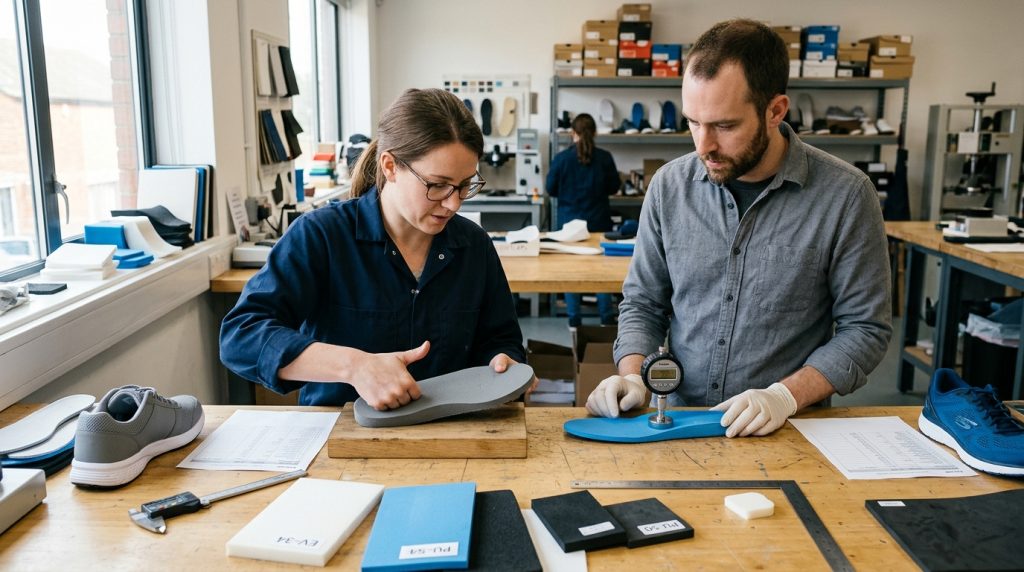
Product developers evaluate insole comfort by separating subjective feel from measurable specs: hardness, rebound, compression, thickness, recovery, surface feel, and wear after repeated loading. Insole rebound hand feel testing turns buyer language like “too dead,” “too firm,” “bouncy,” or “premium soft” into sample targets a factory, lab, and brand team can actually approve.
Insole Rebound Hand Feel Testing
1. Translate buyer language into hardness, rebound, compression, thickness, and recovery targets.
2. Test the material, then test the full insole.
3. Compare at least two constructions side by side.
4. Wear-test the finalist in the intended shoe.
5. Lock approved specs before tooling or bulk orders.
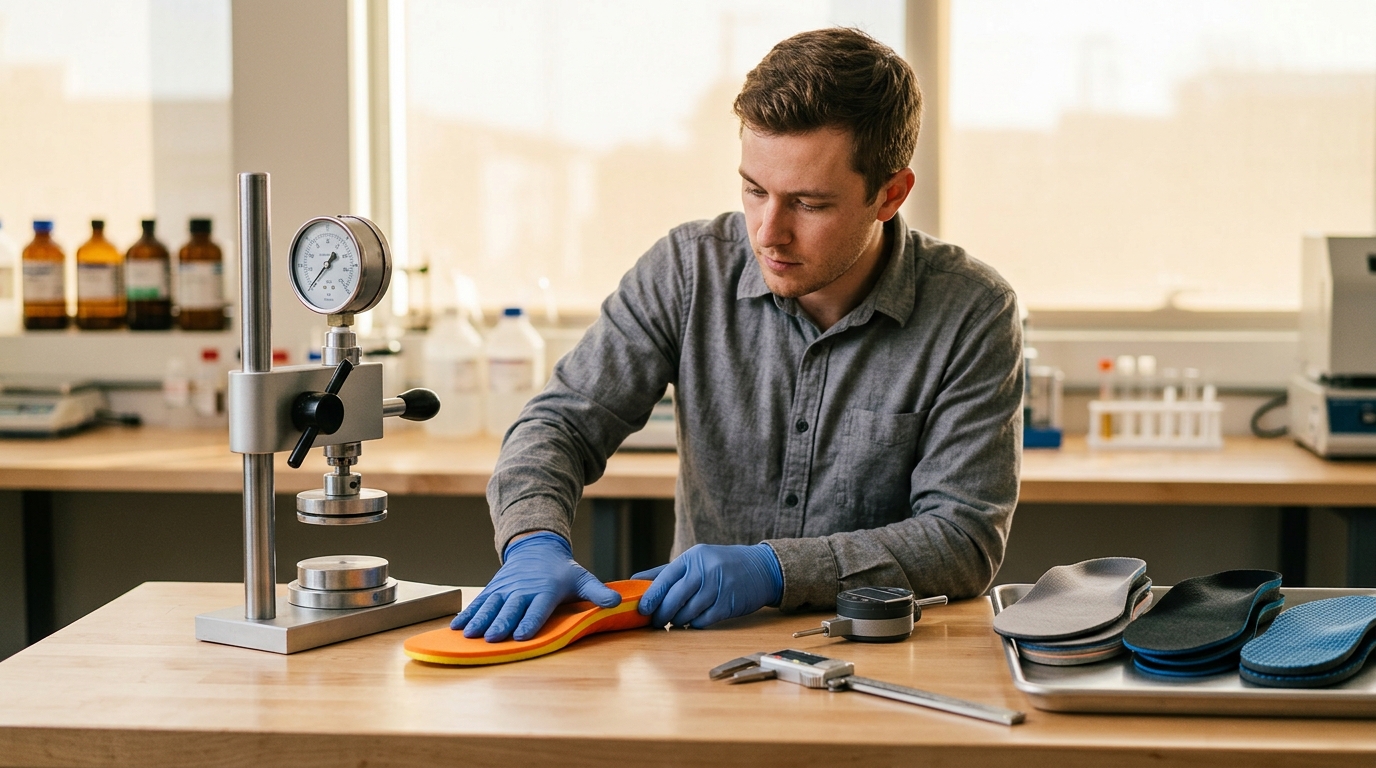
A sample doesn’t fail because someone says, “This feels cheap.” It fails because the team can’t explain what “cheap” means. Maybe the foam rebounds too slowly. Maybe the top cloth feels slick. Maybe the heel compresses past the target after 5,000 loading cycles. The job is to convert that reaction into a measurable change.
At FX Footwear, the first sampling conversation usually starts with plain words. Soft. Dry. Sticky. Springy. Boardy. Dead. Then we map those words to tests and build notes. That’s where insole rebound hand feel testing earns its keep: it gives product, sourcing, and factory teams the same language before money goes into tooling.
A useful sample review separates four questions:
| Buyer question | Testable spec | Why it matters |
|---|---|---|
| Does it feel soft enough? | Hardness, compression deflection | First try-on comfort |
| Does it bounce back? | Rebound %, recovery time | Athletic feel and fatigue perception |
| Does it bottom out? | Compression set, thickness loss | Long-term comfort |
| Does the surface feel right? | Top cloth, friction, moisture feel | Retail try-on and wear comfort |
The mistake is testing only one of these. A low-hardness EVA can feel soft in your hand and still feel thin inside a work shoe. A PU insole can feel less lively than EVA but hold its shape better after wear. A supercritical foam can rebound strongly, yet feel too tall or too unstable if the insole geometry isn’t matched to the last.
Hand Feel Translation
“Hand feel” sounds informal, but product developers use it because a buyer’s first reaction often happens before lab data is ready. They squeeze the arch. They press the heel with a thumb. They flex the forefoot. They rub the top cloth. Then someone says, “Can we make this more comfortable without raising cost?”

That sentence can mean six different things.
| Customer language | Likely technical meaning | Factory action |
|---|---|---|
| Too hard | Hardness too high or compression too shallow | Reduce Asker C or adjust density |
| Too mushy | Initial compression too deep | Increase hardness or add support layer |
| No rebound | Low resilience or slow recovery | Change foam grade or construction |
| Too bouncy | High rebound with poor control | Add firmer base or adjust thickness |
| Feels cheap | Surface feel, weight, edge finish, recovery | Review cloth, lamination, cut quality |
| Good at first, bad later | Compression set problem | Run fatigue and recovery checks |
Here’s the trap: a buyer may ask for “softer,” but the winning sample may need better pressure distribution rather than lower hardness. Drop the hardness too far and the insole can feel plush for ten seconds, then collapse under heel load. In a size 10 men’s athletic shoe, that heel area takes repeated impact. The sample has to survive the body, not just the meeting room.
For EVA insoles, hardness should be recorded in Asker C. FX’s standard EVA range is 20–45 Asker C with ±3 tolerance, depending on the application and construction. Use Asker C in the spec sheet; Shore C creates confusion and can send the factory toward the wrong measurement setup.
For PU insoles, the hand-feel story is different. PU is valued for compression resistance, long-term shape retention, and a soft, comfortable feel. Open-cell PU also supports better breathability. If the buyer wants a soft insole for casual footwear, workwear, or comfort-focused daily shoes, PU may beat EVA on long-term shape retention even when EVA feels livelier on the first squeeze.
Hardness And Compression
Hardness is the easiest number to request and the easiest one to misuse. A 30 Asker C EVA insole and a 30 Asker C heel plug can feel different because geometry, thickness, density, skin, top cloth, and adhesive all change the final feel. You’re measuring a material property, then asking the foot to judge a finished object.
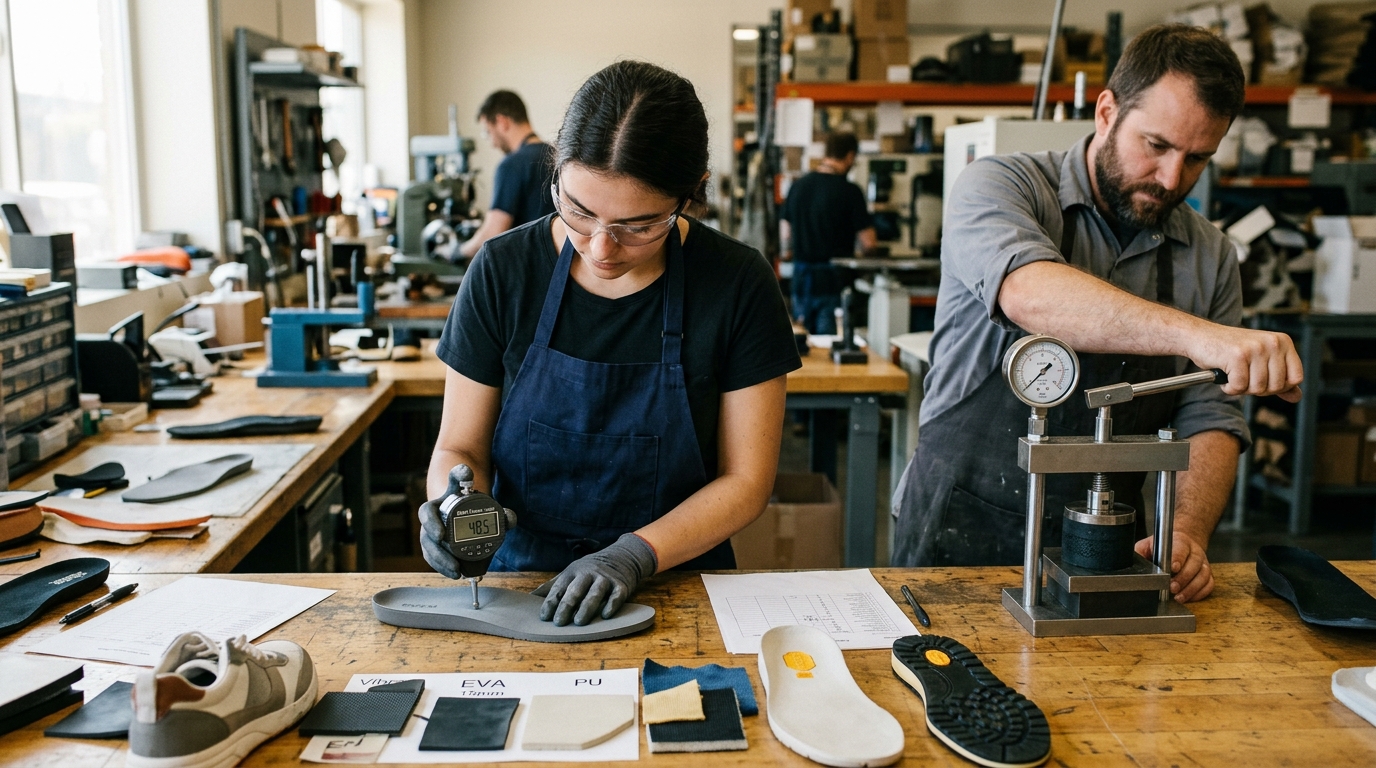
A good review tests hardness at the heel, arch, and forefoot when the construction changes by zone. Single-layer die-cut EVA may only need a simple hardness and thickness check. A multi-density insole needs zone-by-zone documentation, because a soft heel and a firmer arch can read as “supportive comfort” while a uniform soft sheet reads as collapse.
Compression tells you what hardness can’t.
| Test area | What to check | Sampling note |
|---|---|---|
| Heel | Compression depth and recovery | Main risk: bottoming out |
| Arch | Support under static load | Main risk: unstable feel |
| Forefoot | Flex and pressure feel | Main risk: boardy toe-off |
| Full insole | Thickness after loading | Main risk: fit change inside shoe |
Compression set is the boring test that saves a launch. A sample can feel excellent in the first review and still lose too much height after repeated loading. For a retailer or brand, that becomes returns language: “The shoe felt flat after two weeks.” Nobody writes “compression set exceeded the comfort target” in a review.
This is where the shoe matters. An insole for a soft running shoe should usually avoid stealing volume or fighting the midsole. An insole for workwear can accept firmer support if the buyer wants standing comfort and durability. An orthotic or therapeutic application needs tighter documentation, and ISO 13485:2016 matters when the product enters medical-device quality territory.
For US programs, mechanical comfort testing sits beside compliance planning. CPSC and California Prop 65 requirements should be discussed early for US brands and retailers. For EU-destined products, REACH belongs under chemical regulation. It isn’t a certification or a test standard; materials can be sourced to meet REACH requirements by project.
Rebound By Material
Rebound is the “alive” feeling underfoot. It’s also one of the easiest features to oversell. ASTM International’s ASTM D2632-15R24 identifies vertical rebound as a method for measuring rubber resilience, while SATRA’s 2025 update on cushioning methods discusses energy absorption testing for whole-shoe bottoms and footbeds under controlled loading through SATRA TM183 and TM159.
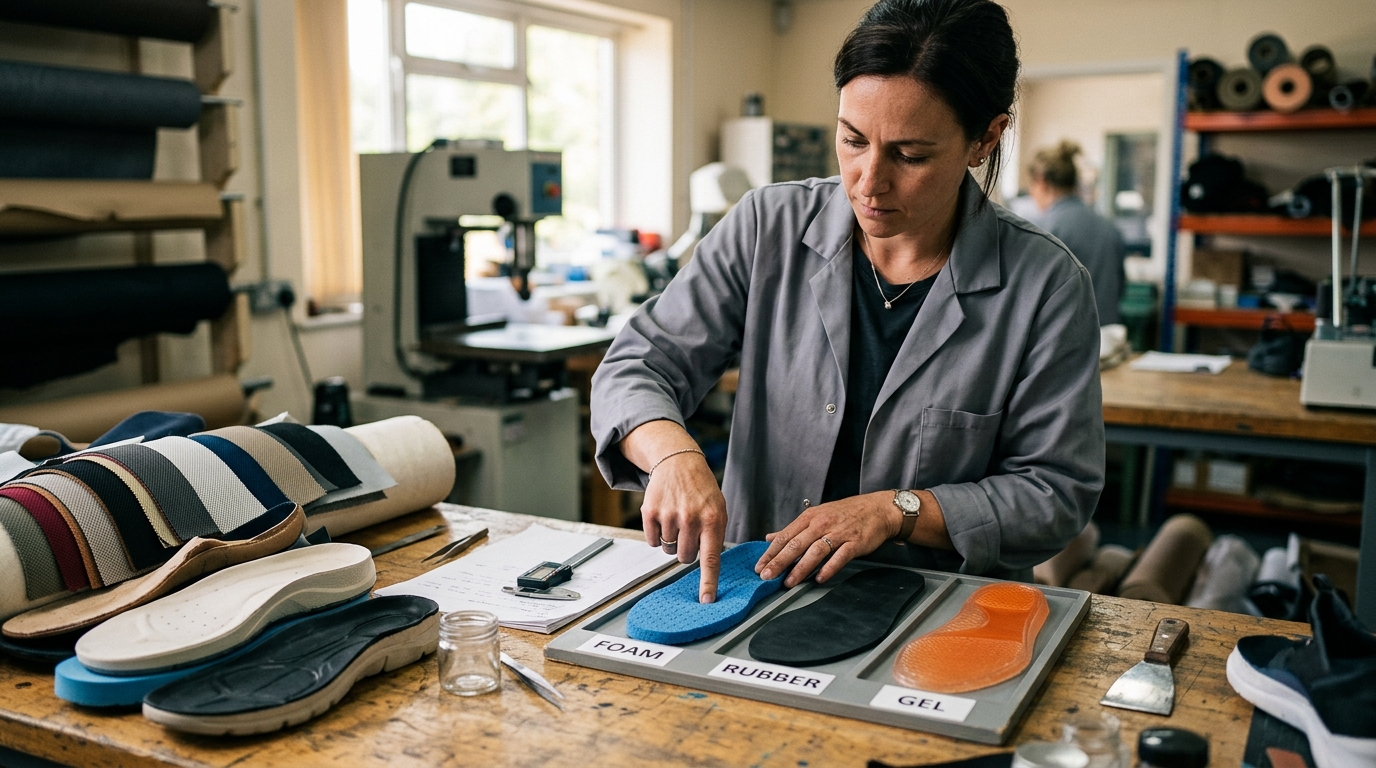
In insole development, the practical rebound ranking is clear: supercritical foam sits above EVA, and EVA sits above PU. That doesn’t make PU the weaker choice for every program. It means PU shouldn’t be sold as the energy-return option. PU is better framed around compression resistance, shape retention, and soft comfort.
Supercritical fluid foaming (SCF) uses nitrogen, CO2, or a combined nitrogen/CO2 process, depending on the resin, equipment, density target, rebound target, and process stability. The public wording should usually be supercritical foam, SCF foam, or nitrogen/CO2 supercritical foam. The structure is microcellular with predominantly closed cells, and the process works without traditional chemical blowing agents.
Material choice changes both feel and cost:
| SCF base resin | Relative cost | Rebound position | Best use |
|---|---|---|---|
| EVA | Lowest | Good | Everyday athletic and value performance |
| TPU | Mid | Stronger in blends | Durable premium midsoles |
| TPEE | Higher | High | Outdoor and thermal-stress applications |
| PEBA | Highest | Top tier | Elite racing and high-performance shoes |
PEBA is the premium end of this set. It’s associated with elite running and racing shoes because it combines low weight with high resilience. In SCF applications, the rebound hierarchy is PEBA, then TPEE, then TPU-blend, then EVA. PEBA is also the highest-cost option, so it doesn’t belong in an entry-level quote unless the brand has already chosen a premium performance target.
A practical FX material shortlist might look like this: PulseSport for performance-focused supercritical foam, Everyday for algae-based EVA that reduces reliance on petroleum-based materials, and PowerFrame for PU programs where scalable comfort and cost control matter. Sugarcane-based EVA, recycled EVA compounds, Susterra-based PU formulations, and open-cell cushioning alternatives can also fit sustainability briefs under GRS-compliant supply chains with traceability documentation.
Leave latex off the FX list. FX Footwear doesn’t produce latex insoles.
Sampling Room Protocol
A clean sampling room protocol starts before the first sample ships. The product developer should define the shoe type, target wearer, price tier, thickness limit, durability expectation, and comfort language. Then the factory can propose materials instead of guessing.
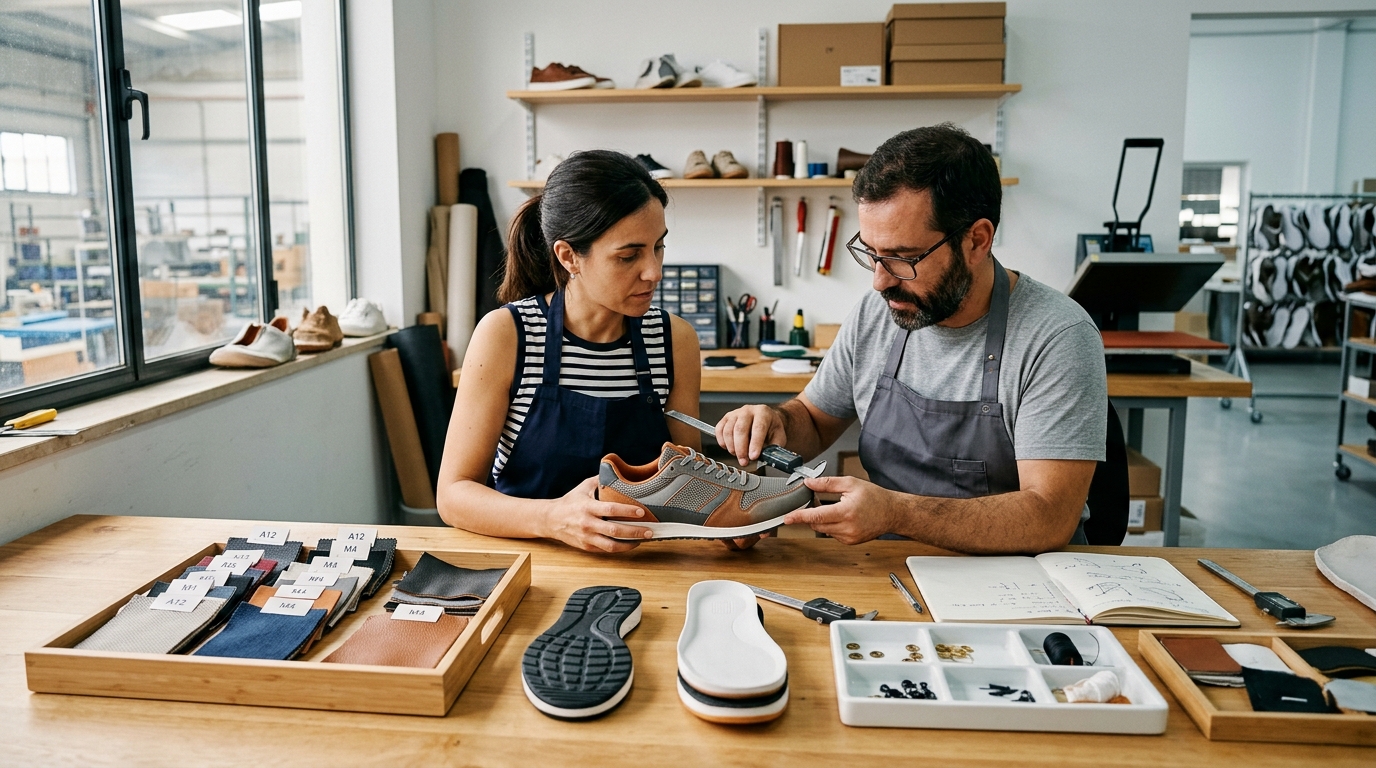
For standard constructions with existing tooling and materials, FX can usually provide an initial quotation within 48 hours. Die-cut or knife-cut samples without new tooling can be around 3 days. New mold or tooling work is closer to 10 business days. Custom insole sampling typically sits around 7–14 days, followed by bulk production after approval at about 30–40 days.
Use this review order:
1. Check thickness and fit in the intended shoe.
2. Measure hardness by material and zone.
3. Run rebound and compression checks.
4. Compare hand feel across at least two samples.
5. Wear-test the approved direction.
6. Confirm branding, top cloth, and edge finish.
7. Lock the control sample and spec sheet.
That last step matters. A control sample should include physical sample retention, material name, hardness range, thickness tolerance, density target when relevant, top cloth reference, adhesive notes, logo method, and finish notes. Heat transfer print and screen print are the normal branding methods for insole top cloth. Emboss or deboss works for structural areas such as heel cups. Laser etching belongs on TPU or rubber outsole or bottom components, not insole top surfaces.
If you’re comparing high quality insoles across vendors, ask for both the number and the sample story. A lab result without a wear note can miss squeak, fit, surface slip, or heat feel. A hand-feel review without lab data can approve a sample that loses height before the first production order is finished.
Cost Performance Decisions
Cost-performance decisions get messy when the buyer asks for premium feel at value-tier pricing. The right answer usually isn’t one material. It’s a construction. You can use a softer top layer over a firmer base, adjust the heel cup, change the top cloth, or move from full-length premium foam to zoned material placement.

A performance running insole may justify SCF foam because rebound and impact absorption are part of the user promise. A casual sneaker may perform better with EVA because cost, weight, and mature production matter more than top-end energy return. A workwear insert may call for PU because long-term shape retention beats a lively first step.
A practical decision matrix looks like this:
| Development goal | Better starting point | Tradeoff |
|---|---|---|
| Low cost, light feel | EVA | Lower long-term shape retention than PU |
| Soft daily comfort | PU | Lower energy return than EVA and SCF |
| Performance rebound | Supercritical foam | Higher cost and tighter process control |
| Supportive structure | TPU plate or carbon plate | More complex fit and flex tuning |
FX Footwear’s one-stop component setup helps here because the insole doesn’t live alone. FX also manufactures midsoles, uppers, heel counters, eyelets, molded parts, EVA/PU foaming, PU pouring, and supercritical physical foaming. When the insole, midsole, and upper team are coordinated, you can fix comfort at the system level instead of overloading the insole with every job.
Regional manufacturing also changes the sourcing math. FX has a multi-country manufacturing footprint across China, Vietnam, and Indonesia, including Northern Vietnam and Southern Vietnam near major footwear manufacturing hubs. For US brands, that can support faster coordination, lower duty exposure in the right program, and better alignment with Tier 1 footwear production schedules.
Before approving a comfort sample, ask for this final check:
> If the buyer says the sample feels good, can your team write the reason in measurable terms: hardness, rebound, compression, thickness, surface, and expected wear behavior? If the answer is no, the sample isn’t ready for bulk approval.
FAQ
How is insole rebound tested?
Insole rebound is tested by measuring how quickly and how strongly foam recovers after compression or impact. Product teams often pair lab rebound data with wear trials, because a high rebound number can still feel unstable if thickness, geometry, or shoe fit is wrong.
What is hand feel?
Hand feel is the first tactile reaction to an insole: softness, surface touch, flex, recovery, and perceived quality. It should be translated into specs such as hardness, compression deflection, top cloth friction, thickness, density, and recovery after repeated loading.
Is EVA harder than PU?
EVA and PU can both be made soft or firm, so material name alone doesn’t answer hardness. EVA insole hardness is commonly controlled in the 20–45 Asker C range, while PU is often chosen for soft comfort and longer shape retention.
Which foam rebounds best?
For FX insole development, the general rebound ranking is supercritical foam, then EVA, then PU. Within supercritical foam applications, PEBA sits at the premium end, followed by TPEE, TPU-blend, and EVA, with cost rising as performance increases.
When should brands test comfort?
Brands should test comfort during first sampling, after material changes, after tooling changes, and before bulk approval. The best timing is before the sample is visually “finished,” because thickness, hardness, rebound, and top cloth can still be adjusted without wasting tooling time.
FX Footwear (Fuxiang Group) helps product developers turn comfort comments into controlled insole specs, then supports sampling through in-house lab validation, material selection, and regional production across China, Vietnam, and Indonesia. For a new program, send the target shoe type, price tier, thickness limit, and the words your buyer uses for comfort.