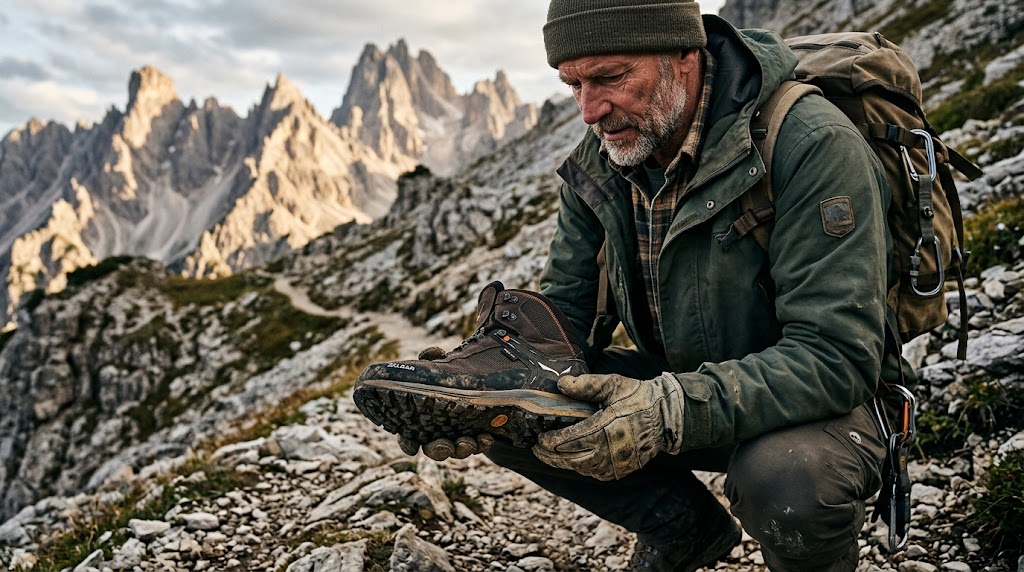
Outdoor boot midsoles need to do three things well: absorb impact on rocky descents, resist torsion across uneven ground, and hold their shape through extreme temperatures. That’s a fundamentally different job than what a running shoe midsole does, and the materials that work in one category often fail in the other.
If you’re sourcing midsoles for trail boots, hiking footwear, or industrial work boots, you’re dealing with a tighter set of material options than you might expect. High-density EVA and TPEE (thermoplastic polyester elastomer) cover most of the performance envelope here, but each carries real tradeoffs in weight, cost, and thermal behavior. This guide breaks down what actually matters when speccing outdoor boot midsoles — no generic advice, just the material science and production realities that affect your product.
Why Outdoor Midsoles Differ
A trail runner hits the ground 1,500–2,000 times per mile. A hiker carrying a 35-pound pack on rocky terrain? Maybe 2,000 steps per mile, but each step delivers 2–3× body weight in ground reaction force, often at odd angles, across surfaces that change every stride.
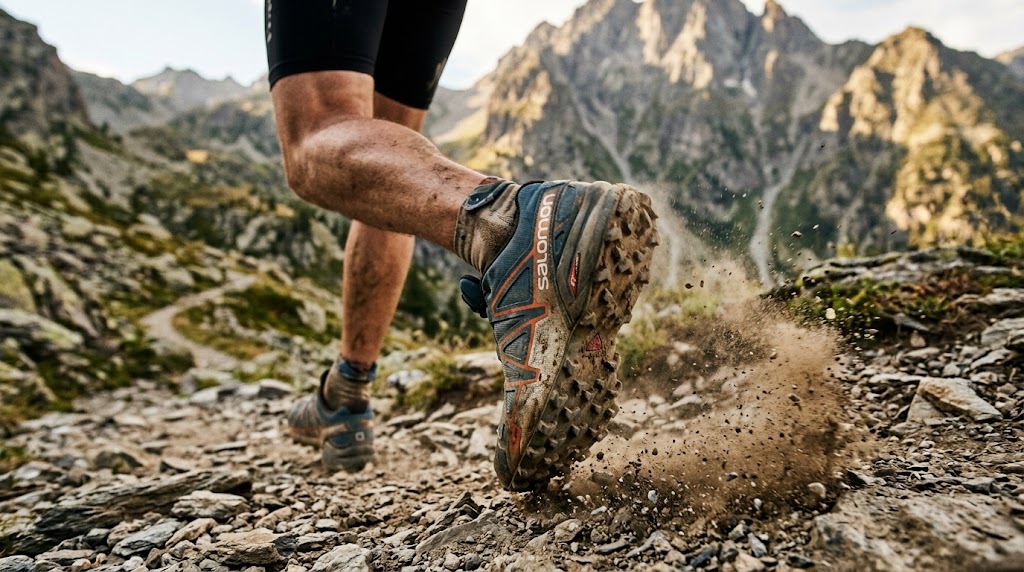
That loading pattern creates three demands that casual and athletic midsoles don’t face simultaneously:
Torsional rigidity. When your foot lands on a root or angled rock, the midsole needs to resist twisting without collapsing laterally. Standard 25 Asker C EVA (the stuff in most sneakers) deforms too easily under lateral loads. Outdoor midsoles typically run 35–45 Asker C or incorporate structural plates to handle this.
Compression set resistance over temperature range. A work boot worn in a 115°F Arizona warehouse and then stored in a 20°F truck overnight needs a midsole that won’t permanently compress at high temps or turn brick-hard at low ones. EVA’s compression set performance degrades noticeably above 60°C. TPEE barely flinches.
Sustained load bearing. Hikers don’t just strike and toe-off. They stand, squat, climb ladders, lean into hillsides. The midsole sees sustained static loads that accelerate compression set in materials optimized for dynamic rebound. This is where PU and TPEE outperform standard EVA by significant margins — but you pay for it in weight or cost.
The bottom line: outdoor boot midsoles are an engineering compromise between cushioning, stability, weight, and environmental durability. The material choice drives everything.
High-Density EVA: The Workhorse
Most outdoor boots on the market — from $90 day hikers to $180 backpacking boots — use some form of high-density EVA in the midsole. There’s a reason it’s everywhere: it’s light, cheap to tool, and performs well enough across a broad range of conditions.
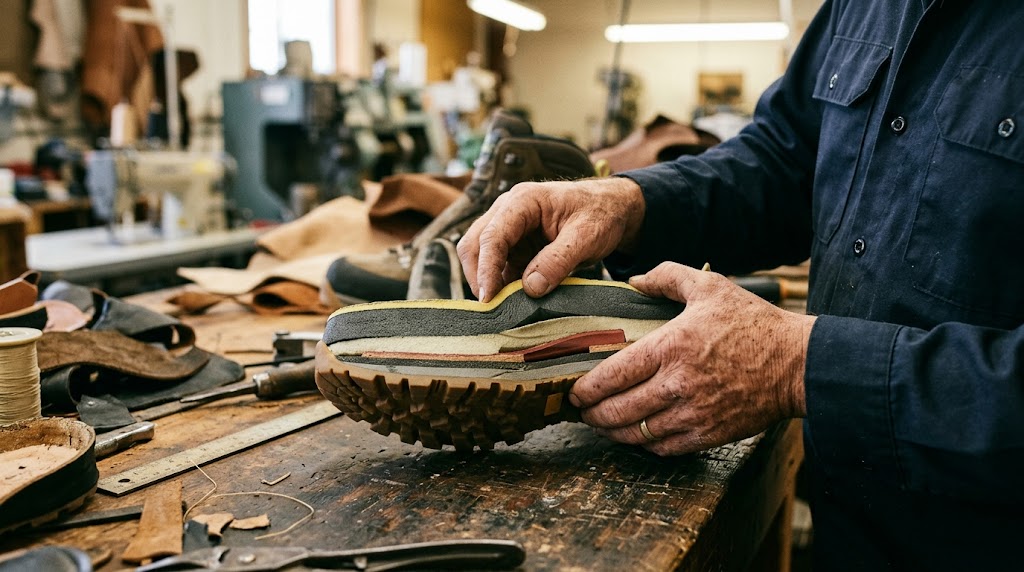
For outdoor applications, we typically spec EVA in the 35–45 Asker C range (±3 tolerance), compression-molded rather than injection-molded. Compression molding produces a denser, more uniform cell structure that resists bottoming out under heavy pack loads. The difference is real — a compression-molded EVA midsole at 40 Asker C will maintain its cushioning properties roughly 20–30% longer than an injection-molded piece at the same hardness.
Here’s where it gets interesting. You can run dual-density EVA constructions — firmer on the lateral side (42–45 Asker C) for torsion resistance, softer medially (35–38 Asker C) for comfort. If you’re considering this approach, our breakdown of dual density midsoles covers who benefits most and when it’s worth the tooling investment.
The tradeoff with EVA in outdoor boots: thermal performance. EVA softens measurably above 50°C and stiffens below -10°C. For three-season hiking boots sold in the US market, that’s usually fine. For winter mountaineering or hot-climate work boots, it’s a limitation you need to spec around — either by blending with rubber compounds at the outsole interface or moving to TPEE.
| Property | Standard EVA (25 Asker C) | High-Density EVA (40 Asker C) | TPEE |
|---|---|---|---|
| Density (g/cm³) | 0.15–0.20 | 0.22–0.30 | 0.35–0.50 |
| Compression set (50%, 24hr) | 40–55% | 30–40% | 15–25% |
| Operating temp range | -10°C to 50°C | -10°C to 55°C | -40°C to 120°C |
| Relative cost | 1× | 1.2× | 2.5–3× |
| Torsional rigidity | Low | Moderate | High |
One thing that doesn’t show up in spec sheets: how EVA behaves after 200 miles on trail versus 500 miles. KEEN’s Targhee line (a solid mid-range hiker) uses a compression-molded EVA midsole that most users report feeling “flat” around 400–500 miles. That’s acceptable for a $140 boot. But if your brand is positioning at $200+ with a durability message, EVA alone may not support the claim.
TPEE for Extreme Conditions
TPEE is the material most sourcing teams overlook for outdoor midsoles, partly because it’s historically been positioned for outsole applications and automotive parts. But its property set maps almost perfectly to what outdoor boots need.
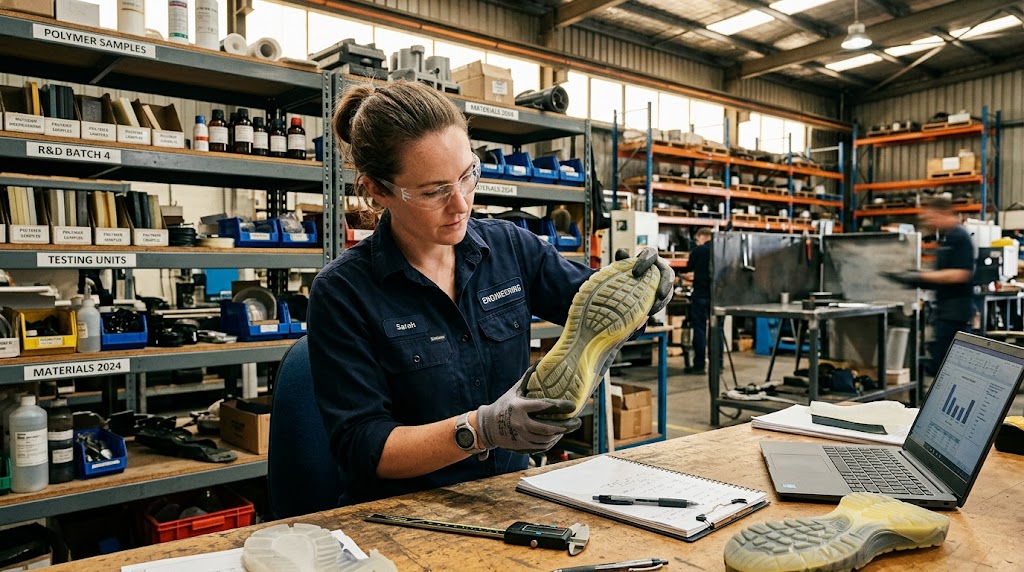
TPEE (thermoplastic polyester elastomer) combines good elasticity with heat resistance and chemical resistance. Its compression set at elevated temperatures is dramatically better than EVA — we’re talking 15–25% compression set versus 30–40% for high-density EVA under the same test conditions. For work boots that see prolonged heat exposure (foundries, roofing, asphalt work), TPEE is the material that won’t let you down after six months.
The thermal stability window is the real headline. TPEE maintains consistent flex properties from -40°C to 120°C. That’s not a spec-sheet fantasy — DuPont Hytrel (the most common TPEE trade name) has documented performance data across this range. For brands selling into markets where boots face genuine temperature extremes, this eliminates the “winter stiffness” complaints that plague EVA-based boots.
When processed through supercritical fluid foaming (using CO₂ or N₂ as the blowing agent), TPEE can achieve densities significantly lower than its injection-molded form while maintaining its mechanical advantages. SCF-processed TPEE foam can reach densities as low as 0.15–0.20 g/cm³ with rebound rates above 60%, closing the weight gap with EVA considerably.
Cost reality check: TPEE resin costs 2.5–3× what EVA compounds cost. Tooling is comparable, but cycle times run longer. For a typical outdoor boot midsole, switching from high-density EVA to TPEE adds roughly $1.50–$2.50 per pair at production volumes of 10,000+. That’s meaningful at the $120 price point but very manageable at $200+.
We process TPEE through our SCF equipment across facilities in China and Vietnam — and as a custom midsole supplier, we can run comparative samples in both materials so you can evaluate the difference hands-on before committing to production tooling.
A note on what TPEE doesn’t do well: it’s heavier than EVA at equivalent cushioning levels (even after foaming), and it doesn’t have the plush initial feel that consumers associate with comfort. It feels firm and supportive on first step-in. That’s actually what outdoor boot buyers want, but it can be a hard sell if your retail demo relies on the “squeeze test.”
Torsion Resistance Engineering
Here’s a scenario. A 190-pound hiker steps onto a wet, angled granite slab while descending with a 40-pound pack. The foot supinates, the ankle rolls slightly outward, and the midsole needs to resist that torsional force while still allowing enough flex at the forefoot for a natural gait transition.
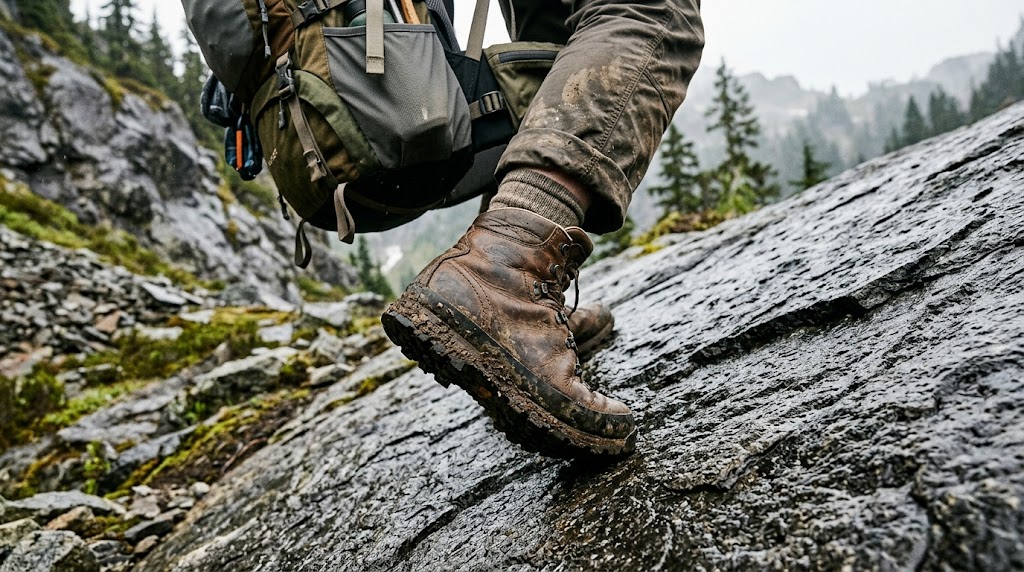
That’s the torsion resistance problem in outdoor midsoles, and it’s why many hiking boots embed structural elements — TPU shanks, nylon plates, sometimes carbon fiber plates — between or within the midsole layers.
The midsole material itself contributes to torsion resistance, but only partially. A 42 Asker C EVA midsole provides moderate resistance. TPEE at similar thickness provides substantially more. But neither material alone delivers the torsion control that technical terrain demands.
Common structural approaches:
- TPU torsion plates (3/4 length, 1.5–2mm thick) embedded between dual-density midsole layers
- Nylon 6/6 shanks running from heel to midfoot
- Carbon fiber plates for premium/ultralight builds (though the cost rarely justifies it outside elite mountaineering boots)
- Geometric features molded directly into the midsole — arch bridges, lateral sidewalls, heel cradles
The material choice for these structural elements matters for the same temperature reasons we discussed above. A TPU shank that’s flexible at room temperature can stiffen dramatically at -20°C, changing the boot’s flex characteristics in exactly the conditions where you need predictable performance. TPEE plates maintain more consistent flex across temperature ranges.
If your design calls for multi-material midsole constructions with embedded structural components, that falls into our functional insole and component category — TPU plates, carbon fiber plates, and complex multi-material assemblies that require tight tolerances and consistent bonding between layers.
Thermal Stability Testing
You can’t spec outdoor boot midsoles without thermal testing, and the standard tests most labs run don’t tell the whole story for this application.
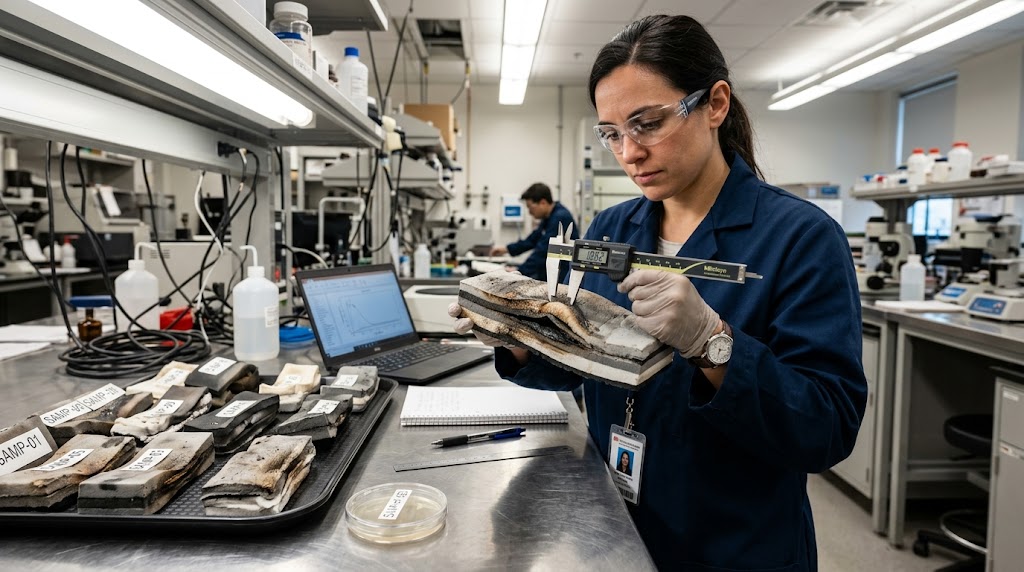
ASTM D395 (compression set) is the baseline. Run it at 23°C, sure, but also request data at 50°C and 70°C. The delta between room-temp and elevated-temp compression set is where you see the real difference between materials. EVA’s compression set might jump from 35% to 55% between 23°C and 70°C. TPEE might go from 18% to 25%. That gap determines whether your boot still cushions after a summer on hot pavement.
Cold-temperature flex testing (ASTM D1790 or equivalent) matters for winter boots. You want to know the temperature at which the midsole’s flexural modulus increases by more than 30% from its room-temperature baseline — that’s roughly the point where users perceive the boot as “stiff.”
We run thermal cycling tests in our in-house lab: 8-hour cycles between -20°C and 60°C, repeated 50 times, then re-measure Shore hardness and compression set. It’s not a standard ASTM protocol, but it simulates real-world conditions better than any single-temperature test.
The connection between midsole thermal behavior and the materials used in other boot components (footbeds, for example) is worth considering together. Our guide on sandal footbed molding covers how material selection affects molding outcomes — some of the same principles apply when you’re bonding midsole layers to footbed surfaces in boot constructions.
Sourcing & Production Realities
Getting outdoor boot midsoles right requires more than picking a material from a spec sheet. The production process matters — a lot.
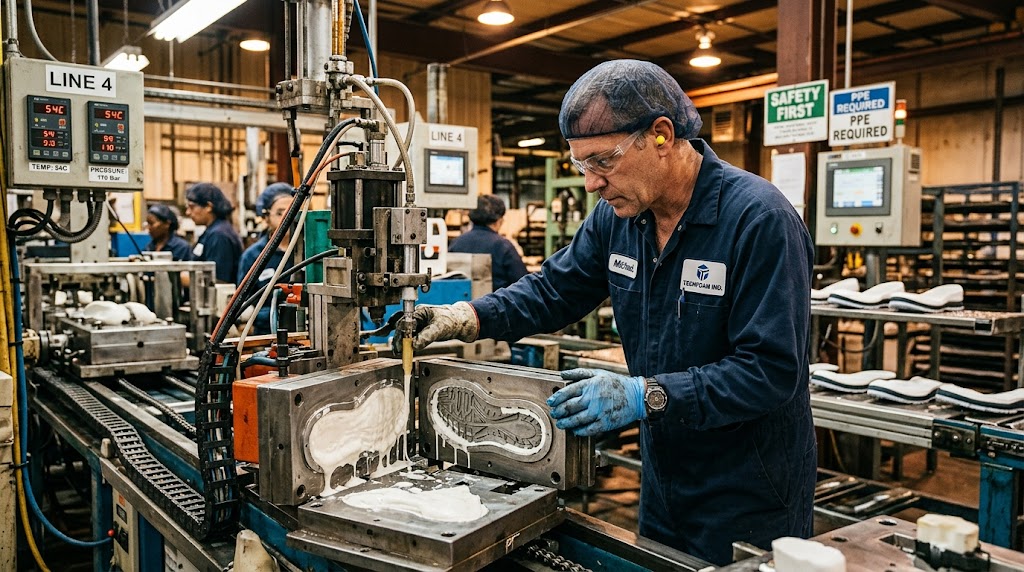
For high-density EVA midsoles, compression molding is the standard for outdoor applications. Tooling costs run $3,000–$8,000 per size run depending on complexity (single-density vs. dual-density, presence of embedded shanks or plates). Lead times for new tooling: roughly 10 business days for samples, with bulk production at 30–40 days after sample approval.
TPEE midsoles processed through SCF require different equipment than standard EVA compression molding. Not every supplier can run both. We operate SCF foaming lines alongside traditional compression molding across our China and Southeast Asia facilities — which means you can get EVA and TPEE midsole samples from the same midsole supplier without splitting your development across multiple factories.
For US-market outdoor boots, compliance considerations include CPSC general requirements and California Prop 65 screening on any adhesives, colorants, or surface treatments used in the midsole assembly. We coordinate testing through Intertek and can provide shoe insole manufacturer-grade documentation for the full component stack.
MOQ reality for TPEE midsoles: because the resin is more expensive and the process is slower, minimum order quantities tend to run higher than EVA — typically 3,000–5,000 pairs per SKU versus 1,000–2,000 for standard EVA. Factor that into your size-run planning.
FAQ
What hardness works best for hiking boot midsoles?
High-density EVA at 38–45 Asker C (±3 tolerance) handles most hiking applications. Heavier pack loads and technical terrain benefit from the upper end of that range or a TPEE alternative.
Does TPEE cost significantly more than EVA?
Yes. TPEE resin runs 2.5–3× the cost of EVA compounds, adding roughly $1.50–$2.50 per pair at volumes above 10,000 units. The cost is justified for boots positioned above $180 retail.
How long do EVA midsoles last in outdoor boots?
Most high-density compression-molded EVA midsoles maintain acceptable cushioning for 400–600 miles of trail use. After that, compression set accumulates and energy return drops noticeably.
Can SCF foaming improve TPEE midsole weight?
Yes. Supercritical CO₂ foaming reduces TPEE density from 0.35–0.50 g/cm³ to approximately 0.15–0.20 g/cm³, significantly closing the weight gap with EVA while retaining TPEE’s thermal and mechanical advantages.
What testing validates outdoor midsole durability?
ASTM D395 compression set (run at 23°C and 50°C+), ASTM D1790 cold flex, and thermal cycling protocols are the core tests. Request elevated-temperature compression set data — it reveals material differences that room-temperature testing misses.
If you’re developing outdoor boots and need midsole samples in both high-density EVA and TPEE, FX Footwear (Fuxiang Group) can run both from the same production base. With facilities in China, Vietnam, and Indonesia — positioned alongside major Tier 1 footwear manufacturing hubs — we offer end-to-end production control from material foaming through final component assembly. Reach out to our team for a technical consultation and comparative samples within 10 business days of confirmed specs.