MATERIAL DEVELOPMENT · PARTICLE FOAM
Popcorn Foam for Footwear Components
Develop visible bead textures and cushioning structures around the shape, feel and construction your footwear needs.
FX Footwear works with bead-foam footbeds and ETPU-based composite insole constructions. Start with the component brief, then align material, forming, finish and sample checks.
MATERIAL IDENTITY
What Does the Bead Structure Tell You?
“Popcorn foam” describes the recognizable appearance of expanded foam particles joined into a material or component. It is a visual description, rather than a complete material specification.
ETPU identifies expanded thermoplastic polyurethane. The finished component may also include PU, EVA or a textile cover, depending on its construction.
Material Identity
Polymer, bead grade and any composite formulation.
Component Construction
Shape, thickness, cover and material placement.
Approval Basis
A reference sample and agreed component checks.
MATERIAL → COMPONENT
Two Insole Applications for Popcorn Foam
Explore a visibly textured insole and an ETPU-PU heel cushioning composite. Shape, thickness and material arrangement are developed around the intended footwear.

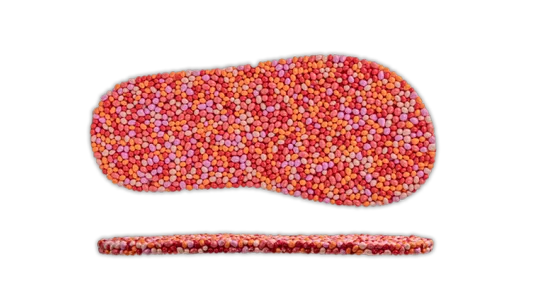
POPCORN-TEXTURED INSOLE
PulseSport Bubbles
A popcorn-textured insole for everyday and lifestyle footwear programs. Review the exposed surface, outline, thickness and color together with the target shoe and sample.
- Visible popcorn texture
- Thickness, outline and color options
- Everyday and lifestyle applications
MULTI-MATERIAL CONSTRUCTION
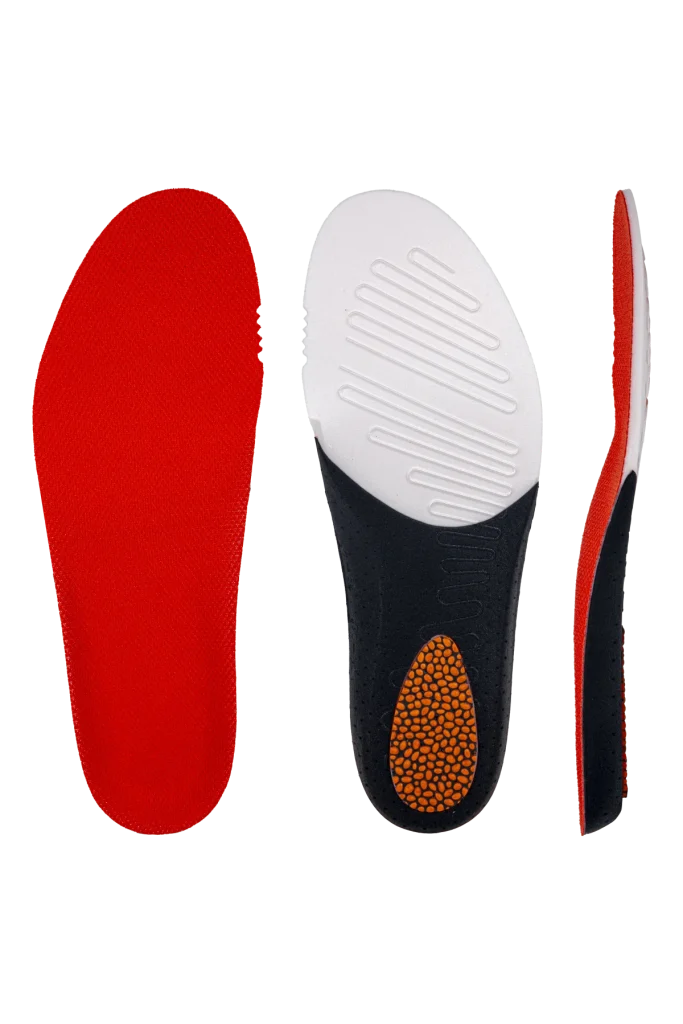
ETPU-PU Heel Cushioning
This insole reference combines an ETPU-bead/PU foam composite at the heel, an SCF EVA body and EVA arch support. Each material has a defined role in the construction.
- ETPU beads and PU foamed together
- SCF EVA main insole body
- EVA arch support
TEXTURE & FINISH
Define the Surface, Color and Finish
For an exposed bead component, appearance and contact feel belong in the same brief. For a covered construction, review the cover and interface as part of the sample.
Particle Appearance
Agree the visible bead size, color distribution and surface consistency against a physical reference.
Contact Surface
Review the exposed texture or cover material, then assess the intended feel inside the shoe.
Edges & Transitions
Define exposed edges, trimming and any joins to adjacent materials. Check the same details on the approval sample.
PROJECT REFERENCE · SANUK
A Visible Bead Surface in a Real Footbed
The ETPU footbed used in Sanuk Bubble Sling and Bubblecush makes the bead surface part of the visible design.
FX’s component work focuses on footbed shape, material feel, bead color distribution and exposed edges. The sandal assembly and finished-footwear testing sit with Sanuk and the shoe factory.
View the Sanuk Footbed CaseFROM BRIEF TO APPROVAL
Develop the Route Around the Part
Material selection and component design move together. Confirm the joining and forming route for the selected construction before approving a production specification.
- 01
Define the Component
Share the drawing, footwear application, fit envelope and size range.
- 02
Review the Material System
Confirm the bead material, composite or joining system, cover and placement.
- 03
Form & Finish a Sample
Agree forming, trimming and any lamination steps for the chosen construction.
- 04
Approve Against the Brief
Compare shape, feel, appearance and the agreed component-test results.
FX’s particle-bonding development is patent-pending. Material and joining-system details are confirmed for each program.
Explore FX InnovationSAMPLE & SPECIFICATION
Evaluate the Finished Component
Specify the construction, thickness, conditioning and acceptance criteria before comparing results. Use Asker C for applicable hardness measurements.
| CHECK | WHAT TO DEFINE | APPROVAL BASIS |
|---|---|---|
| Fit & Geometry | Outline, thickness, profile, sizes. | Drawing and dimensional checks. |
| Feel & Recovery | Hardness, resilience, compression set. | Agreed method, conditioning and limits. |
| Joining & Lamination | Bead cohesion, interfaces, fabric bond. | Bond or peel checks. |
| Appearance | Color mix, texture, edges. | Approved appearance and defect limits. |
| Use Exposure | Heat, moisture, abrasion. | Agreed exposure and evaluation plan. |
The in-house lab supports incoming-material and core physical-property checks. Requested external tests can be coordinated for the selected material and market requirements.
Explore Material TestingSTART A DEVELOPMENT CONVERSATION
Start with Your Component Brief
Send your component drawing, color reference and target feel. FX can review a popcorn-textured insole, a heel cushioning composite or a visible-bead footbed against your program.
Request a Sample- Footwear application and component type
- Outline, profile, thickness and size range
- Color mix, visible texture or cover
- Target feel and fit constraints
- Test methods and acceptance requirements
MATERIAL QUESTIONS
Popcorn Foam FAQs
What does “popcorn foam” mean?
It describes the recognizable bead appearance of the foam. The name alone does not specify the polymer, formulation, joining route or finished performance.
Is every popcorn component ETPU?
“Popcorn” describes appearance, so it does not establish the polymer by itself. Confirm the material grade and complete construction for the selected drawing and sample.
Are the beads always steam-fused?
The ETPU-PU heel reference combines beads with PU in a foamed composite. The joining route depends on the selected material and construction.
Can the bead surface stay visible?
A visible bead surface is documented in the Sanuk footbed case. Agree the exposed texture or cover, edge finish and color mix on the approval sample.
How are sample timing and cost agreed?
Timing starts after specifications, applicable drawings and material requirements are confirmed. We assess tooling, material availability, construction complexity and external testing before confirming sample timing, charges and freight.
What test data should we compare?
Resilience, energy return, compression set and compression fatigue describe different behaviors. Compare results using the same method, sample thickness, conditioning and acceptance limits.