Heel and Forefoot Contact
Review the profile at both ends of the insole. Compare cushioning and foot position in the intended shoe, rather than choosing thickness by hand feel.
Profile · Cushioning · Shoe Volume

APPLICATION / HIGH-IMPACT SPORTS
Develop insoles around repeated jumps, landings and quick stops. Align cushioning, in-shoe fit and sample evaluation with the footwear your brand is building.
Discuss Your Sports Insole ProjectDEFINE THE MOVEMENT
A shoe built for repeated landings needs a defined development brief. Describe the movements, playing surface and available shoe volume before selecting the insole material.
Review the profile at both ends of the insole. Compare cushioning and foot position in the intended shoe, rather than choosing thickness by hand feel.
Check heel seating, edge fit and the sock-to-cover interface. Review them together with the upper and sole during changes of direction.
Agree on conditioning and repeated-loading checks for the project. Compression set and compression fatigue describe different aspects of material behavior.
Developing a basketball-specific shoe? Read the basketball insole selection guide ↗
PROFILE AND IN-SHOE FIT
More foam changes where the foot sits inside the shoe. Set heel and forefoot allowances with the last, upper and sole before confirming the profile.
Check the heel position and available depth in the finished shoe.
Review toe clearance and flexibility at the intended thickness.
Compare the insole contour with the shoe cavity; check for gaps, curling or concentrated pressure.
MATERIAL SHORTLIST
Review foam candidates against the agreed profile and target feel. Polymer name alone does not determine cushioning, resilience or the finished-shoe experience.
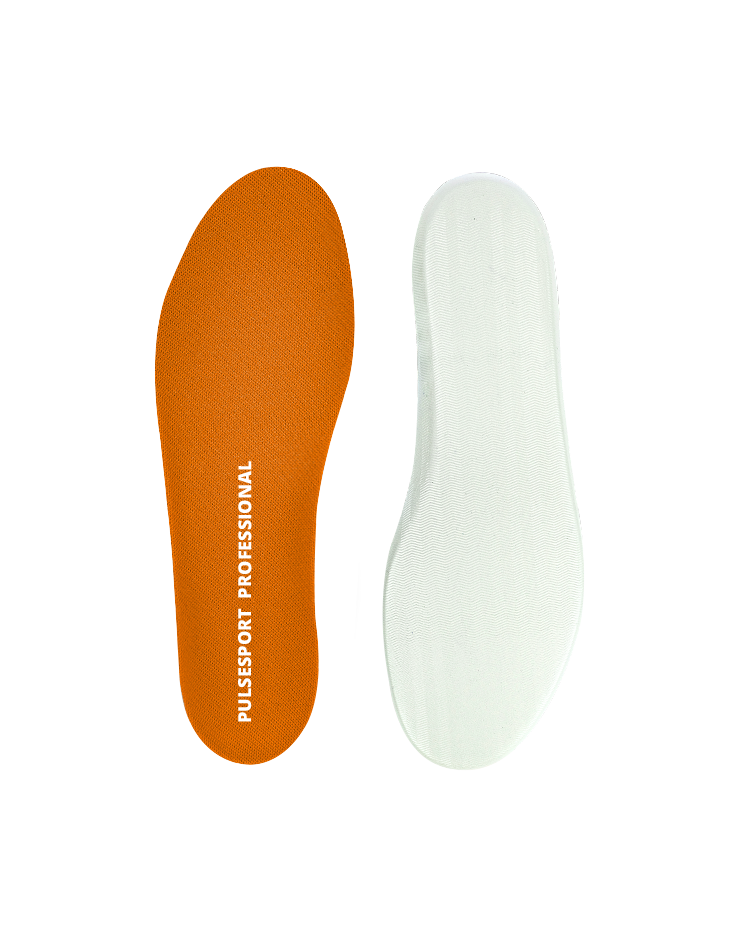
PulseSport Professional offers a starting point for reviewing documented foam families. Confirm the selected grade, construction and physical-property requirements before treating a sample as suitable for your sports program.
SAMPLE EVALUATION
Use the same shoe size, intended construction and agreed test conditions when comparing candidates. Record each sample version so the result can be traced back to its specification.
Review dimensions, mass, density, Asker C hardness, resilience, compression set and layer adhesion as applicable. FX supports incoming-material and core physical-property checks and coordinates requested external testing.
Agree on relevant impact and repeated-use evaluation with the project’s testing partner. The brand or Tier 1 footwear assembler carries out finished-shoe wear testing.
For a fuller explanation of test scope, explore the shoe shock-absorption testing guide ↗
FROM APPLICATION TO SPECIFICATION
FX Footwear develops custom footwear components for brand programs. Share the target shoe and landing requirements so the component team can review practical insole options.
Request a Sample ReviewSample scope, timing and charges are confirmed for your project.
DEVELOPMENT QUESTIONS
Thickness must fit the available shoe volume and the target underfoot feel. Compare the profile in the finished shoe because added material also changes foot position and clearance.
No single material property describes the complete impact response. Use the agreed test method and shoe construction to evaluate the behavior you need.
A shared construction can be considered when both briefs align. Confirm the shoe geometry, movement demands and sample results for each program.
Define which variables stay fixed and which are being changed. Record grade, profile, conditioning and method with each sample result.
This page focuses on repeated landings and stops in sports footwear. For mixed gym, interval and strength sessions, explore our training shoe insole application.