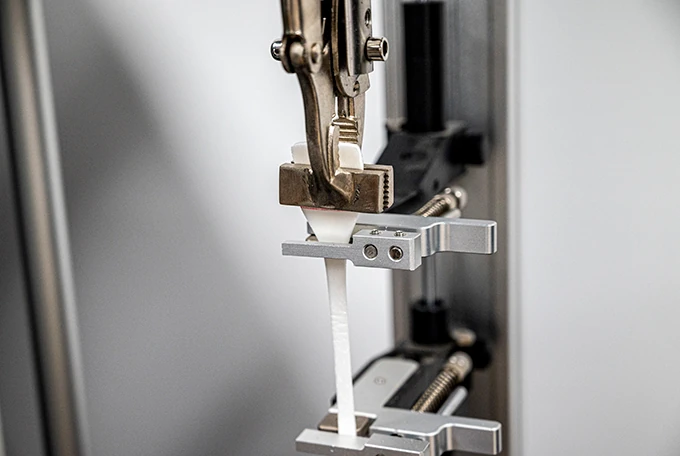
Footwear Material Testing: In-House Labs and Project-Specific Validation
FX Footwear uses in-house testing to connect sample approval, material selection, and production control. Internal validation supports faster decisions, while buyer-required third-party reports are coordinated by project scope.

Who We Work With
When a buyer, retailer, importer, or market program requires external evidence, third-party testing is coordinated according to the required project scope.




Comprehensive Testing Standards
Our laboratory team conducts material and component checks using the agreed project method, including ASTM, DIN, SATRA, ISO, AATCC, and GB/T references when required by the buyer's test plan.
Lab testing evidence
Laboratory results support sample approval and production quality
For OEM and ODM footwear-component programs, laboratory testing supports more than material verification. Representative sample records, inspection results, and supporting documentation help buyers confirm product performance, approve samples, manage production quality, and coordinate third-party verification when required.
Representative sample test record
Routine material results documented during product development
This representative record retains the report structure used for routine material checks. The number and arrangement of detail values follow the applicable test method, while acceptance criteria are confirmed for each approved project and sample version.
| Test Item | Unit | Standard | Test Results | |||||||
|---|---|---|---|---|---|---|---|---|---|---|
| Detail Data | Result | |||||||||
| Specific Gravity | g/cm3 | 0.109 | 0.108 | 0.11 | ||||||
| Durometer | Asker C | 32 ± 3C | 29 | 29 | 29 | 30 | 30 | 30 | 29-30 | |
| Rebound Resilience | % | MIN 75 | 79.7 | 79.9 | 80.0 | 79.6 | 79.8 | 79.8 | 80 | |
| Compression Set | % | MAX 60 | 39.3 | 39.7 | 39.5 | 39.8 | 40 | |||
| Shrinkage Test | % | MAX 2.0 | 0.41 | 0.39 | 0.4 | |||||
| Die-C Tear Strength | Kg/cm | MIN 8.0 | 11.970 | 13.650 | 13.060 | 12.9 | ||||
| Split Tear Strength | Kg/cm | MIN 0.5 | 0.99 | 0.99 | 1.0 | |||||
| Tensile Strength | Kg/cm2 | MIN 18.0 | 32.320 | 32.710 | 32.610 | 32.5 | ||||
| Breaking Elongation | % | MIN 150 | 189.800 | 196.400 | 193.000 | 192 | ||||
Claim-to-evidence matrix
What proof supports the buyer-facing claim?
| Buyer-facing claim | Evidence to align | Third-party trigger | Sample or bulk checkpoint |
|---|---|---|---|
| Responsive or high-rebound feel | Resilience result linked to the approved material grade, sample version, and specified test method. | Buyer-required verification, public performance claim, or disputed test result. | Compare approved sample, pilot production, and bulk production using the same test method and conditioning. |
| Durable comfort and shape retention | Compression set, density, repeated loading records, and pre/post measurements. | Retailer durability claim, warranty concern, or high-wear category. | Retesting is recommended whenever density, thickness, foam grade, lamination construction, or processing conditions change. |
| Shock absorbing performance | Impact test configuration, sample construction, conditioning conditions, and recovery performance. | Buyer-specified test protocol or public impact claim. | Document setup so results can be compared across sample rounds. |
| Sustainable or recycled material claims | Material traceability documentation, traceability file, and selected recycled or bio-based content support. | Brand, retailer, importer, or market documentation requirement. | Traceability is reviewed before sample approval and before bulk release. |
| Bulk consistency | Material batch records, approved golden sample, Production Site details, IQC/IPQC/FQC inspection records, and lot traceability. | Customer audit, dispute, or retailer onboarding. | Golden sample plus lot-level report path. |
Quality control workflow
Quality checkpoints from incoming materials to shipment release
| QC stage | Inspection focus | Laboratory verification trigger |
|---|---|---|
| Incoming Material Inspection | Fabric color, texture, GSM; EVA, SCF, and ETPU thickness, hardness, and compression comparison; outsourced printing inspection; foam appearance inspection; heat-transfer logo color matching. | New material qualification, supplier change, incoming abnormalities, or customer-required testing. |
| In-Process Inspection - PU Pouring | Mold number verification, material confirmation, first-article approval, thickness, hardness, tensile check, appearance, and color consistency. | First article, trial production, abnormal appearance, or batch verification. |
| In-Process Inspection - Automatic PU | Mold verification, rebound feel, color comparison, thickness, hardness, and section inspection. | Trial adjustment, process abnormality, or production sampling. |
| In-Process Inspection - ETPU Bead | Bead color ratio, thickness, and adhesive tear check. | Material change or bonding abnormality. |
| Heat / Cold Pressing | First-article confirmation, mold accuracy, thickness, hardness, tensile, appearance, holding pressure, oven temperature, and process parameter verification. | Any process adjustment, abnormal deformation, discoloration, or routine sampling. |
| Cutting / Trimming / Transfer | Cutting accuracy, tolerance (≤0.5 mm where applicable), edge quality, trimming, logo position, adhesion, and print quality. | Logo defects, edge lifting, or transfer abnormality. |
| Lamination | Adhesive compatibility, coating amount, oven speed, peel strength, edge lifting, and surface flatness. | Bonding abnormality, new adhesive, or process adjustment. |
| Packaging & Final Inspection | Appearance, dimensions, workmanship, packaging condition, and shipment sampling. | Customer shipment approval, pre-shipment inspection, shipment release verification, and shipment documentation review. |
| Non-Conformance Management | Incoming defects, in-process defects, inventory aging, color migration, scrap review, daily quality reports, and corrective actions. | Root-cause analysis, recurring defects, and corrective/preventive action (CAPA). |
Quality control workflows vary according to manufacturing process and factory capability. Project-specific inspection plans are established for SCF materials, EVA, PU, ETPU, laminated constructions, and other footwear-component platforms.
Documentation package
Documents buyers can request before sample approval
| Document type | What buyers can check | Typical application |
|---|---|---|
| FX in-house lab report | Material batch or lot number, sample version, construction, test method, test result, specification, tolerance, approval status, and test date. | Sample approval, batch comparison, incoming material review, and quality troubleshooting. |
| Third-party test report | Buyer-specified testing scope, regulatory compliance requirements, restricted-substance verification, retailer or brand requirements, and independent verification for disputed test results. | Independent verification for customer approval, regulatory compliance, retailer requirements, or international market access. |
| Material traceability file | Material traceability, recycled or bio-based content documentation, lot identification, and GRS-related supply-chain records where applicable. | Sustainability projects involving recycled EVA, sugarcane EVA, algae-based EVA, bio-based PU, and other traceable material solutions. |
| Customer Compliance Documentation | Compliance documents supporting customer qualification, including BSCI, SLCP, customer assessments, and other project-specific compliance records where applicable. | Customer qualification, supplier onboarding, compliance review, and responsible sourcing programs. |
| Sample approval packet | Approved golden sample, specification sheet, approved artwork, test plan, compliance notes, production requirements, and quality acceptance criteria. | Final pre-production alignment between product development, purchasing, quality, and manufacturing teams. |
Credential and document scope
Confirmed credentials and project-specific support stay separate
| Item | Status | Where it belongs | Buyer-facing context |
|---|---|---|---|
| GRS | Confirmed credential. | Recycled-material supply-chain and traceability context. | Specified recycled routes can be supported with matching traceability documents. |
| ISO 13485:2016 | Confirmed credential with scope sensitivity. | Suitable for projects where ISO 13485 quality-management requirements are specified. | The quality-management context is relevant for project scopes that require it. |
| Higg FEM | Participating assessment program. | Facility sustainability assessment. | Environmental performance information available upon request. |
| REACH | EU restricted-substance regulation handled project by project. | EU-destined products when the customer defines scope. | FX can coordinate REACH-related work when the buyer specifies the required material scope. Testing scope depends on the selected material and customer specification. |
| Other customer-required documents | Project-specific. | Reviewed according to the buyer's current requirement and supplied documentation. | The approval path stays focused on confirmed credentials, project-specific documents, and reportable test evidence. |
Retest triggers
When a material change needs a new checkpoint
Material changes
Foam density, resin formulation, material grade, supplier source, or recycled/bio-based content changes can alter hardness, rebound, recovery, weight, bonding performance, and supporting compliance documentation.
Construction changes
Top-cover materials, adhesive systems, lamination methods, support plates, molding routes, size grading, or logo application methods can affect appearance, peel strength, dimensional stability, fit, and wear behavior.
Production changes
Tooling, production location, packaging, market destination, retailer requirements, or visual-defect standards should be reviewed before bulk production or repeat orders.
Sample test packet planning
A useful test brief includes the target material, sample version, market destination, retailer requirements, and approval deadline. FX Footwear can recommend the appropriate in-house checks, document package, and third-party testing items needed before production release.
Discuss Test RequirementsInnovation in Mind
Customers pushing product boundaries rely on our testing capabilities to validate performance and durability under real-use conditions. Through close collaboration and customized testing programs, we help turn innovation into scalable, market-ready solutions.