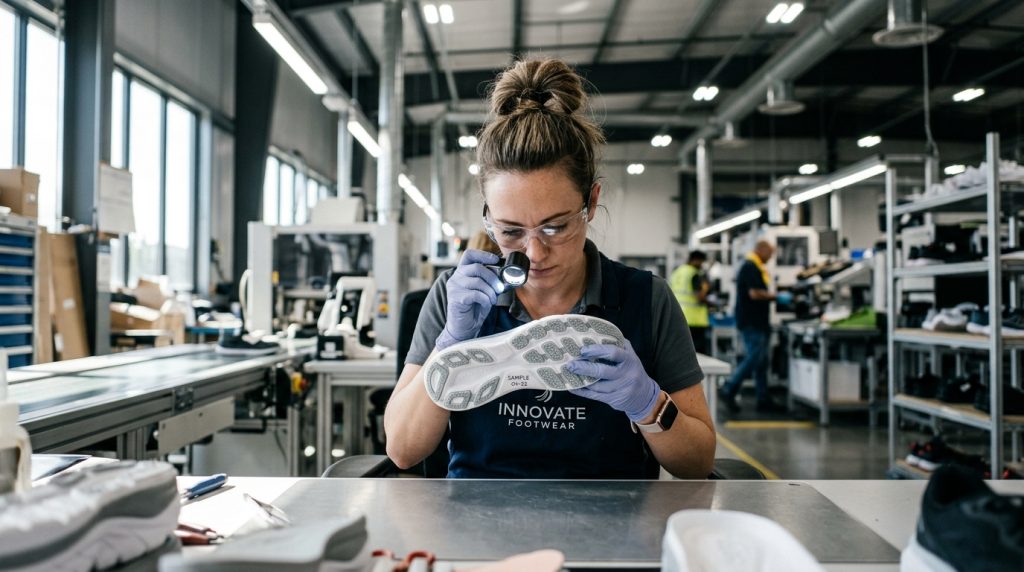
When footwear brands and product developers search for reliable shoe sole manufacturers, the sheer range of available technologies, materials, and compliance requirements can feel overwhelming. From vulcanized rubber outsoles to supercritical foam midsoles, every layer of a shoe sole serves a distinct mechanical purpose — and understanding how each is made directly affects your product’s performance, cost, and marketability. This guide breaks down the core manufacturing technologies, quality standards, and sourcing considerations that matter most to US buyers working with global supply chains.
Core Sole Manufacturing Technologies
The foundation of sole production rests on a handful of established processing methods, each suited to different materials and performance goals. Compression molding remains the most widely used technique for EVA and rubber components. A pre-measured material billet is placed into a heated mold, pressed under high tonnage, and then cooled under pressure to retain its shape. The result is a dense, consistent unit that works particularly well for midsoles and wedge constructions.
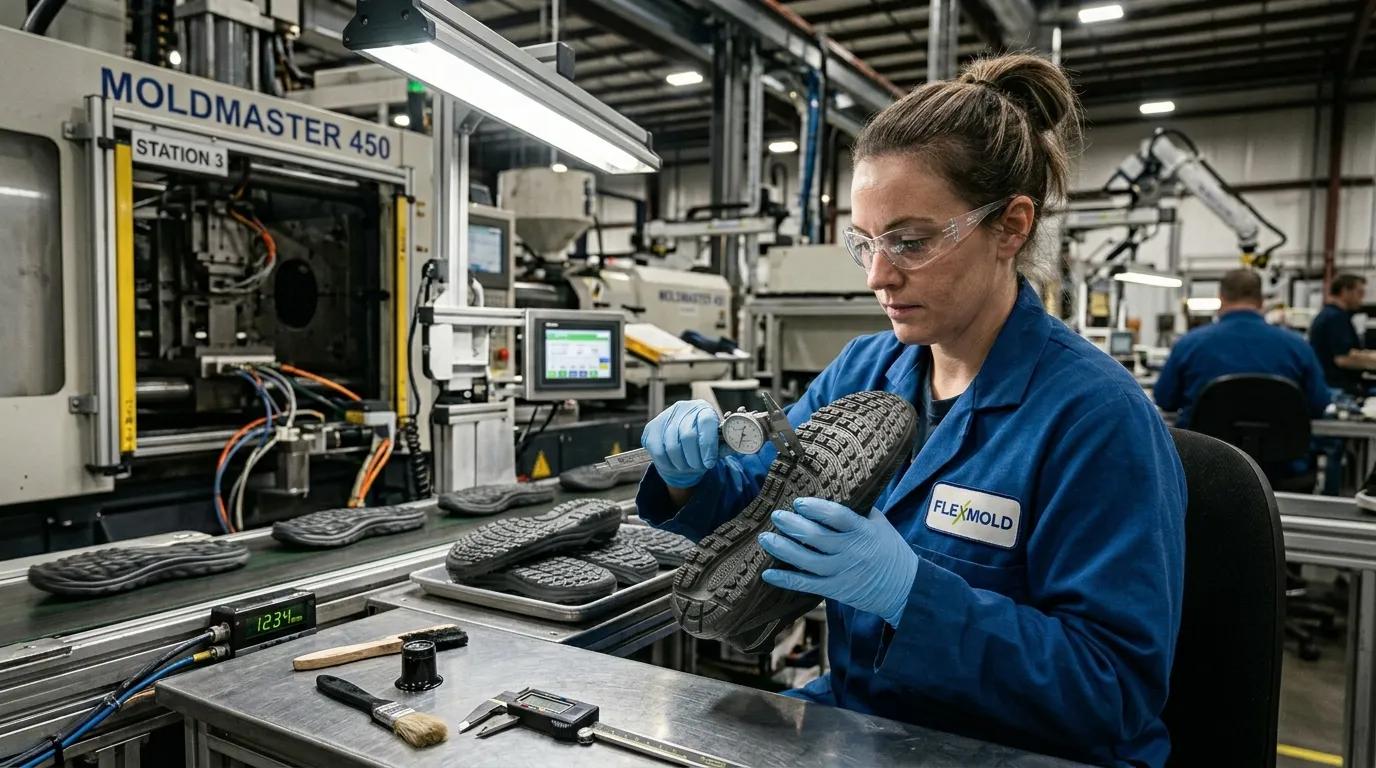
Injection molding offers a faster cycle time and tighter dimensional tolerances, making it the preferred method for TPU and phylon outsoles. Molten material is injected into a closed mold under pressure, filling complex geometries — including flex grooves, lug patterns, and multi-durometer zones — with exceptional repeatability. This method is ideal for brands manufacturing at scale, where consistency from unit to unit is non-negotiable.
Blow molding and direct-attach processes round out the primary technology set. Direct-attach, sometimes called direct injection, bonds the outsole or midsole directly to the upper during molding, eliminating a separate cement-and-stitch assembly step. This reduces labor costs and improves bond strength, though it requires tighter coordination between upper production and sole manufacturing lines.
Materials: Rubber, EVA, TPU, PU
Material selection drives every downstream decision in sole manufacturing — from tooling design to finished weight to recyclability. Natural rubber offers excellent grip and abrasion resistance, making it the standard for outdoor and work boot outsoles. Synthetic rubber (SBR, NBR, or EPDM blends) is more cost-effective and easier to compound for specific hardness targets, though it typically sacrifices some grip performance on wet surfaces.
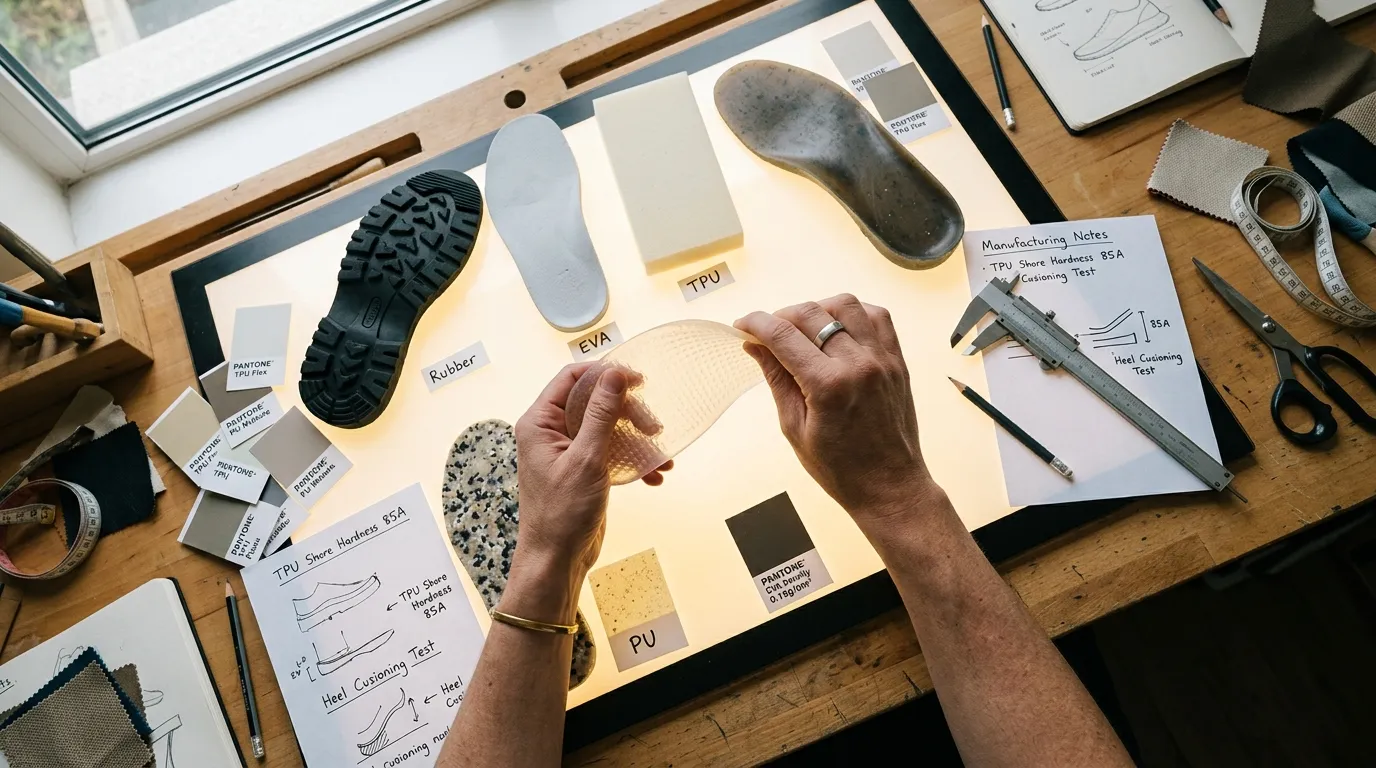
EVA (ethylene-vinyl acetate) is the dominant midsole foam because of its balance between cushioning, weight, and cost. Compression-molded EVA can be tuned across a broad Shore C hardness range, while phylon (re-molded EVA) offers a lighter, more refined surface finish. For brands prioritizing energy return, supercritical foam technologies — like those explored in our breakdown of energy return in running shoe midsoles — expand what’s possible with EVA and PEBA chemistry.
TPU (thermoplastic polyurethane) and PU (polyurethane) serve premium and performance categories. TPU is durable, transparent-capable, and well-suited for plates, shanks, and structural outsole components. Poured PU creates exceptionally lightweight, fine-cell foam with a smooth skin, commonly used in dress shoes and work footwear. Each material has distinct processing windows, and experienced shoe sole manufacturers maintain dedicated lines to avoid cross-contamination between compound types.
Tooling, Molds & Dimensional Standards
Tooling investment is one of the largest upfront costs when developing a new sole unit, and understanding the standards that govern mold production helps buyers negotiate effectively. Aluminum molds are faster to cut and cost roughly 40–60% less than steel equivalents, making them appropriate for development samples and limited-volume production runs. Steel molds withstand hundreds of thousands of cycles and are the standard for full-scale commercial production.
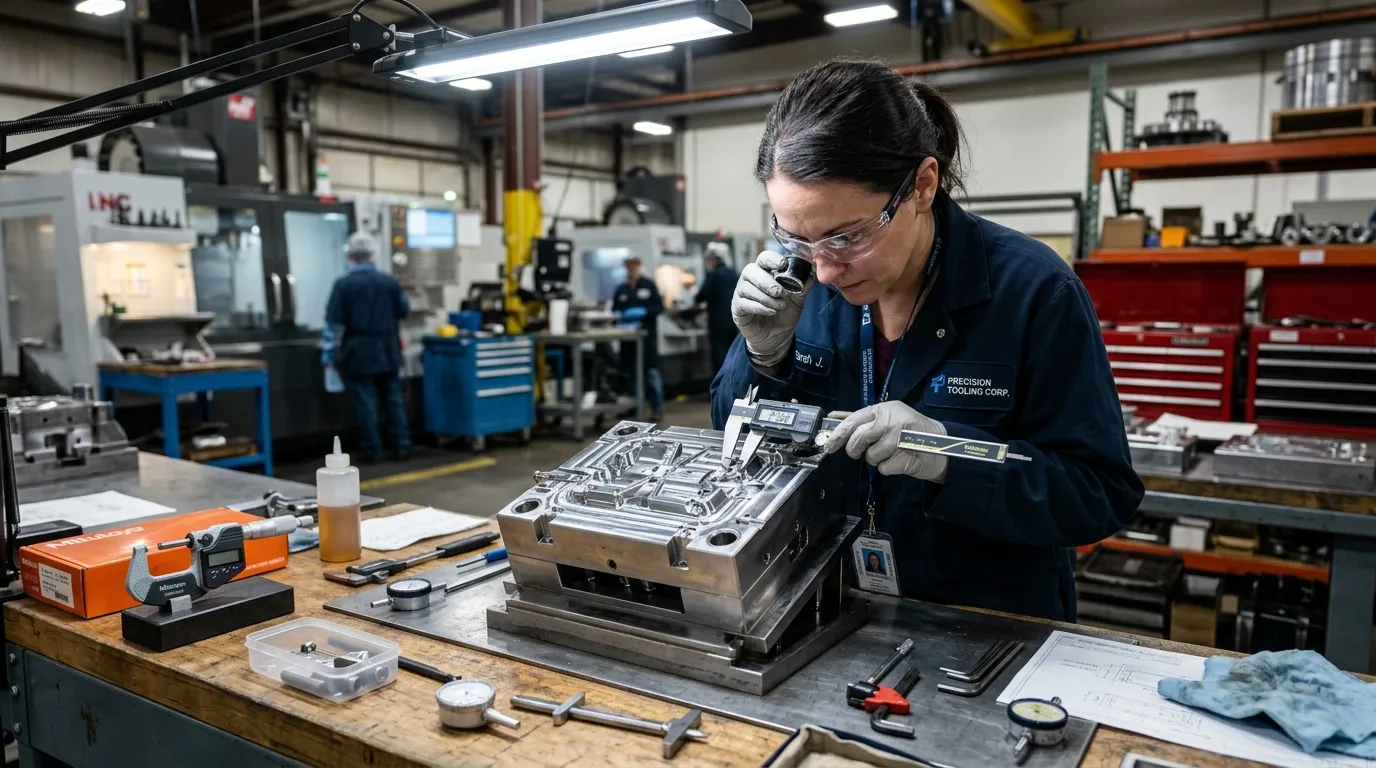
Dimensional standards for sole components are typically governed by ASTM International and ISO frameworks. ASTM F2913 covers slip resistance for footwear outsoles, while ISO 20344/20345 sets the test methods for safety footwear sole properties including energy absorption, slip resistance, and fuel oil resistance. Most US retail partners — particularly in the occupational and athletic segments — require third-party test reports against these standards before approving a new sole unit.
Shrinkage tolerance is a critical mold design parameter that separates experienced manufacturers from newer entrants. EVA, for example, can shrink anywhere from 3% to 8% depending on density formulation and cooling rate. A qualified custom midsole supplier accounts for these variables at the CAD stage, building compensated dimensions into the mold so the finished component hits spec without post-production trimming. Mismanaged shrinkage is one of the most common sources of fitblock failure on first samples.
Quality Control & Compliance Standards
Quality control in sole manufacturing operates across three stages: incoming material inspection, in-process dimensional checks, and finished goods physical testing. Incoming inspection covers raw rubber or foam compound verification — checking Shore hardness, specific gravity, and Mooney viscosity to confirm the batch matches the approved material standard. Deviations at this stage, if missed, propagate through the entire production run.
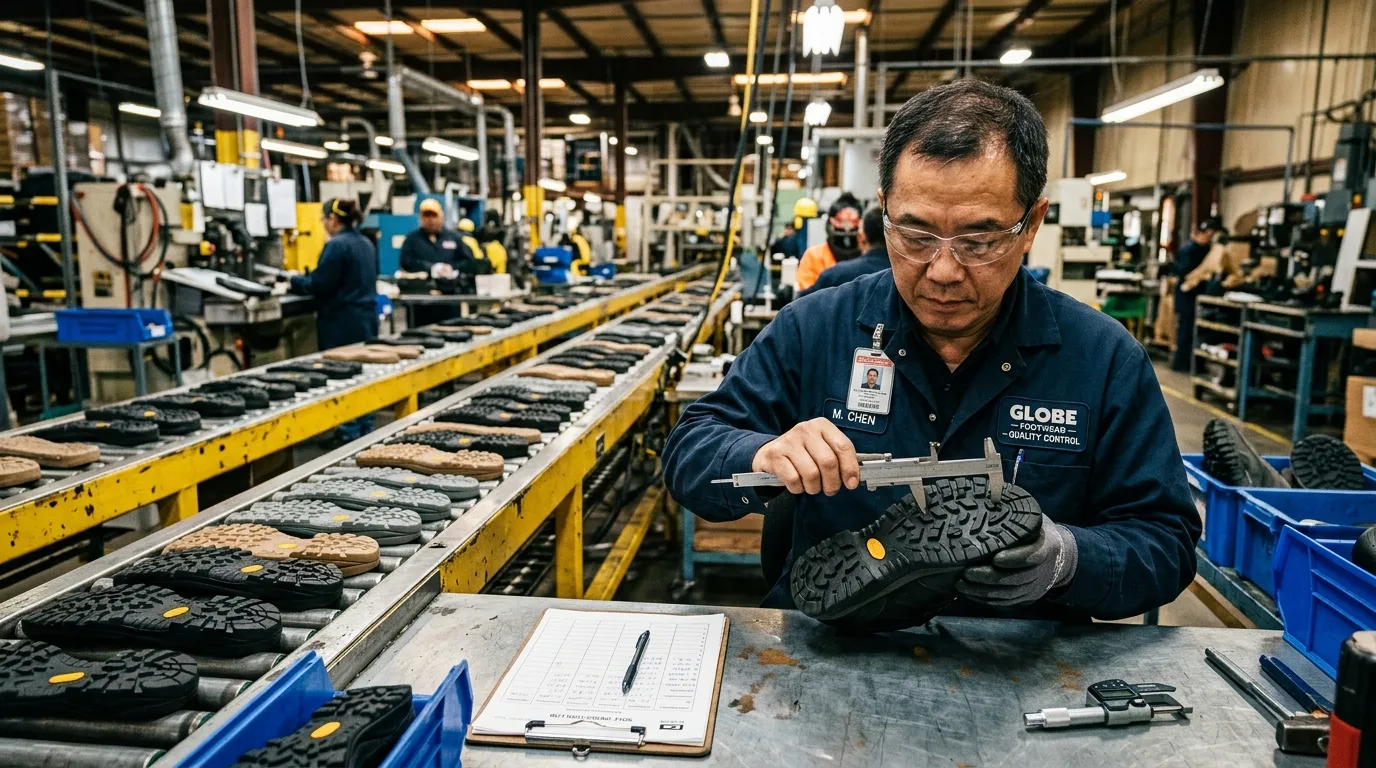
In-process controls include visual inspection for flash, sink marks, and color consistency, plus dimensional sampling using calipers and profile gauges against the approved product drawing. Statistical process control (SPC) methods, where production data is tracked in real time against control limits, are increasingly common among Tier 1 manufacturers supplying large US athletic brands.
Finished goods testing for US market entry often includes REACH compliance (restricting hazardous substances under EU/CPSC-equivalent frameworks for US retailers), Prop 65 compliance for California-bound product, and brand-specific performance standards. Chemical testing for azo dyes, heavy metals, and PAHs (polycyclic aromatic hydrocarbons) in rubber compounds is standard. Reputable shoe sole manufacturers maintain up-to-date test reports from accredited labs such as SGS, Intertek, or Bureau Veritas, and should be able to supply these on request before purchase order issuance.
Sourcing Shoe Sole Manufacturers: Key Criteria
Selecting the right manufacturing partner goes beyond price per pair. Lead time reliability, tooling ownership terms, and minimum order quantity (MOQ) flexibility are equally important — especially for emerging brands scaling from development into first production. The typical development timeline from CAD approval to approved pre-production samples runs 45–75 days for a new sole unit, assuming no major mold revisions.
Vertical integration is a meaningful differentiator among global shoe sole manufacturers. Partners who control compounding, molding, and assembly under one roof reduce the inter-vendor handoffs that introduce variability and delay. When evaluating suppliers, ask specifically about in-house compound mixing capability: manufacturers who buy pre-mixed compound from third-party suppliers have less control over material consistency than those who blend raw polymers themselves.
For brands building out a complete component stack — outsole, midsole, and insole — working with a partner who offers all three simplifies vendor management and improves system-level fit compatibility. FX Footwear (Fuxiang Group) operates as a full-service midsole supplier with integrated outsole and upper sourcing capabilities, giving US buyers a single accountable point of contact from material selection through finished component delivery. Understanding each supplier’s capacity calendar, holiday shutdown periods, and raw material lead times is essential before committing to a production schedule.
FAQ
FAQ: What materials do shoe sole manufacturers use most?
EVA foam, rubber (natural and synthetic), TPU, and polyurethane are the four primary materials in commercial sole production. EVA dominates midsole applications because of its light weight and tunable cushioning. Rubber — particularly carbon black-reinforced compounds — is standard for outsoles due to its abrasion resistance. TPU is favored for structural components and premium outsoles, while poured PU serves dress and occupational categories requiring fine-cell cushioning with a smooth surface profile.
FAQ: How long does sole tooling development take?
From approved 2D/3D design files to first sample, aluminum mold development typically takes 20–30 days. Steel production molds run 35–50 days depending on geometry complexity and the manufacturer’s current tooling queue. Multi-density or multi-component molds — such as those used for two-color outsoles or integrated midsole-outsole units — add 10–15 days. Brands should factor in at least one to two revision cycles when building their development calendar.
FAQ: What certifications should shoe sole manufacturers hold?
For US market supply, ISO 9001 quality management certification is the baseline expectation. Manufacturers supplying athletic brands should demonstrate familiarity with ASTM F2913 (slip resistance) and ASTM F1976 (impact attenuation). For occupational footwear, ASTM F2412/F2413 governs the complete safety footwear standard. Chemical compliance documentation — including REACH, Prop 65, and OEKO-TEX for rubber and foam components — is increasingly required by major US retailers as a condition of vendor approval.
FAQ: What is the typical custom sole MOQ?
MOQs vary significantly by construction type and material. For compression-molded EVA midsoles, 300–500 pairs per size run is a common minimum among mid-tier manufacturers, while larger factories may require 1,000+ pairs. Injection-molded TPU outsoles tend to carry higher MOQs — often 500–1,000 pairs — due to material purge and color change costs. Some manufacturers offer development-stage pricing at lower quantities (100–200 pairs) for sample approval, with standard MOQs applying at the production order stage.
FAQ: How do manufacturers ensure sole-to-upper bond strength?
Bond strength is controlled through surface preparation, adhesive selection, and process parameters. For cement-lasted construction, the mating surfaces of both the sole and upper are roughed, primed, and coated with a polyurethane or neoprene adhesive before heat activation under a press. Acceptable peel strength for most US athletic and outdoor brands is ≥4.0 kgf/cm measured per ASTM D903 or equivalent. Direct-attach (direct injection) construction inherently achieves stronger bonds by eliminating the adhesive interface, but requires compatible upper materials and close process monitoring to prevent delamination at flex points.
Whether you’re developing a high-performance running platform or scaling production on a work boot line, partnering with the right manufacturing team makes the difference between consistent quality and costly rework. FX Footwear (Fuxiang Group) brings deep technical expertise across the full sole construction stack — from compound formulation and mold engineering to finished component compliance documentation for US retail. Reach out to our team to discuss your project specifications, timeline, and volume requirements.