
Choosing the right EVA foam insole manufacturers can make or break your footwear line. Whether you’re launching a casual sneaker collection or developing performance running shoes, the insole is where foot meets function — and the quality of your EVA foam directly impacts comfort, durability, and brand reputation. For OEM brands navigating a crowded supplier landscape, understanding what separates a mediocre EVA insole from an exceptional one is critical. This buying guide breaks down the key factors you should evaluate when sourcing EVA foam insoles, compares standard EVA against next-generation supercritical EVA technology, and highlights what leading manufacturers like FX Footwear (Fuxiang Group) bring to the table. By the end, you’ll have a clear framework for selecting a manufacturing partner that aligns with your product goals, volume requirements, and sustainability commitments.
The EVA foam insole market has evolved dramatically over the past decade. What was once a commodity component has become a genuine performance differentiator — and the manufacturers who understand this shift are the ones worth partnering with. Let’s explore what matters most when evaluating EVA foam insole manufacturers for your OEM brand.
Standard EVA vs. Supercritical EVA
Understanding the fundamental differences between standard EVA and supercritical EVA foam is the first step toward making an informed sourcing decision. Standard EVA (ethylene-vinyl acetate) has been the workhorse of the footwear industry for decades. It’s produced through traditional compression or injection molding processes, where chemical blowing agents create the foam’s cellular structure. Standard EVA offers a reliable balance of cushioning, weight, and cost-effectiveness, making it the go-to choice for everyday footwear categories including casual shoes, work boots, and entry-level athletic footwear.
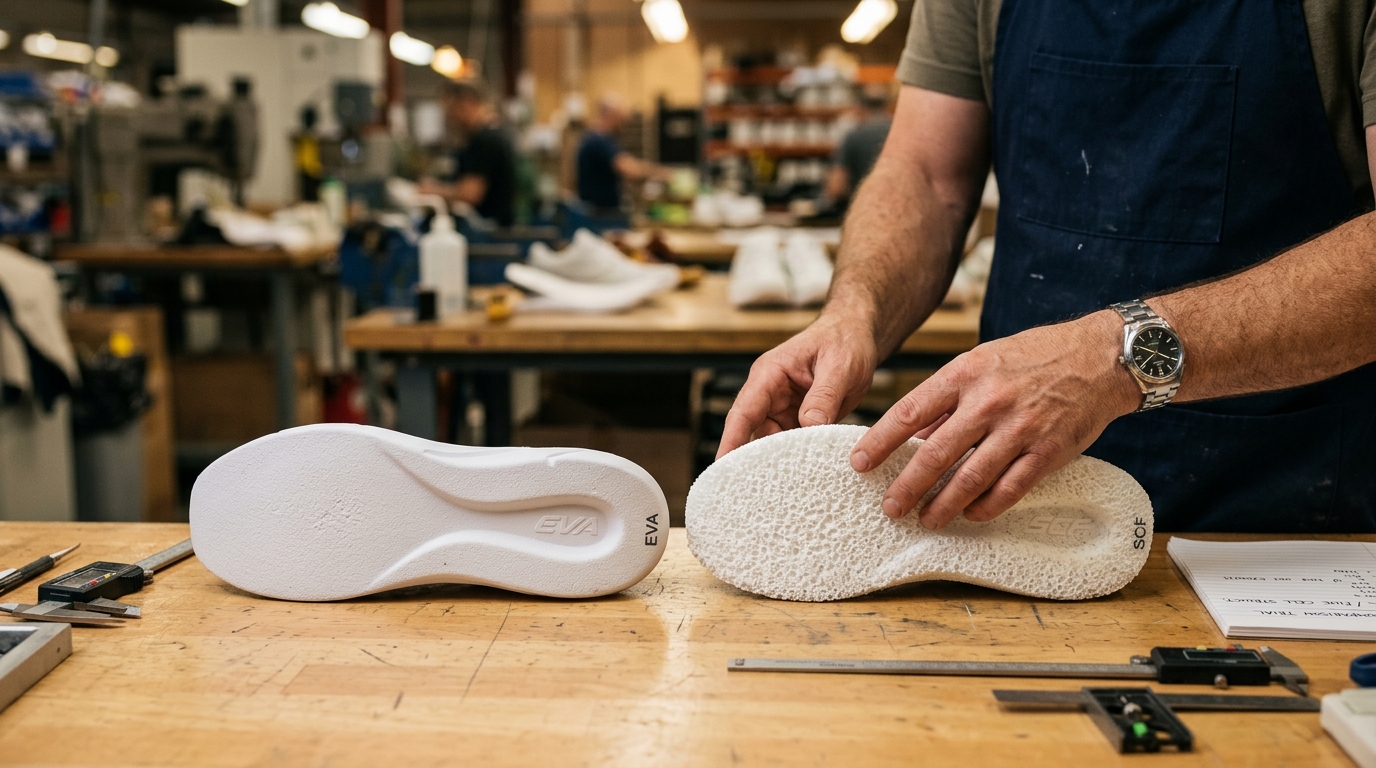
However, standard EVA has well-documented limitations. Over time, the cellular structure breaks down under repeated compression, leading to a phenomenon called compression set — the foam permanently flattens and loses its cushioning properties. Depending on the formulation and density, standard EVA insoles can lose 30-50% of their original thickness and resilience within six months of regular use. For brands positioned in the mid-to-premium market, this degradation can trigger warranty claims and damage customer loyalty.
Supercritical EVA represents a significant leap forward in foam technology. Instead of chemical blowing agents, supercritical CO₂ or nitrogen is used to create the foam’s cellular structure under precisely controlled temperature and pressure conditions. The result is a foam with a much more uniform, fine-celled microstructure. This translates to measurably superior energy return (often 15-25% higher than standard EVA), dramatically lower compression set (meaning the foam bounces back to its original shape far more consistently), and a lighter overall weight at equivalent cushioning levels. FX Footwear’s PulseSport line, for example, uses supercritical CO₂ foam insole technology to deliver these exact performance advantages.
The trade-off, predictably, is cost. Supercritical EVA requires specialized equipment and more stringent process controls, which translates to a higher per-unit price. For OEM brands, the decision between standard and supercritical EVA often comes down to the target retail price point and the performance expectations of the end consumer. A $60 casual sneaker may not need supercritical technology, but a $130 running shoe almost certainly benefits from it. Understanding where your product sits on this spectrum helps you communicate more effectively with potential manufacturers and avoid over-engineering (or under-engineering) your insole component. Brands developing performance running footwear should also consider how insole technology interacts with overall stack height and midsole thickness, since these factors work together to define the shoe’s ride characteristics.
Density Range and Compression Set
When evaluating EVA foam insole manufacturers, two technical specifications deserve more attention than any others: density range and compression set. These metrics directly determine how the insole performs on foot, how long it lasts, and which footwear categories it’s suited for. A manufacturer’s ability to offer a wide, precisely controlled density range signals their technical sophistication and manufacturing flexibility.
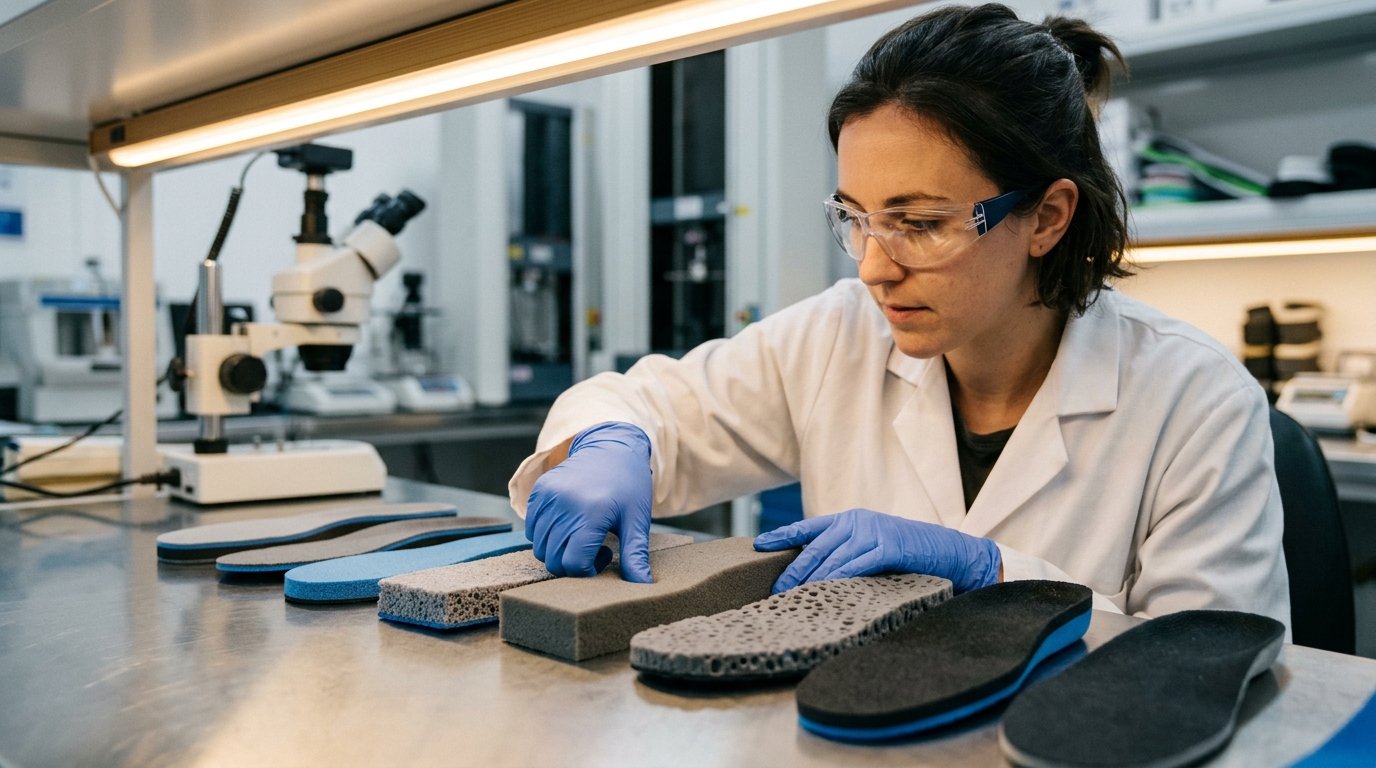
EVA foam density is measured in kilograms per cubic meter (kg/m³) or pounds per cubic foot (pcf). For insole applications, the useful density range typically spans from around 100 kg/m³ for ultra-soft comfort insoles up to 300+ kg/m³ for firm, supportive orthotic-style insoles. Most OEM brands need access to multiple density options across their product lines. A manufacturer that can only produce within a narrow density window will limit your design possibilities. Top-tier suppliers maintain consistent cell structure and physical properties across a density range of at least 150-350 kg/m³, giving your product development team the freedom to specify exactly the right firmness for each application. FX Footwear’s EVERYDAY series, for instance, offers an extensive density range within standard EVA that covers everything from plush lifestyle insoles to firmer stability-focused options — all available through their capabilities as a custom midsole supplier with integrated insole production.
Compression set is measured as a percentage, representing how much of its original thickness a foam sample fails to recover after sustained compression under controlled conditions (typically 50% compression at 50°C for 6 hours, per ASTM D3574 or equivalent standards). A lower compression set percentage means better resilience and longer functional life. Standard EVA formulations typically exhibit compression set values of 40-60%, while premium formulations can achieve 25-40%. Supercritical EVA routinely delivers compression set values below 30%, with the best formulations approaching 15-20%.
When requesting samples or technical data sheets from prospective manufacturers, always ask for compression set data tested to a recognized standard. Be wary of suppliers who provide only “in-house” test results without reference to ASTM, ISO, or equivalent protocols. Reliable EVA foam insole manufacturers will have third-party test reports available and can discuss how their specific formulations perform across different density ranges. The relationship between density and compression set isn’t always linear — some manufacturers achieve remarkably low compression set at moderate densities through proprietary crosslinking techniques or additive packages. This is where the real differentiation happens between commodity suppliers and partners who invest in material science. Ask to see aging test data as well, which simulates months or years of wear in accelerated laboratory conditions. This data is especially important for brands offering extended comfort guarantees.
Key Certifications for OEM Insoles
Certifications serve as objective proof that a manufacturer meets specific quality, safety, and environmental standards. For OEM brands selling into the US market and beyond, working with certified suppliers isn’t optional — it’s a baseline expectation from retailers, distributors, and increasingly from end consumers. The certification landscape for footwear materials can feel overwhelming, but a few key certifications should be non-negotiable when selecting EVA foam insole manufacturers.
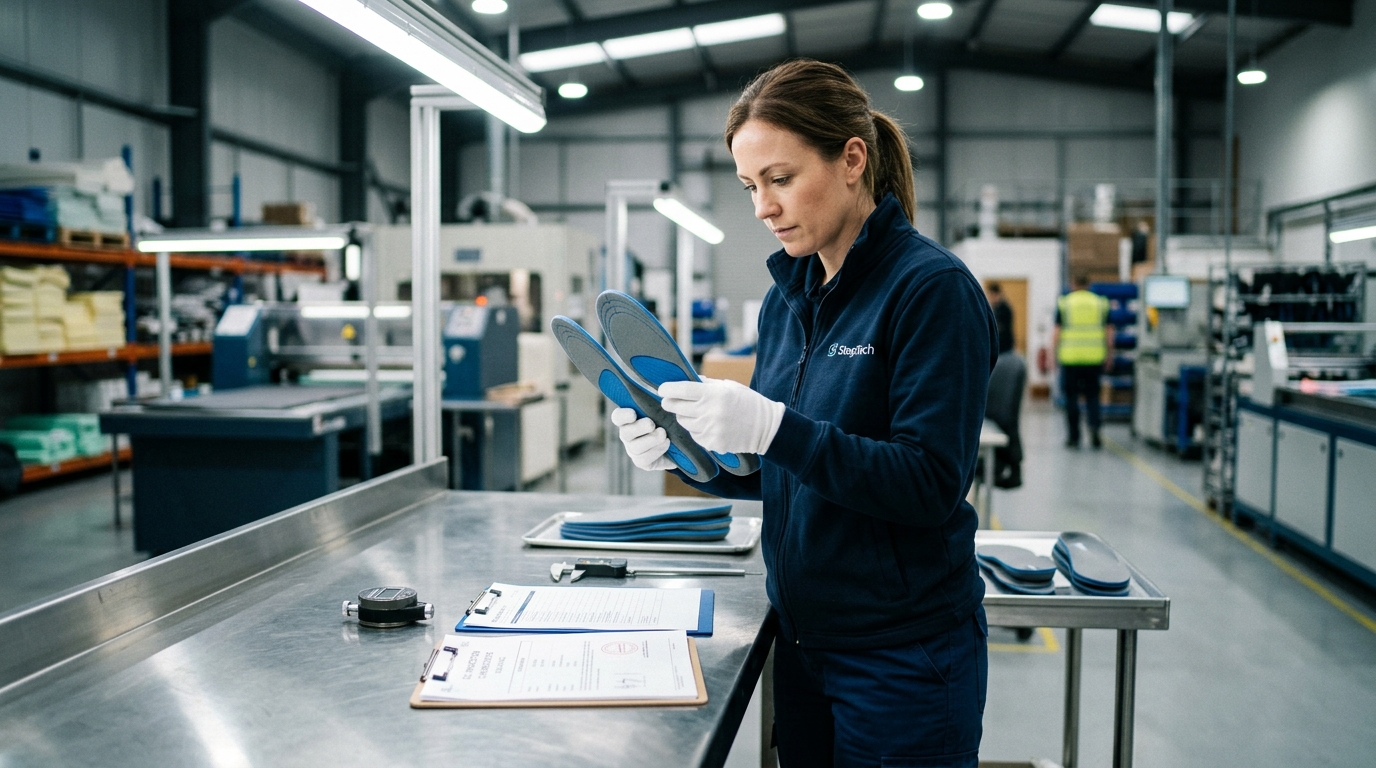
ISO 9001 (Quality Management System) is the foundational certification. It demonstrates that a manufacturer has established, documented, and consistently follows quality management processes across their operations. While ISO 9001 alone doesn’t guarantee product quality, its absence is a significant red flag. Manufacturers without ISO 9001 certification may lack the systematic process controls needed for consistent batch-to-batch quality at OEM volumes.
REACH compliance is essential for any brand selling in the European Union, and increasingly expected for US market products as well. REACH restricts the use of certain hazardous chemicals in manufactured goods, including substances like formaldehyde, heavy metals, and specific phthalates that can appear in foam formulations and adhesives. Your EVA insole supplier should be able to provide current REACH test reports — not just a self-declaration, but actual laboratory testing from an accredited facility. Similarly, California Proposition 65 compliance matters for brands distributing in the US, as this regulation requires disclosure of products containing chemicals known to cause cancer or reproductive harm.
Beyond regulatory compliance, sustainability certifications are becoming a meaningful differentiator. OEKO-TEX Standard 100 certification verifies that textile and foam products have been tested for harmful substances and are safe for human use. GRS (Global Recycled Standard) certification matters if your brand uses or markets recycled EVA content. Some progressive EVA insole manufacturers are also pursuing Higg Index assessments and carbon footprint certifications as major brand partners increasingly require environmental impact transparency throughout their supply chains.
Don’t overlook facility-level certifications either. ISO 14001 (Environmental Management) and SA8000 (Social Accountability) certifications address environmental practices and labor conditions respectively. For OEM brands that undergo social compliance audits from major retailers — think Walmart, Target, or Dick’s Sporting Goods — sourcing from SA8000-certified factories can significantly streamline the approval process. Always request copies of current certifications directly from the manufacturer, verify them through the issuing body if possible, and confirm that the certifications cover the specific production facility where your insoles will be made, not just the company’s headquarters.
Evaluating Supplier Manufacturing Capabilities
Certifications and material specs tell part of the story, but a thorough evaluation of manufacturing capabilities reveals whether a supplier can actually execute your vision at scale. When comparing EVA foam insole manufacturers, look beyond the sales pitch and dig into their production infrastructure, tooling capabilities, lead times, and quality control systems.
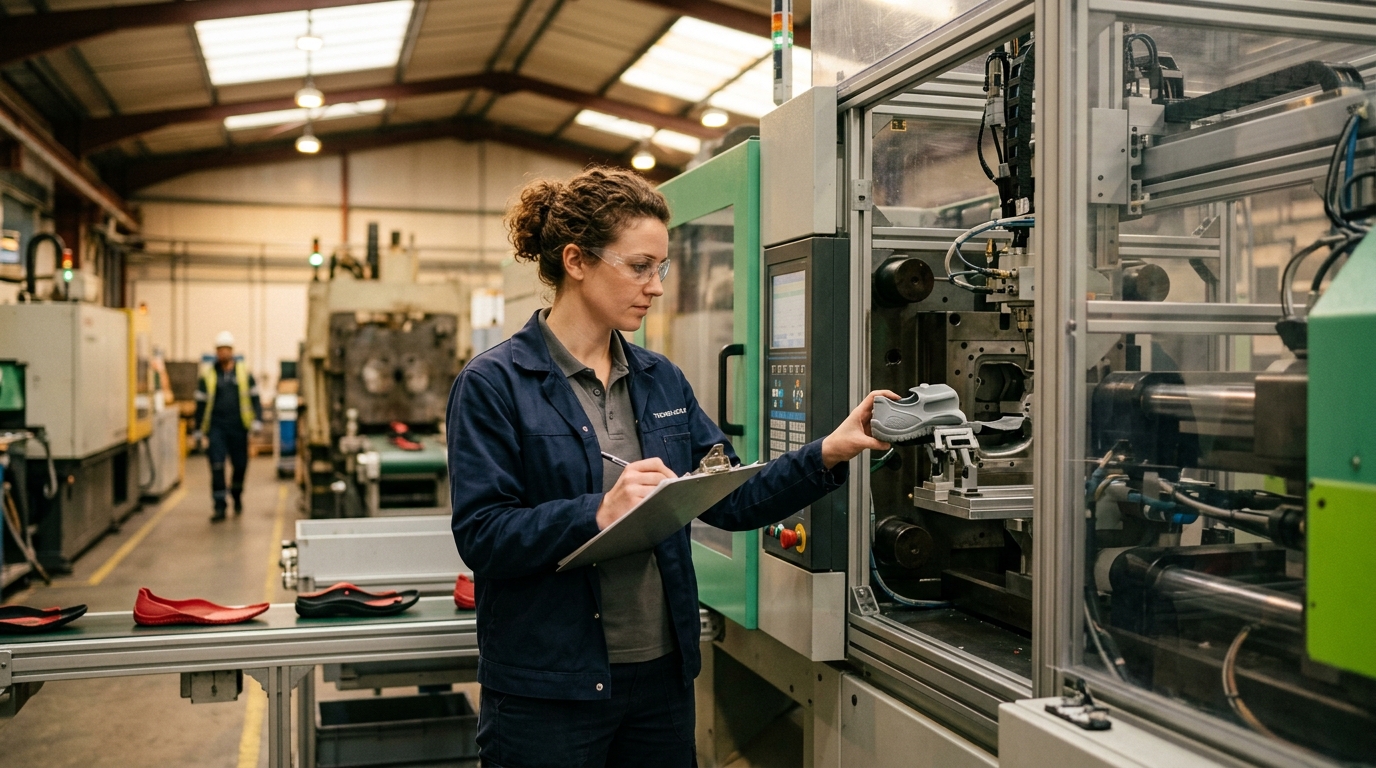
Production capacity and scalability should match your current needs and anticipated growth. Ask for monthly production volumes (in pairs), current capacity utilization rates, and how quickly they can scale for seasonal spikes. A manufacturer running at 95% capacity may not be able to accommodate your rush orders. Conversely, a factory with massive capacity but very low utilization might indicate quality or business stability concerns. Ideal partners operate at 60-80% capacity with clear expansion pathways.
Tooling and customization flexibility is critical for OEM brands developing proprietary insole designs. Evaluate whether the manufacturer has in-house tooling capabilities (CNC machining, 3D prototyping) or outsources mold production. In-house tooling typically means faster iteration cycles, lower tooling costs, and better design confidentiality. Ask about minimum order quantities (MOQs) for custom insoles — these can range from 500 pairs at flexible manufacturers to 10,000+ pairs at high-volume commodity producers. If you’re an emerging brand, working with a partner like FX Footwear that functions as a shoe insole manufacturer with reasonable MOQs can be the difference between launching on time and waiting months for production slots.
Quality control infrastructure separates professional operations from hobbyist setups. Look for manufacturers with dedicated QC teams, inline inspection stations (not just final inspection), and laboratory testing equipment for hardness, density, compression set, and dimensional accuracy. Ask how they handle out-of-spec production — do they have a documented nonconformance process? What is their defect rate? Best-in-class EVA insole manufacturers maintain defect rates below 1% and can provide statistical process control (SPC) data on request.
R&D capabilities indicate whether a manufacturer is a true development partner or simply a production house. Suppliers with material science expertise can help you optimize formulations for specific performance targets, suggest cost-saving material substitutions without sacrificing quality, and keep you ahead of market trends. This is particularly valuable for brands exploring hybrid insole constructions — such as combining EVA foam with TPU stability plates, gel cushioning inserts, or antimicrobial topcovers. A manufacturer with strong R&D also stays current on emerging technologies like supercritical foaming, bio-based EVA alternatives, and recycled content formulations.
Communication and project management may seem soft, but they’re among the most commonly cited frustrations in OEM supplier relationships. Evaluate the manufacturer’s responsiveness during the inquiry phase — if they’re slow to respond before they have your business, expect worse after. Look for assigned project managers, clear communication channels (not everything routed through a single sales contact), and willingness to provide regular production updates with photographic documentation.
FX Footwear’s EVA Insole Solutions
FX Footwear (Fuxiang Group) has established itself as a comprehensive partner for OEM brands seeking both standard and advanced EVA insole solutions. With vertically integrated manufacturing capabilities spanning material compounding through finished insole production, FX Footwear offers the kind of end-to-end control that delivers consistency and flexibility simultaneously.
The EVERYDAY series represents FX Footwear’s standard EVA insole platform, purpose-built for the high-volume OEM market. Available across a wide density range, the EVERYDAY line serves casual footwear, work shoes, lifestyle sneakers, and entry-level athletic categories. What distinguishes the EVERYDAY series from generic EVA insoles is the precision of FX’s compounding process — each density grade is formulated with optimized crosslinking and foaming parameters to achieve the best possible compression set resistance within the standard EVA category. For brands that need reliable, cost-effective cushioning at scale, the EVERYDAY platform delivers exactly that. It’s also available in multiple durometer options and can be customized with contoured footbeds, arch support features, and branded topcover materials.
For performance-oriented OEM brands, the PulseSport supercritical EVA line is where FX Footwear truly differentiates. Using supercritical CO₂ foaming technology, PulseSport insoles achieve a cellular structure that’s fundamentally different from conventionally foamed EVA. The result is an insole that is measurably lighter, more resilient, and more durable than standard EVA at equivalent cushioning levels. PulseSport insoles exhibit compression set values significantly below industry averages for standard EVA, making them ideal for running shoes, training footwear, and any application where sustained cushioning performance is a selling point. Brands targeting the athletic and outdoor segments — where consumers pay close attention to underfoot technology — can leverage PulseSport as a genuine product differentiator.
FX Footwear’s manufacturing infrastructure supports both series with the quality systems and certifications that major OEM brands require. With a certification and verification base spanning GRS, ISO 13485:2016, Higg Index, and SLCP, plus in-house material testing laboratories, the company is built to serve as a long-term wholesale midsole supplier and insole manufacturing partner. Their engineering team works directly with brand product developers to optimize insole geometry, material selection, and construction methods for each specific application. For brands with specialized needs — such as OEM insole designs requiring structural reinforcement or multi-density construction — FX Footwear’s cross-functional development approach ensures that the insole integrates seamlessly with the overall shoe design. This collaborative model reduces development timelines, minimizes sample iterations, and helps brands get to market faster without compromising on material performance.
FAQ
What is EVA foam used for in insoles?
EVA (ethylene-vinyl acetate) foam is used as the primary cushioning material in shoe insoles, providing shock absorption, comfort, and lightweight support across casual, athletic, and work footwear categories. Its versatile density range allows manufacturers to create everything from ultra-soft comfort insoles to firm supportive footbeds.
How does supercritical EVA differ from standard?
Supercritical EVA uses CO₂ or nitrogen under high pressure instead of chemical blowing agents to create a finer, more uniform cell structure, resulting in 15-25% higher energy return, significantly lower compression set, and reduced weight compared to standard EVA at equivalent cushioning levels. The trade-off is higher manufacturing cost due to specialized equipment requirements.
What certifications should EVA insole suppliers have?
At minimum, look for ISO 9001 quality management certification, REACH compliance testing, and OEKO-TEX Standard 100 for material safety. Facility-level certifications like ISO 14001 (environmental) and SA8000 (social accountability) are increasingly important for brands selling through major US retailers.
What MOQs do EVA insole manufacturers require?
Minimum order quantities vary widely, from as low as 500 pairs at flexible manufacturers to 10,000+ pairs at high-volume commodity producers. Custom insoles with proprietary tooling typically require higher MOQs to offset mold development costs.
How long do EVA foam insoles typically last?
Standard EVA insoles maintain optimal cushioning performance for approximately 300-500 miles of use or 4-6 months of daily wear, while supercritical EVA insoles can last significantly longer due to superior compression set resistance. Actual lifespan depends on foam density, user weight, and activity intensity.
Ready to source EVA foam insoles that match your brand’s performance standards and production timeline? FX Footwear (Fuxiang Group) offers both the EVERYDAY standard EVA platform and the PulseSport supercritical EVA line — backed by vertically integrated manufacturing, rigorous quality systems, and a collaborative development approach built for OEM partners. Reach out to the FX Footwear team today to request samples, technical data sheets, and a consultation tailored to your product roadmap.