Whether you’re launching a new performance running line or upgrading your basketball footwear collection, sourcing custom insoles for athletes is one of the most consequential decisions you’ll make as a sports brand. The insole sits at the intersection of comfort, biomechanical performance, and injury prevention — yet it’s often treated as an afterthought during product development. That’s a mistake. In 2026, athletes and consumers alike demand data-backed cushioning, superior energy return, and materials that align with sustainability goals. This step-by-step guide walks sports brands, product managers, and sourcing teams through every phase of the process: defining performance criteria, navigating the OEM workflow, managing sampling rounds, meeting international testing standards, and selecting a supplier who can scale with you. By the end, you’ll have a clear checklist to confidently source custom athletic insoles that elevate your footwear line.
Performance Criteria for Athletes
Before you contact a single factory, your product team needs to define what “performance” actually means for your target athlete. A trail runner pounding uneven terrain for three hours has radically different insole needs than a court-sport athlete making explosive lateral cuts. Establishing clear performance criteria upfront prevents costly redesigns later and gives your manufacturing partner the specifications they need to deliver.
Start by mapping out four core performance pillars: cushioning and impact absorption, energy return, stability and arch support, and moisture management. For cushioning, consider the heel-strike forces your athlete will endure — running generates forces of two to three times body weight, while jumping sports can spike even higher. Energy return is measured as a percentage of the energy stored during compression that is released during toe-off, and top-tier athletic insoles now achieve return rates above 60 percent. Stability encompasses torsional rigidity, heel cup geometry, and arch profile, all of which should be tailored to the sport’s movement patterns.
Don’t overlook material selection during this phase. Open-cell foams excel at breathability but may sacrifice durability under repetitive high-load cycles, whereas closed-cell foams like EVA offer longevity but can trap heat. Newer options like supercritical foaming technology deliver a compelling balance of lightweight cushioning and resilience. If you’re evaluating materials in this space, exploring a supercritical CO2 foam insole can give you a concrete benchmark for what next-generation foam performance looks like. Document every criterion in a detailed product brief — this becomes the north star for your entire sourcing journey.
OEM Workflow Step by Step
Understanding the OEM workflow removes much of the uncertainty from custom insole sourcing and helps you set realistic timelines. Most projects follow a predictable arc: initial inquiry, design consultation, material selection, tooling, sampling, revisions, pre-production approval, and mass production. The full cycle from first contact to delivery of bulk goods typically spans 90 to 150 days, though complexity and tooling requirements can push that timeline.
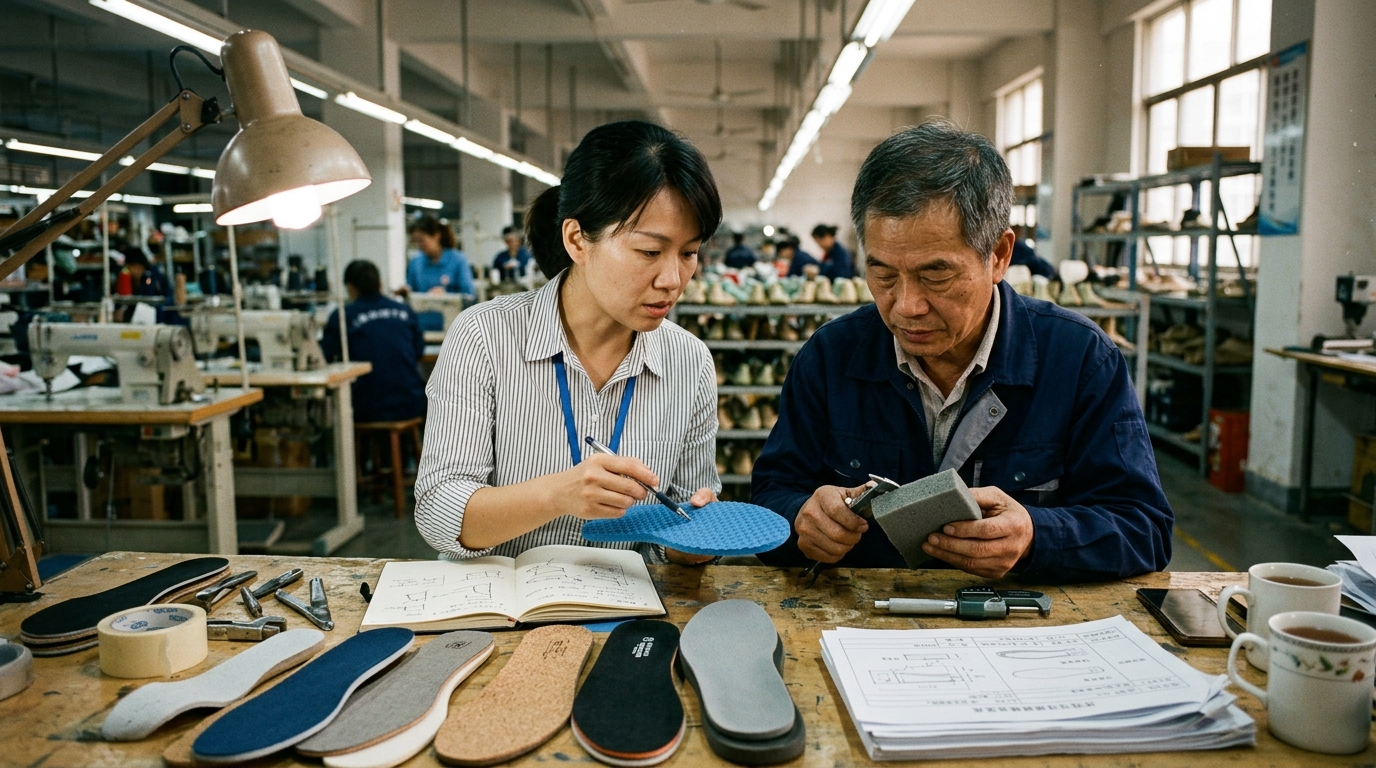
Phase one is discovery and design. You’ll share your product brief, target price point, annual volume projections, and any CAD files or 3D scans you’ve already developed. A capable OEM partner will assign a dedicated project engineer who reviews your specs, flags potential manufacturability issues, and proposes material and construction alternatives you may not have considered. This is also the stage where you discuss intellectual property protections, NDAs, and exclusivity terms. Brands that skip formalizing these agreements early often face headaches later.
Phase two covers tooling and prototyping. Compression molds or injection molds are fabricated based on the approved design — this is typically the single largest upfront cost in the project. Once tooling is complete, the factory produces initial samples (usually called T1 samples) for your review. Expect at least two to three rounds of sampling before locking the final specification. Each round should be accompanied by a sample evaluation report where you score the insole against your original performance criteria. During this phase, many leading foam insole manufacturers will also provide material data sheets and preliminary test results to help you make informed decisions before committing to mass production.
Phase three is production and logistics. After you sign off on a pre-production sample (the “gold standard” sample that the factory retains as a reference), bulk manufacturing begins. Establish clear quality checkpoints: in-line inspections at 20 percent and 80 percent completion, plus a final random inspection before shipment. Define your Incoterms, shipping method, and payment milestones in writing before production starts.
Sampling Best Practices
Sampling is where sourcing projects succeed or fail, and too many brands rush through it to hit aggressive launch dates. Treat every sample round as a learning opportunity, not just a checkbox exercise. A disciplined sampling process saves money, reduces time-to-market in the long run, and ensures the insole that reaches your customer actually performs as promised.
Request a minimum of six sample pairs per round — you’ll need pairs for internal fit testing, biomechanical lab evaluation, wear testing on real athletes, and a reference pair to retain. When evaluating T1 samples, focus on dimensional accuracy, material hardness (Shore A or Shore C durometer), density, and surface finish. Don’t obsess over cosmetic perfection at the T1 stage; that’s what T2 and T3 rounds are for. Instead, verify that the core functional geometry — heel cup depth, arch profile, metatarsal pad placement — matches your design intent within acceptable tolerances (typically ±1 mm for critical dimensions).
Wear testing is non-negotiable for athletic insoles. Recruit at least five athletes who represent your target user profile and have them log a minimum of 40 hours of sport-specific activity on the sample insoles. Collect structured feedback using a standardized questionnaire that covers cushioning feel, stability, temperature comfort, and any pressure hotspots. Pair subjective feedback with objective data: pressure-mapping insoles from brands like Novel or Tekscan can quantify load distribution and identify design improvements that athletes might not articulate. According to the American College of Sports Medicine, proper footwear components including insoles play a measurable role in reducing overuse injuries, which underscores the importance of thorough testing before you go to market.
If your T2 samples still don’t meet spec, don’t panic — schedule a video call with the factory’s engineering team rather than relying solely on email markups. Screen-sharing annotated photos and walking through pressure-map data in real time dramatically reduces miscommunication and typically shaves an entire revision cycle off the timeline.
Testing Standards & Compliance
Selling athletic insoles in the US market in 2026 means navigating a landscape of testing standards, material safety regulations, and retailer-specific compliance programs. Ignoring this landscape doesn’t just risk product recalls — it can lock you out of major retail channels entirely.
At the material level, ensure your insole foams and adhesives comply with CPSIA (Consumer Product Safety Improvement Act) requirements, particularly if your products could be marketed to athletes under 12. Heavy metal content, phthalate limits, and flammability standards all apply. For performance testing, the most widely referenced framework is ASTM F1614, which covers cushioning properties of shoe inserts, and ASTM D2632 for resilience of foam materials. Your OEM supplier should be able to conduct or facilitate these tests through accredited third-party labs like SGS, Intertek, or Bureau Veritas.
Beyond baseline compliance, many sports brands pursue voluntary certifications that signal quality to retail buyers and consumers. OEKO-TEX Standard 100 certification verifies that textile components are free from harmful substances, and it’s increasingly requested by athletic retailers in the US and EU. If sustainability is part of your brand story — and in 2026, it should be — look for suppliers with ISO 14001 environmental management certification and the ability to provide lifecycle assessment (LCA) data for your insole materials. The US Environmental Protection Agency provides frameworks for evaluating environmental claims that can guide your sustainability messaging and keep it compliant with FTC Green Guides.
Build a compliance checklist early in the sourcing process and share it with prospective suppliers during the RFQ (Request for Quotation) stage. Any factory that hesitates to provide test reports or certification documentation should be treated as a red flag. Compliance isn’t a nice-to-have — it’s a gatekeeper for market access.
Supplier Selection Checklist
Choosing the right manufacturing partner is about far more than finding the lowest per-unit price. The supplier you select becomes an extension of your product development team, and the wrong choice can derail your timeline, compromise quality, or damage your brand reputation. Use this structured checklist to evaluate every prospective supplier objectively.
Technical capability. Does the factory have in-house tooling design and fabrication? Can they work with the specific foam chemistries your product requires — EVA, PU, TPU, supercritical foams, or hybrid constructions? A supplier with diverse material capabilities, like an established shoe insole manufacturer, gives you more flexibility to innovate across product lines without switching factories.
Capacity and scalability. Confirm the factory’s monthly insole output in pairs and ask what percentage of capacity is currently allocated. A factory running at 95 percent capacity may struggle to accommodate your order spikes during peak season. Request references from brands of similar size to yours — a factory that excels with 10,000-pair orders may not have the systems to handle 500,000-pair programs, and vice versa.
Quality management systems. Look for ISO 9001 certification as a baseline. Beyond the certificate, ask to review their quality control SOPs: how do they handle incoming material inspection, in-process checks, and final outgoing quality audits? What is their defect rate benchmark, and what corrective action process do they follow when defects are identified? A transparent supplier will share this information freely.
Communication and responsiveness. During the RFQ and sampling phases, pay close attention to response times, language clarity, and willingness to proactively flag issues. If communication is difficult before you’ve placed an order, it will only get worse once production is underway. Prioritize suppliers that assign a dedicated account manager and can communicate during US business hours.
Logistics and trade terms. Verify the supplier’s experience with US import requirements, preferred freight forwarders, and ability to ship DDP (Delivered Duty Paid) if that’s your preference. Ask about their standard lead times for repeat orders versus new tooling projects, and confirm whether they maintain buffer stock of your custom materials.
Intellectual property protection. Confirm that the supplier is willing to sign an NDA and a non-compete clause preventing them from selling your proprietary designs to competitors. Ask whether they’ve had IP disputes in the past and how they were resolved. Factories based in regions with strong IP enforcement frameworks offer an additional layer of protection.
Score each supplier against these criteria on a 1-to-5 scale, weight the categories based on your brand’s priorities, and let the data guide your decision rather than gut instinct alone.
Cost Drivers & Budgeting
Understanding what drives insole cost helps you negotiate effectively and avoid surprises when quotes arrive. The four biggest cost drivers for custom insoles for athletes are material selection, tooling complexity, order volume, and finishing or packaging requirements.
Material costs can vary by a factor of three to five between basic EVA foam and advanced supercritical or dual-density constructions. Get material pricing broken out separately from conversion costs so you can model different material scenarios without requesting entirely new quotes. If you’re exploring cost-effective yet high-performing foam options, reviewing what leading EVA insole manufacturers offer can help you benchmark pricing for this popular material category.
Tooling is a one-time investment but can range from $2,000 for a simple flat-die cut insole to $15,000 or more for multi-cavity injection molds with complex arch and heel geometries. Ask whether the factory retains tooling ownership or if you can negotiate to own the molds — owning your tooling gives you leverage and portability if you ever need to switch suppliers.
Volume is the most powerful lever you have. Most OEM factories offer tiered pricing with meaningful breaks at 5,000, 10,000, 50,000, and 100,000 pairs. If your initial order is small, negotiate for pricing that steps down automatically as cumulative volume hits predefined thresholds within a 12-month period. This protects you from overpaying on launch orders while rewarding the supplier for the long-term relationship.
Finally, factor in landed cost, not just FOB price. Freight, customs duties (check the current HTS code classification for your insole type), insurance, and inland transportation to your distribution center all add up. In 2026, many brands are also budgeting for carbon offset costs associated with ocean freight — a line item that didn’t exist five years ago but is increasingly expected by ESG-conscious retail partners.
FAQ
What MOQ is typical for custom insoles?
Most OEM insole manufacturers set minimum order quantities between 3,000 and 5,000 pairs per SKU for custom tooled insoles, though some offer lower MOQs for stock-mold programs.
How long does custom insole development take?
From initial design consultation to delivery of bulk goods, expect 90 to 150 days depending on tooling complexity and the number of sampling rounds required.
Which foam is best for athletic insoles?
There’s no single best foam — EVA offers affordability and versatility, PU provides superior durability, and supercritical foams deliver an excellent balance of lightweight cushioning and energy return.
Do I need third-party testing for insoles?
Yes, third-party testing through accredited labs like SGS or Intertek is essential for verifying material safety, performance claims, and compliance with US consumer product regulations.
Can I own the tooling molds?
Many factories allow clients to own tooling molds, often for an additional fee, which gives you the flexibility to transfer production to another supplier if needed.
If you’re ready to source custom insoles for athletes that meet the highest performance and quality standards, FX Footwear (Fuxiang Group) brings decades of footwear materials expertise, advanced foaming technologies, and a proven OEM workflow designed for sports brands like yours. From initial concept through mass production, our engineering team partners with you at every step to deliver insoles that give your athletes a genuine competitive edge. Reach out to start your sourcing conversation today.