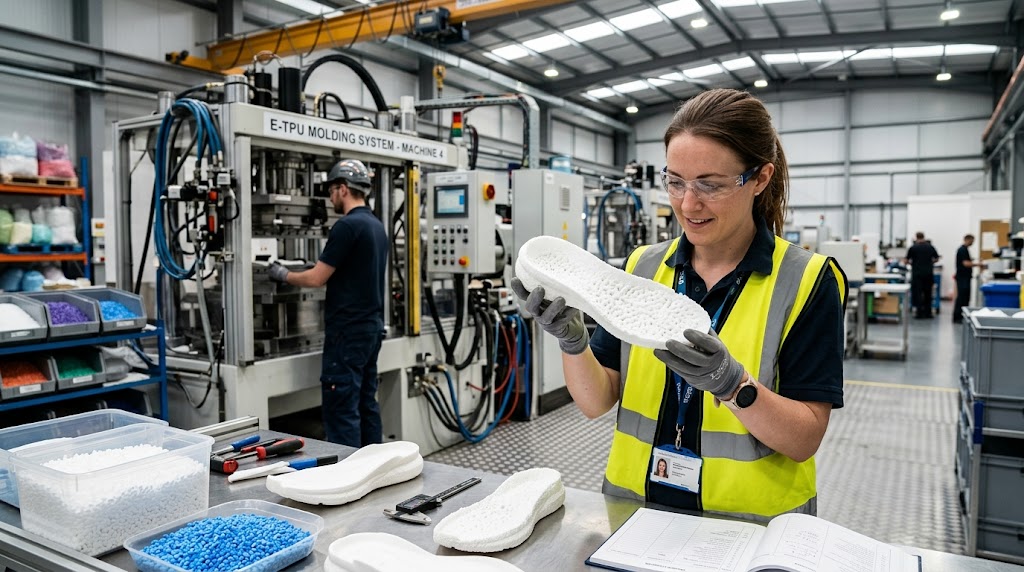
Pellet foam molding is the process of fusing pre-expanded foam beads (often called “popcorn foam”) into a finished shoe component using steam, heat, or mechanical pressure inside a mold. If you’ve held an Adidas Boost midsole, you’ve already felt the result. The individual beads bond together while retaining their cellular structure, creating parts that are lightweight, resilient, and tunable in density. This guide breaks down each stage of the process, explains why it matters for footwear brands sourcing components at scale, and covers where Fuxiang Group (FX Footwear) fits into the picture — including a patented popcorn foam approach we’ve developed in-house.
Before getting into pellet foam specifically, it helps to understand where this sits in the broader foaming universe. We covered the foundational split between physical foaming vs. chemical foaming in a previous article — pellet foam molding falls firmly on the physical foaming side, typically using supercritical CO₂ or N₂ as the blowing agent during the bead expansion stage.
What Pellet Foam Actually Is
Pellet foam molding starts with raw polymer pellets — tiny granules of EVA, TPU, TPEE, or PEBA — and converts them into expanded beads through a supercritical fluid foaming (SCF) process. Those beads are then fused inside a mold to create the final part. Two distinct stages. Two different pieces of equipment. One finished component.
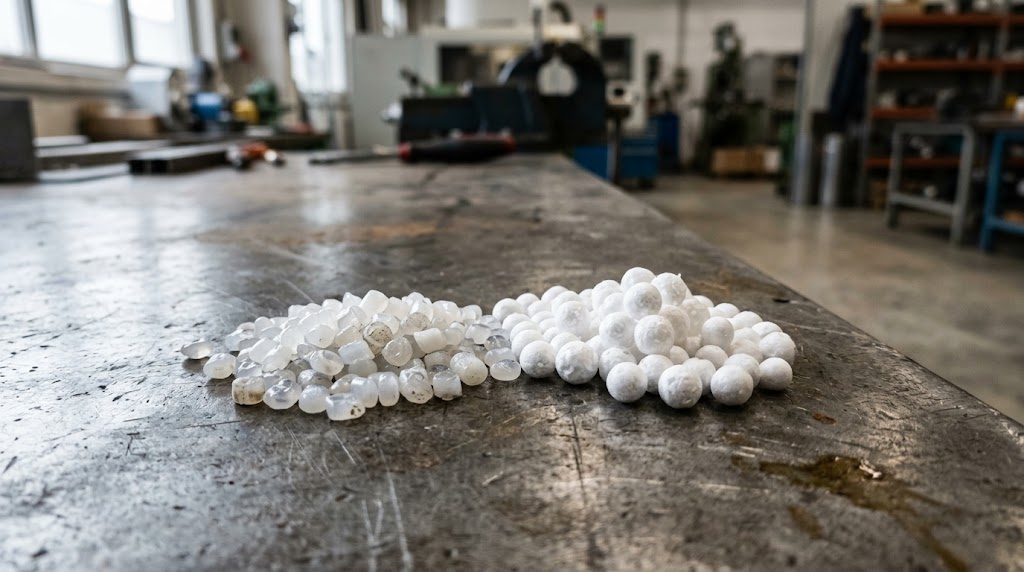
The “popcorn foam” nickname comes from the visual similarity: raw pellets go in small and dense, come out puffed up and light. (The analogy breaks down if you think too hard about it, but it stuck for good reason.) Each expanded bead contains a microcellular structure — thousands of tiny gas-filled cells that provide cushioning and energy return once the beads are bonded together.
What makes this different from traditional compression-molded EVA or injection-molded PU? In those processes, you’re foaming a single mass of material inside a mold. With pellet foam, each bead is its own independent foam unit before molding begins. That’s the key distinction, and it unlocks some specific performance advantages we’ll get into below.
The base resin you choose determines the performance ceiling of the finished part:
| Base Resin | Relative Cost | Key Strength | Common Use |
|---|---|---|---|
| EVA | Lowest | Lightweight, mature process | Everyday athletic, casual |
| TPU | Moderate | Elasticity, abrasion resistance | Premium midsoles |
| TPEE | Higher | Heat + chemical resistance | Outsoles, outdoor performance |
| PEBA | Highest | Energy return + low weight | Elite racing shoes |
EVA is by far the most widely processed SCF base material — cost-effective and well-understood. PEBA sits at the other extreme: the fastest-growing, highest-performance option, but priced accordingly and typically reserved for elite-level athletic footwear. Most commercial pellet foam applications blend resins (TPU + EVA, PEBA + EVA) to hit a price/performance sweet spot.
Pre-Expansion: Making the Beads
This is where the magic happens, frankly. Raw polymer pellets enter an autoclave or continuous extrusion system, where they’re saturated with supercritical CO₂ or N₂ under high pressure and temperature. When the pressure drops rapidly, the dissolved gas expands inside the polymer matrix, creating the cellular foam structure.
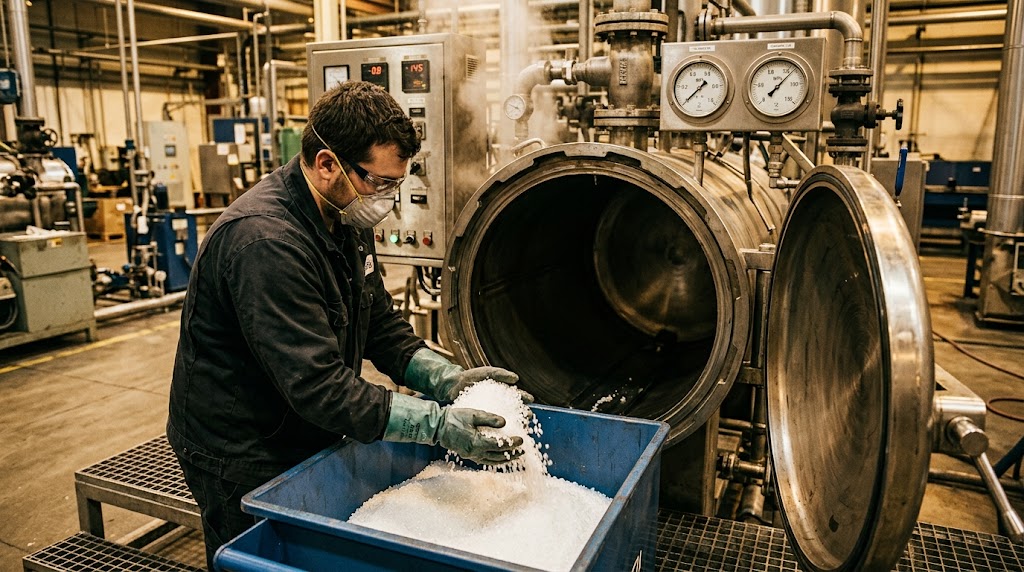
The result? Beads that weigh a fraction of the original pellet. Achievable foam density can go as low as 0.07 g/cm³, with rebound rates exceeding 80%. No chemical blowing agents involved — just CO₂ or N₂, which means no volatile organic compounds (VOCs) and a cleaner production process.
Here’s what most articles on this topic skip: controlling bead expansion uniformity is the hardest part of the entire pellet foam molding chain. If bead size distribution varies too much, you get inconsistent density in the finished part. Hot spots in cushioning. Weak zones at the edges. The pre-expansion parameters — saturation pressure, hold time, depressurization rate, temperature profile — all interact with each other in ways that require significant process know-how. This is where experience separates a capable manufacturer from someone who just bought the equipment.
A quick reference on how pre-expansion parameters shift by resin:
- EVA beads: Expand easily, good flowability, forgiving process window
- TPU beads: Form initially hard pellets that expand into soft foam in air — counterintuitive until you’ve seen it
- PEBA beads: Require precise control but deliver the highest resilience; typically blended with EVA or TPU before foaming to balance cost and performance
After expansion, beads are collected, dried, and often aged for a stabilization period (usually 12–24 hours, depending on resin type) before they’re ready for the next stage.
Steam Chest Molding: Fusing Beads Together
Once you have a batch of expanded beads at the target density and size distribution, they go into a steam chest mold. This is the step that turns loose popcorn into a finished midsole, insole, or other shoe component.
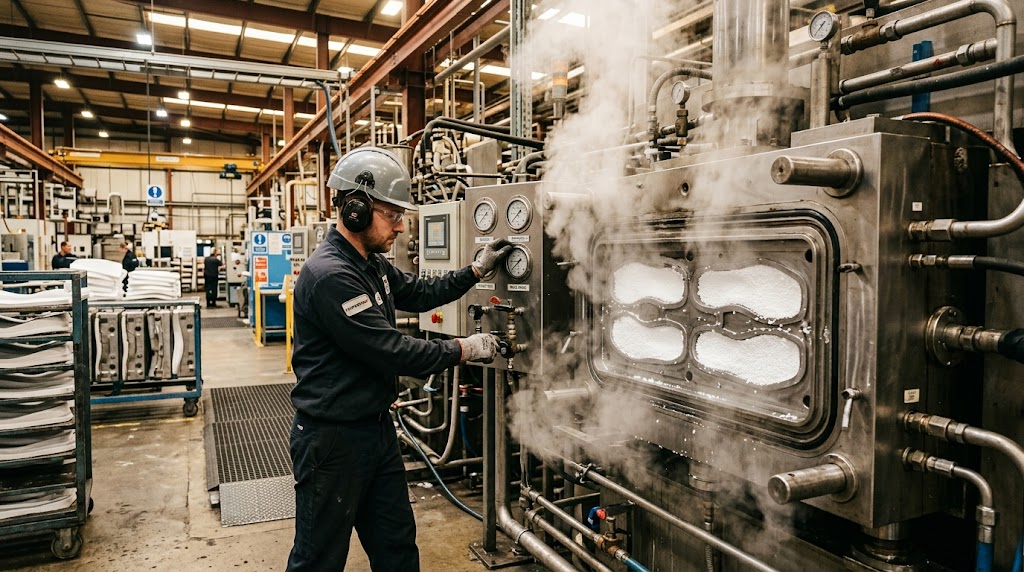
The process works like this:
1. Expanded beads are loaded into a mold cavity (pneumatic fill, sometimes with a pre-compression step)
2. Steam is injected at controlled temperature and pressure — typically 100–130°C for EVA-based beads, higher for TPU or PEBA
3. The heat softens the outer skin of each bead just enough that adjacent beads fuse at their contact surfaces
4. The mold is cooled (water cooling channels built into the tool)
5. The part is demolded
The steam parameters are everything. Too little steam and the beads won’t bond — you get a part that crumbles when you flex it. Too much and the cells collapse, killing the cushioning properties you worked so hard to create in pre-expansion. The window between “under-bonded” and “over-fused” can be surprisingly narrow, especially with PEBA-based foams.
Why steam and not just heat? Steam transfers energy uniformly to irregular bead surfaces in a way that conduction (hot plates) or radiation simply can’t match. It penetrates the gaps between beads and heats the entire volume simultaneously rather than from the outside in. That’s why steam chest molding became the industry standard for expanded bead parts, borrowed from the EPS (expanded polystyrene) packaging industry decades ago and refined for footwear applications.
> Bonding quality check: In production, we assess inter-bead bonding by cutting cross-sections and examining whether failure occurs through beads (good — cohesive failure) or between beads (bad — adhesive failure at the bond interface). A well-fused part should tear through the beads themselves, not pull apart at the seams.
One more thing worth mentioning: mold design for pellet foam isn’t the same as for compression-molded EVA. Steam chest molds need steam channels, venting, and fill ports that traditional insole molds don’t have. This means dedicated tooling investment — a consideration for brands evaluating pellet foam components for the first time.
FX Footwear’s Popcorn Foam Patent
FX Footwear (Fuxiang Group) holds a patent on a popcorn foam construction method that addresses one of the persistent challenges in pellet foam molding: achieving consistent bead bonding across complex geometries while maintaining target density profiles.
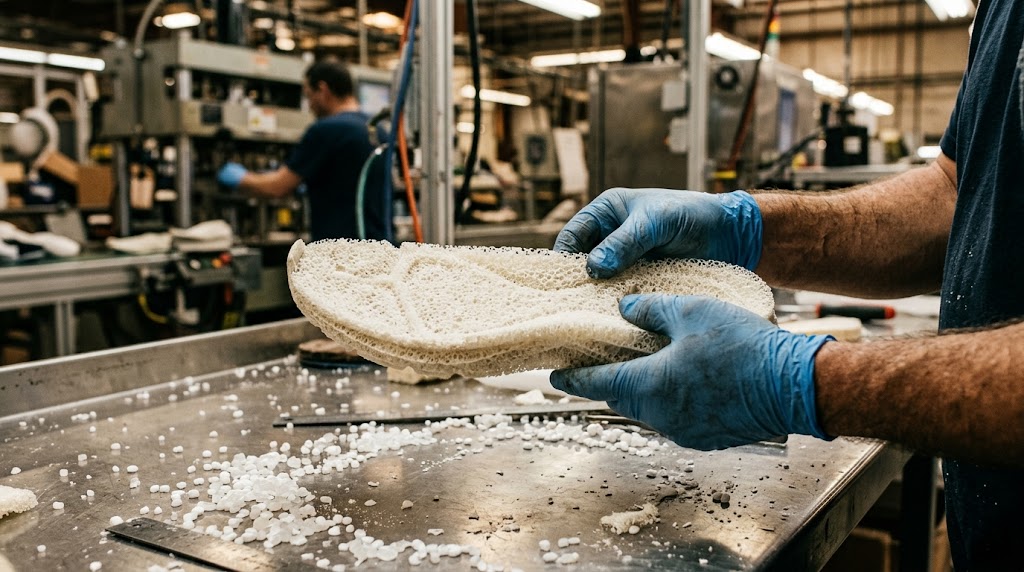
Without disclosing proprietary process details, the approach involves controlled pre-compression and staged steam delivery that improves fill uniformity in mold cavities with varying thicknesses — think heel-to-forefoot transitions in a midsole, where the cavity depth changes dramatically. Standard steam chest molding tends to produce tighter packing (and therefore higher density) in thinner sections, which means the part doesn’t cushion evenly. Our patented process mitigates that.
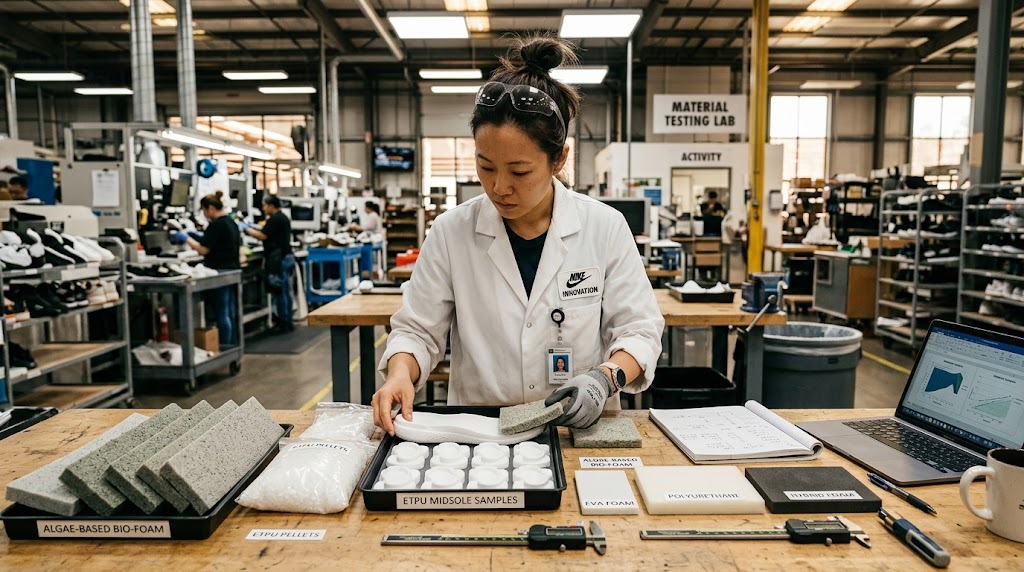
We run this through our in-house lab, where we can validate compression set, rebound, and density distribution on production samples without relying solely on external testing facilities. That feedback loop — mold, test, adjust, repeat — is what makes the difference between a specification on paper and a part that actually performs in someone’s shoe for 500 miles.
This capability sits alongside our broader supercritical CO₂ foam insole line (PulseSport), which uses SCF technology for direct-foamed insoles rather than the bead-based approach. Different process, related physics, same underlying principle: physical foaming with CO₂ produces a microcellular structure with predominantly closed cells that delivers consistent energy feedback.
When Pellet Foam Beats Alternatives
Not every shoe component should be pellet foam. Here’s where it actually makes sense — and where it doesn’t.
Pellet foam works best when:
- You need high rebound and low density simultaneously (midsoles for performance running)
- The component has complex 3D geometry that benefits from bead fill vs. compression molding
- You’re using premium resins like TPU or PEBA that perform significantly better in SCF bead form than in traditional foaming
- Energy return is the primary spec — SCF-expanded beads using PEBA can exceed 80% rebound, which compression-molded EVA simply can’t match
Pellet foam is overkill or wrong when:
- You need a flat, uniform insole for casual or workwear applications (die-cut EVA is faster, cheaper, and perfectly adequate)
- Volume is low and you can’t justify the steam chest mold tooling
- Compression resistance and long-term shape retention matter more than energy return (PU wins here — open-cell PU provides better breathability and holds its shape under sustained load for applications like therapeutic footwear)
- Budget is the primary constraint at a value price tier
The energy return hierarchy in SCF applications runs: PEBA > TPEE > TPU-blend > EVA. But raw rebound percentage isn’t the only variable. A PEBA midsole in an elite marathon racer has different requirements than a TPU/EVA blend midsole in a daily trainer. Cost per pair, durability over cycles, manufacturing yield — these all factor into the material selection conversation.
For context on where we source SCF materials: FX processes EVA and TPU beads in-house across our facilities in China, Northern Vietnam, Southern Vietnam, and Indonesia. TPEE and PEBA are sourced resins that we process through our SCF equipment. Companies like Shincell (申赛新材料), based in Suzhou, have been supplying PEBA foam technology for applications like the Adidas ADIZERO ADIOS PRO EVO series — that gives you a sense of the performance tier we’re talking about.
Sustainability Angle for Pellet Foam
Because SCF uses only CO₂ or N₂ as blowing agents — without traditional chemical blowing agents — the process eliminates VOC emissions associated with older foaming methods. That’s a tangible environmental benefit, not a marketing claim.
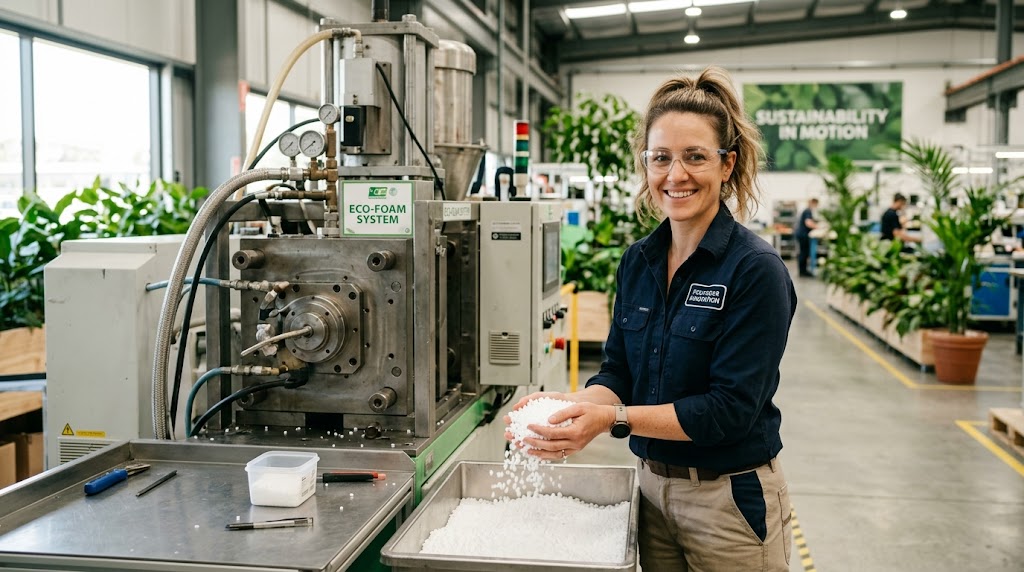
There’s also a material efficiency argument. Pellet foam molding generates less scrap than compression molding because bead fill naturally conforms to the mold cavity. Flash trimming waste is minimal. And because FX holds GRS (Global Recycled Standard) certification, we can incorporate recycled EVA compounds into SCF bead production with full traceability documentation for brands that need it.
One honest caveat: PEBA and TPEE resins don’t currently have widely available recycled-content grades suitable for SCF processing. The sustainability story is strongest with EVA-based pellet foam, where sugarcane-based EVA and recycled EVA compounds are commercially proven. If a brand tells you their PEBA midsole is “sustainable,” ask them what percentage of the resin is bio-based. (The answer, right now, is usually close to zero — or a partial bio-content formulation at best.) As a shoe insole manufacturer with both SCF and traditional foaming capabilities, we help brands navigate these tradeoffs honestly rather than overpromising on green claims.
FAQ
What is pellet foam molding?
Pellet foam molding is a two-stage process: raw polymer pellets are first expanded into lightweight foam beads using supercritical CO₂ or N₂, then fused together inside a steam chest mold to form finished shoe components like midsoles and insoles.
Which materials work for pellet foam?
Four base resins are commonly used: EVA (most cost-effective), TPU (best elasticity), TPEE (heat resistant), and PEBA (highest energy return). EVA and TPU are the most widely processed; PEBA is reserved for premium athletic applications.
How does pellet foam differ from compression-molded EVA?
Compression-molded EVA foams a single material mass inside a mold. Pellet foam fuses thousands of pre-expanded beads, allowing each bead to retain its own cellular structure. This typically delivers higher rebound and lower density at the part level.
Is pellet foam more expensive than traditional foam?
Yes, generally. Steam chest mold tooling costs more, and premium resins like PEBA add significant material cost. EVA-based pellet foam narrows the gap, but the process still carries a premium over standard die-cut or compression-molded EVA.
Can pellet foam midsoles use recycled materials?
Recycled EVA compounds can be processed into SCF beads with GRS-certified traceability. Recycled-content PEBA and TPEE grades for SCF processing aren’t commercially mature yet, so the strongest sustainability case currently applies to EVA-based pellet foam.
If you’re evaluating pellet foam molding for your next footwear project — whether that’s an SCF-expanded EVA insole or a TPU-blend midsole — FX Footwear (Fuxiang Group) can take you from material selection through sampling to bulk production across four manufacturing regions in Asia. Reach out to our team to discuss your specs, target rebound values, and timeline. We’ll get you an initial quote within 48 hours for standard constructions.
Browse more articles in Sustainability & Innovation.