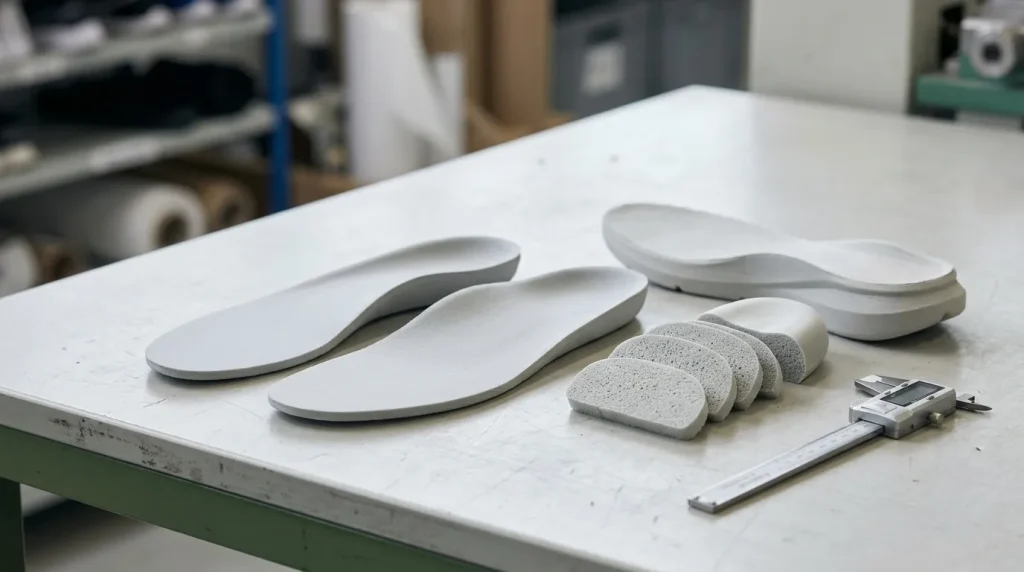
Yes, a running shoe supercritical foam insole is worth it when the brief calls for lightweight resilience, impact absorption, and a more responsive underfoot feel than many standard EVA constructions can provide. It should not be the default for every running shoe, because cost target, stack height, midsole design, outsole geometry, and production requirements still decide the material choice.
Running Shoe Supercritical Foam Insole
A running shoe supercritical foam insole is worth specifying for performance running, run-train, and premium comfort programs where resilience and weight reduction matter enough to justify a higher material cost. For basic casual running shoes, molded EVA or PU often gives a better cost-to-benefit ratio.
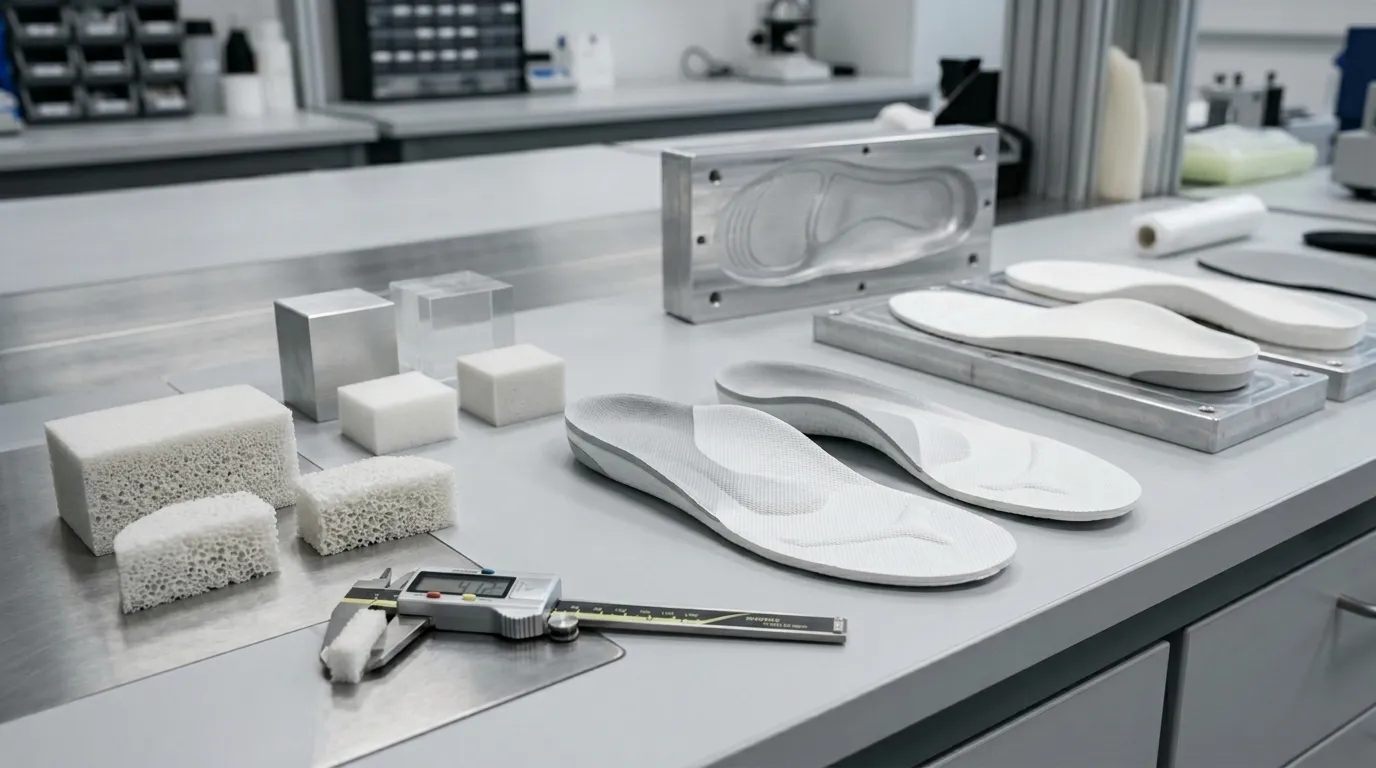
Supercritical fluid foaming (SCF) is a physical foaming process used to create lightweight foam without traditional chemical blowing agents. For brand teams, the practical question is less about the exact process gas and more about whether the finished foam meets the required resilience, density, compression set, aging, and hand-feel targets. In footwear, SCF foam typically has a microcellular structure with predominantly closed cells, which can support a more responsive feel under repeated loading.
The tradeoff is real. While SCF foam can improve lightweight cushioning and resilience, it requires early alignment around material grade, hardness, density, thickness, top cover construction, bonding method, logo process, and required test results. In some briefs, a full SCF sockliner is worth the added material cost. In others, EVA, PU, or a zoned construction gives a better cost-performance balance.
At FX Footwear, we support material selection based on product requirements rather than promoting one material for every project. In many cases, a well-designed EVA or PU construction remains the better engineering choice.
For running programs, FX Footwear aligns insole design with the midsole system through supercritical foam cushioning instead of treating the sockliner as a separate comfort pad. The insole should complement the cushioning characteristics of the midsole rather than being developed as an isolated comfort layer.
Material Tradeoffs For Running
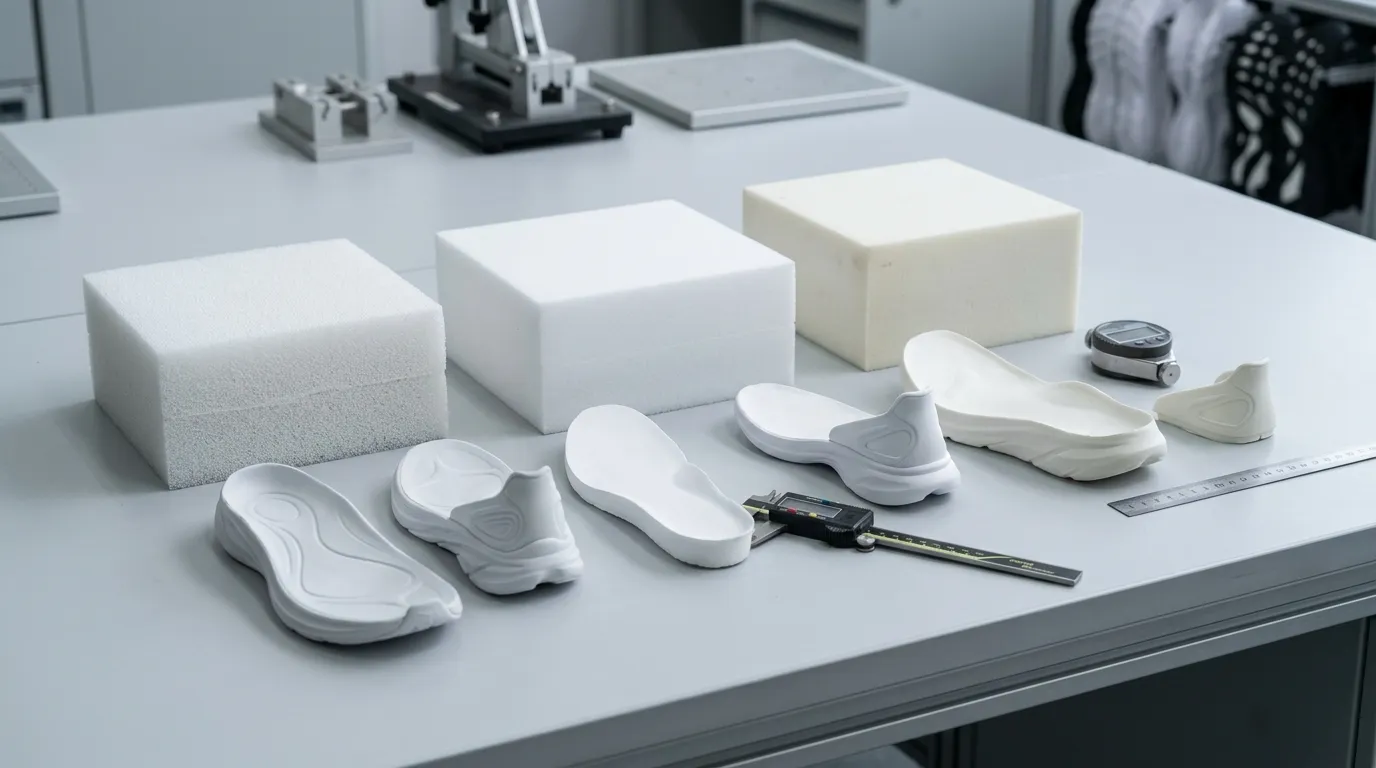
Compare SCF foam with EVA and PU by the required test results, and the choice gets clearer.
| Material | Best fit | Main advantage | Watch-out |
|---|---|---|---|
| Supercritical foam / SCF | Performance running; run-train; premium comfort | High resilience, lower weight | Higher cost, tighter control |
| EVA | Daily running; value performance; casual athletic | Cost-efficient, predictable molding | Lower resilience than SCF grades |
| PU | Long-wear comfort; orthotic support; work-athletic hybrids | Compression resistance, shape retention | Check high-rebound PU by resilience data |
In general, SCF foams have the highest rebound potential, followed by performance-grade EVA, while conventional PU is usually selected for long-term cushioning stability rather than maximum energy return. That ranking is not absolute: newer high-rebound PU systems can reach resilience levels around 50%, and some conventional EVA grades sit much lower. Compare named grades by resilience, compression set, density, hardness, and aging data rather than relying on category labels. Within SCF applications, commercial footwear grades generally follow this rebound-potential direction: PEBA, then TPEE, then TPU-based SCF systems, then EVA-based SCF systems. PEBA is the top-tier racing-shoe direction, not an entry material. EVA-based SCF is more mature and cost-effective.
That matters because an insole does not work alone. A thin SCF sockliner sitting on a very soft midsole may feel good in hand but vague underfoot. A firmer SCF insole over a responsive midsole can sharpen step-in feel without adding much weight. Runners notice that immediately, and sourcing teams still need the material choice to fit the cost target.
FX’s June 2026 product catalogue shows the range. PulseSport Lite examples list density fields at 0.05D and 0.09D, while PulseSport Pro examples list 0.07D, 0.09D, and 0.12D. Those numbers should stay tied to the named product grade. Don’t turn one sample spec into a blanket SCF claim.
SCF Specs To Test
A good running insole spec starts with testable targets, not adjectives.
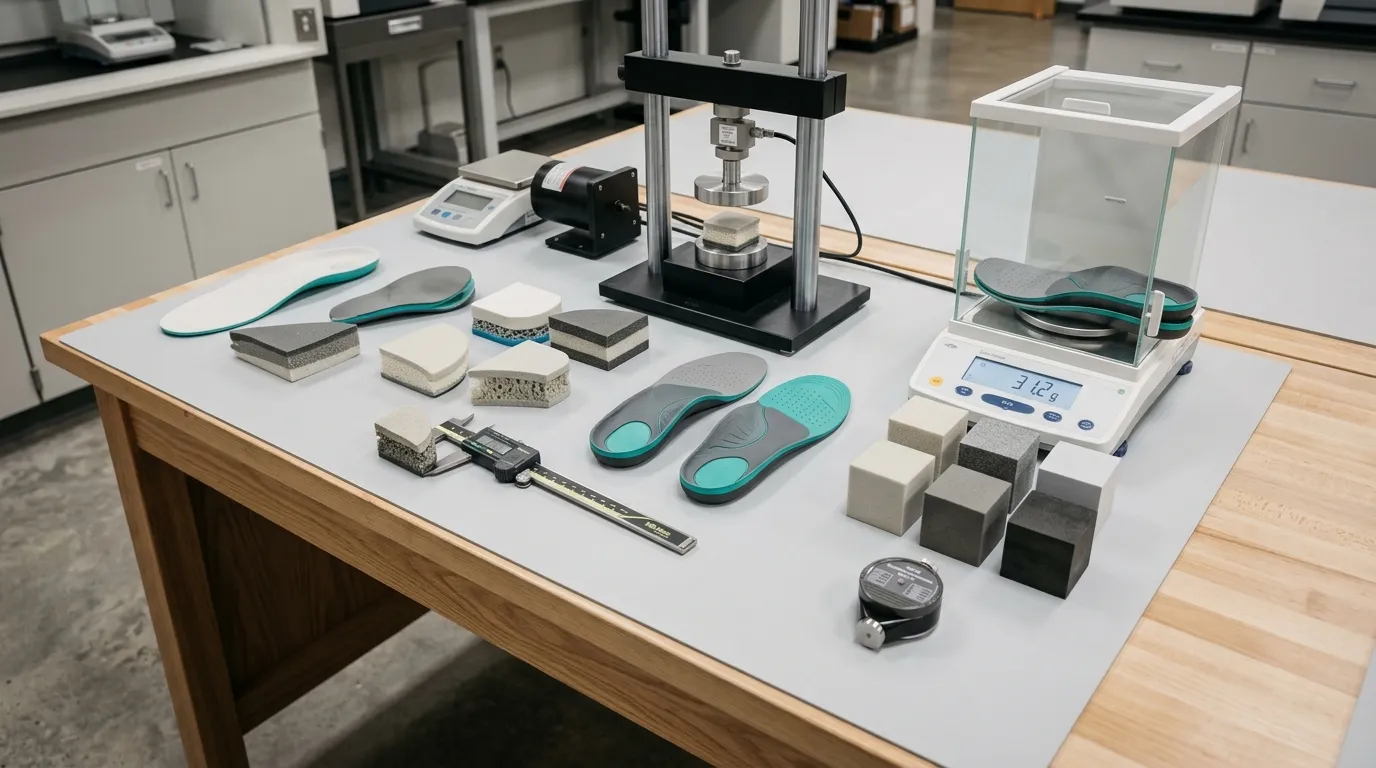
Ask for hardness, density, resilience, compression set, weight per pair, thickness tolerance, top cover bonding strength, and aging behavior. For EVA insole work, hardness should be discussed in Asker C, commonly around 20-45 Asker C with a +/-3 tolerance depending on the construction. For foam comparison work, ASTM International’s D3574 test methods are a common reference point for flexible cellular material testing, including properties such as resilience and compression set.
For SCF running insoles, pay special attention to these four points:
- Resilience target: selected supplier specs can reach 80%+, while FX PulseSport catalogue examples vary by grade, including 50%, 65%, 70%, and 75% resilience fields.
- Compression set: lower is better for long-term shape retention, but the acceptable number depends on thickness, runner weight, and shoe use.
- Edge quality: pinholes, exposed edges, wrinkles, and surface haze are usually related to process questions, while color consistency may also be influenced by material formulation and batch variation.
- Bonding: top cover material changes feel, moisture behavior, and defect risk. Mesh, tricot, Lycra, cooling mesh, recycled mesh, and terry don’t behave the same during lamination.
This is where early supplier input saves weeks. A brand development team may ask for a premium rebound feel, a recycled top cover, a complex heel logo, and a low target price in the same brief. One of those variables may need to move. Better to find that out before the mold is cut.
When EVA Or PU Wins
Use EVA when the running shoe needs reliable cushioning, simple conversion, broad cost control, and predictable mass production. Compression-molded and die-cut EVA insoles all have a place in running and athletic footwear. Multi-density EVA can also give zoned comfort without moving into SCF pricing.
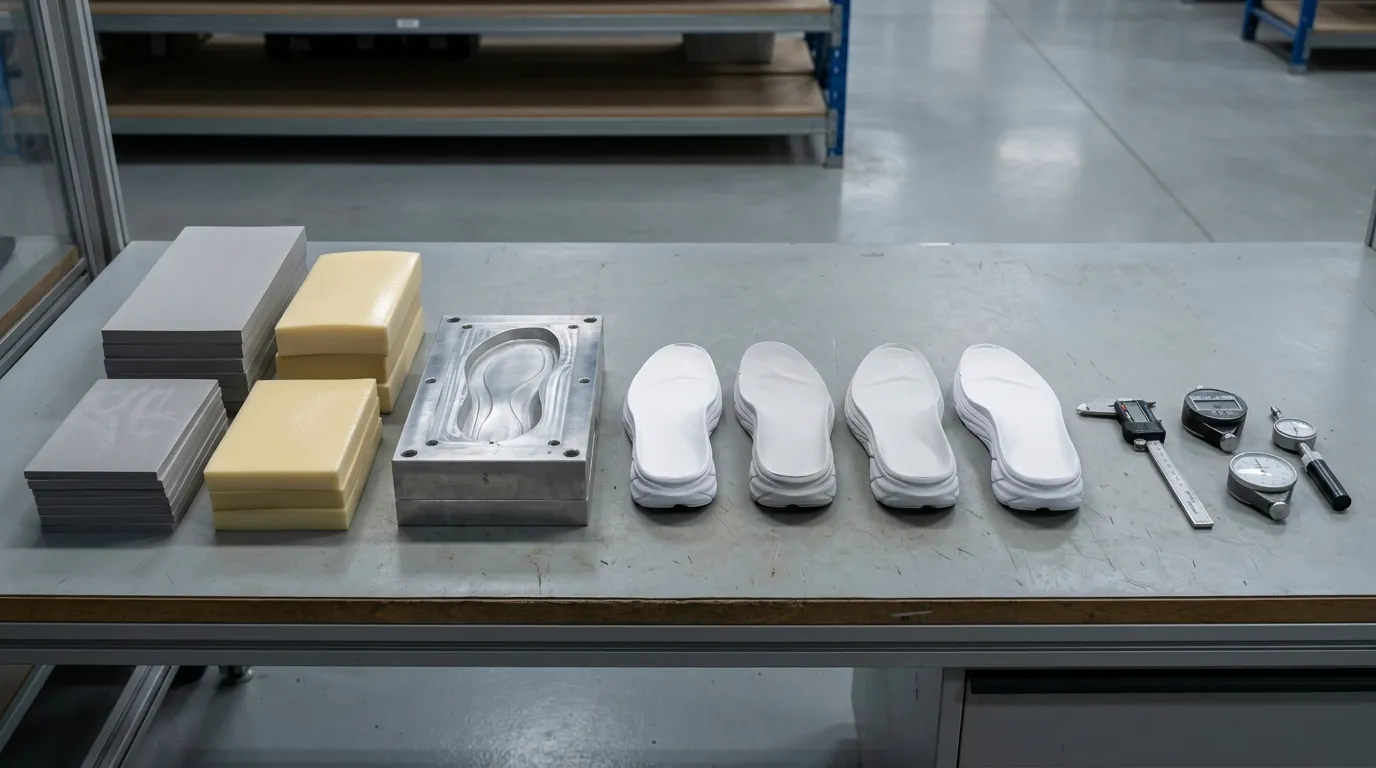
Use PU when the brief values compression resistance, soft comfort, and long-term shape retention over snap. Open-cell PU improves breathability, and PU works well in comfort running, walking-running hybrids, workwear, and therapeutic or orthotic footwear applications. Do not describe conventional PU as the maximum-rebound option. If a high-rebound PU grade is being considered, compare its resilience, compression set, and aging data against the EVA or SCF alternatives.
A common mistake is choosing SCF only because the shoe has 'running' in the category name. Not every running shoe requires an SCF insole. Material selection should be based on cushioning objectives, target positioning, cost requirements, and how the insole works together with the midsole system.
Supplier Questions Before Sampling
Sampling is where SCF value either becomes visible or disappears into rework.
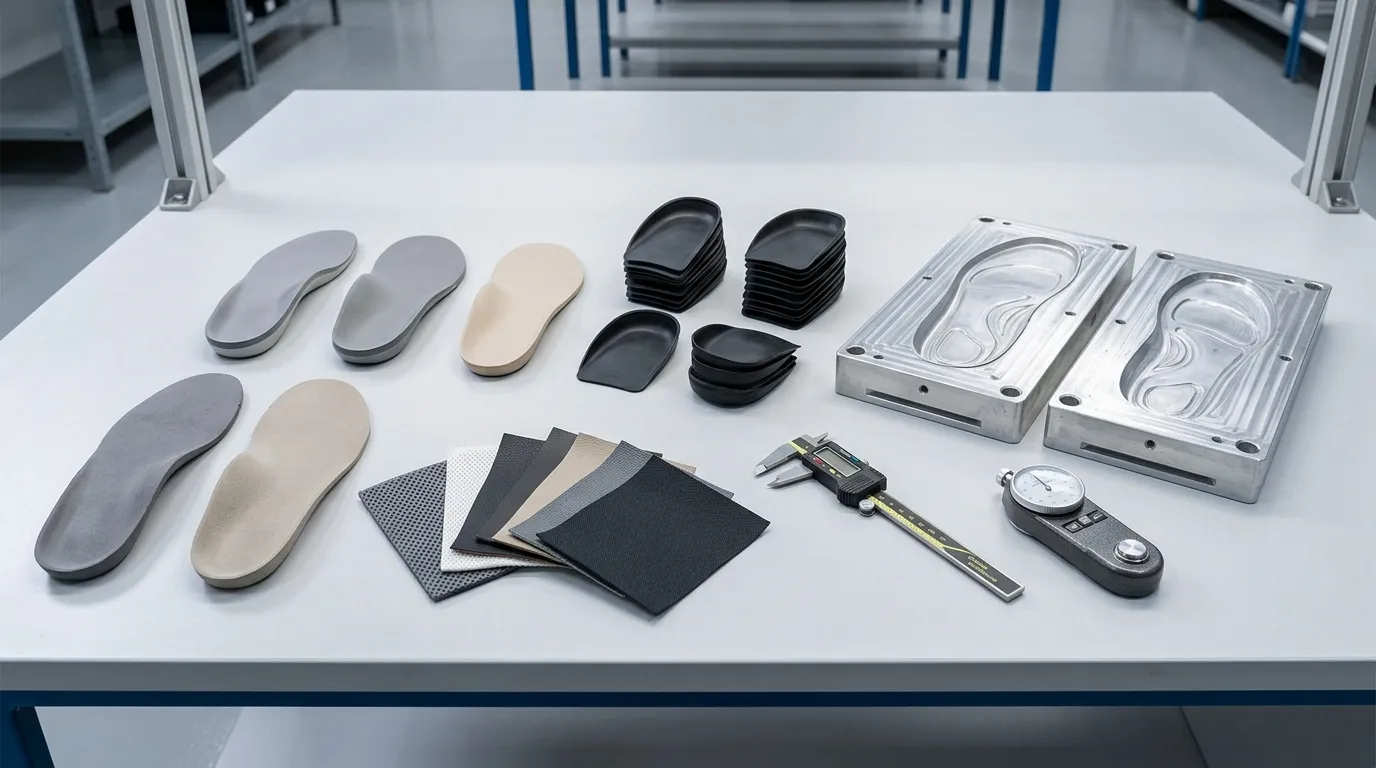
Before you ask for a running shoe supercritical foam insole sample, send the supplier the shoe type, target positioning, insole thickness, last shape, top cover, logo method, runner-use scenario, density or weight target, and any must-pass test method. If you have an approved EVA or PU reference, include it. A vague 'make it more premium' brief usually creates two extra sample rounds.
Ask these questions before tooling:
- Which SCF material platform best fits the required cushioning performance and cost target?
- What hardness, density, resilience, compression set, and aging performance can be consistently achieved in mass production?
- Which design features may require adjustments during sampling?
- If production may shift between China, Vietnam, or Indonesia, what tooling transfer and scheduling steps should be planned?
- Which top cover materials and logo processes are recommended for this construction?
FX’s normal sampling reference is practical: die-cut or knife-cut samples without new tooling can take about 3 days, while new mold/tooling work is closer to 10 business days. Custom insole sampling is often 7-14 days, with bulk production after sample approval around 30-40 days. SCF insole production commonly sits around 30-45 days.
And yes, regional production matters. FX Footwear's China, Northern Vietnam, Southern Vietnam, and Indonesia footprint can help brands align component production closer to footwear assembly hubs. With standardized molding equipment and aligned production standards across manufacturing sites, most insole programs can be produced across different FX factories once tooling and material specifications are confirmed. If production moves from one facility to another, the main practical point is tooling transfer and scheduling; molds can be transferred by planned shipment or, when necessary, hand-carried by staff.
FAQ
Is SCF foam good for runners?
Yes, SCF foam is good for runners when the shoe brief needs lightweight rebound, impact absorption, and a more responsive step-in feel. It works best in performance running and run-train models, not every casual athletic shoe.
Is SCF better than EVA?
SCF foam usually has higher rebound and lower weight potential than standard EVA. EVA still wins when the program needs lower cost, simpler production, and broad durability at scale.
Does PU have higher rebound?
Usually not for conventional PU. Conventional PU is generally selected for compression resistance, long-term comfort, and shape retention rather than maximum energy return. However, newer high-rebound PU systems can achieve resilience levels around 50%, making them an option when the brief needs a balance of comfort and responsiveness.
Which SCF resin should I choose?
Choose SCF EVA for cost-effective performance, TPU-based SCF systems for durability and resilience balance, TPEE for higher heat and chemical resistance, and PEBA for elite-level rebound potential. PEBA is premium and usually needs cost-performance balancing.
How long do samples take?
Die-cut samples without new tooling can take about 3 days. New mold or tooling work is closer to 10 business days, and custom insole sampling usually takes 7-14 days depending on materials and revisions.
FX Footwear can help your team compare EVA, PU, and SCF options against a real running shoe brief: target cost, resilience, density, compression set, hand feel, top cover, logo method, and regional production plan. As a shoe insole manufacturer with in-house lab support and component production across insoles, midsoles, uppers, heel counters, eyelets, and molded parts, FX is built for material decisions that have to survive sampling and mass production.