
Why is maintaining mass-production consistency so much harder than making a single perfect EVA midsole sample? For footwear brands, approving a high-performance midsole prototype is only the first step. The true manufacturing test comes when you need to reproduce the same density, weight, cushioning feel, energy return, dimensions, and color across tens of thousands of pairs—and ensure that same flawless quality on every reorder.
Achieving this level of reliability requires a High-Rebound EVA Midsole Factory to operate like a finely tuned system. From locking down chemical formulations and inspecting incoming raw compounds to monitoring foaming temperatures, tracking molding parameters, and catching defective batches before they ship, quality control must be tightly managed at every stage. In this article, we outline what these critical quality controls look like in practice and what factory evidence your development team should request before greenlighting mass production.

Why Is Batch Consistency Difficult in High Rebound EVA Midsoles?
EVA performance is determined by more than the polymer name. Resin grade, vinyl acetate content, fillers, crosslinking agents, blowing agents, pigments, mixing history, expansion ratio, temperature, pressure, and cooling all influence the finished foam.
Small changes can produce a midsole that looks correct but feels different underfoot. Excessive expansion may lower density and weight while weakening dimensional stability. A temperature or cycle-time shift can change cell structure, hardness, or surface finish. Pigment additions can also affect processing behavior if the formula is not validated.
High rebound makes process variation more visible. A brand may specify a lively, responsive ride, but rebound cannot be controlled independently from density, hardness, compression set, and geometry. The factory therefore needs a defined process window rather than a single target number.
For a broader comparison of the material families available to development teams, see FX Footwear’s guide to EVA, PU, and TPU midsoles.
How Does the Factory Lock the EVA Material Formula?
Consistency starts with a controlled bill of materials. The approved compound should identify the resin grade, supplier, formulation revision, pigment system, additive package, and permitted substitution rules. Production should not switch to a nominally similar EVA grade without technical review because a change in melt behavior or VA content can alter expansion and rebound.
Incoming material control commonly includes:
- Supplier certificate and lot identification
- Visual inspection for contamination or color variation
- Verification of resin or compound grade
- Sampling for density, hardness, or flow-related checks where applicable
- Quarantine until the lot passes inspection
- Traceable storage with first-in, first-out handling and defined temperature or moisture conditions
For custom compounds, a retained reference sample from the approved development batch gives the laboratory a physical benchmark. If a future lot behaves differently, the factory can compare raw material and finished foam results instead of relying on memory or subjective hand feel.
Which Foaming Parameters Affect Rebound and Density?
The foam cell structure is created during expansion. Whether the program uses conventional chemical foaming, compression-molded EVA, Phylon re-pressing, or a supercritical process, the factory must control the parameters that govern nucleation and cell growth.
Critical variables can include mixing time, compound temperature, charge weight, mold temperature, pressure, heating time, expansion ratio, release timing, and post-foaming stabilization. A high rebound EVA formulation needs uniform, well-distributed cells that recover efficiently after compression. Irregular cells or local density gradients can create inconsistent cushioning within one midsole as well as between batches.
Production teams should record actual values, not merely the machine recipe. Calibrated sensors and scheduled equipment maintenance matter because a displayed setpoint does not guarantee that the material experienced the correct temperature or pressure.
Brands considering advanced physical foaming can also review supercritical foam versus traditional EVA to understand how process choice changes cell structure and performance.
How Are Molding and Cooling Kept Within Tolerance?
After foaming, molding determines final geometry, surface texture, and local compression. The factory should control material charge or preform weight, mold cleanliness, press temperature, pressure, cycle time, and part orientation. For re-pressed Phylon, the relationship between the expanded blank and the final mold is especially important because variation in the blank can transfer into finished density or dimensions.
Cooling and conditioning are also production steps, not idle time. Removing a part too early or stacking it while it is still warm can cause distortion. A defined cooling fixture, rest period, and inspection timing help ensure that dimensions are measured after the component has stabilized.
Molds should have preventive-maintenance records. Vent blockage, surface wear, uneven heating, or cavity damage may gradually shift the result even though the formula has not changed. First-piece approval after a mold change, maintenance event, or long shutdown reduces this risk.
What Tests Confirm EVA Midsole Batch Consistency?
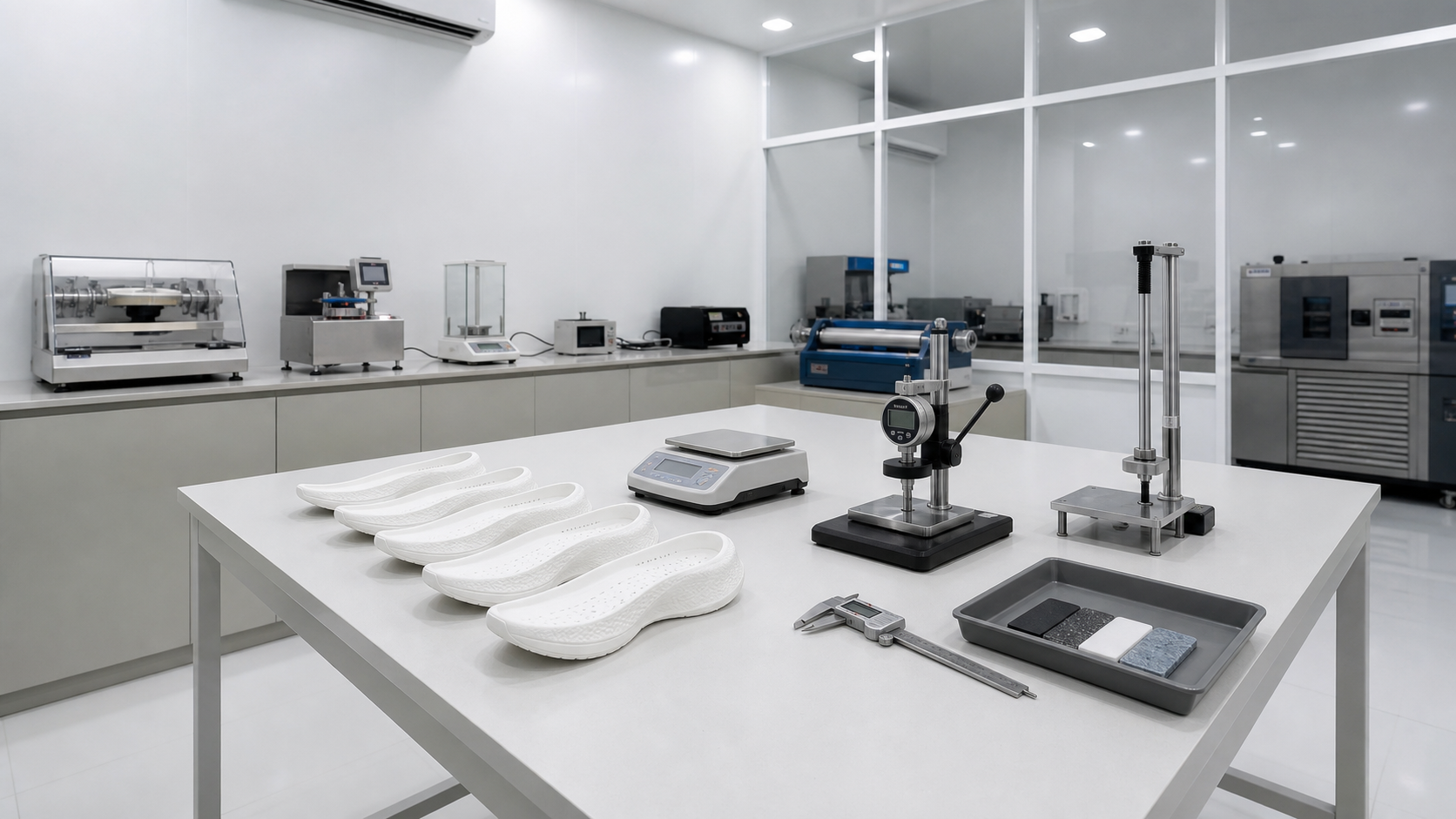
A factory should convert the brand’s product brief into measurable acceptance criteria. The test plan must define the method, specimen conditioning, sample size, frequency, target, tolerance, and reaction when a result fails.
Core batch checks typically include:
| Control item | What it helps verify |
|---|---|
| Finished weight | Material charge and overall density consistency |
| Density or specific gravity | Foam expansion and material uniformity |
| Asker C or specified hardness | Cushioning feel and structural support |
| Rebound or resilience | Energy-return consistency |
| Compression set | Recovery after sustained deformation |
| Dimensions and thickness | Fit with the upper, outsole, and last |
| Shrinkage after conditioning | Dimensional stability |
| Color difference | Repeatability against the approved standard |
| Flex or fatigue testing | Resistance to repeated use |
| Bonding tests when assembled | Adhesion to films, plates, or outsole components |
Test methods should be agreed before production because two laboratories can obtain different results if conditioning time, specimen thickness, temperature, or equipment differs. The approved sample and its test report should become the production reference.
FX Footwear outlines its available validation approach on its lab testing page.
How Do SPC and Control Limits Detect Process Drift?
Pass-or-fail inspection can catch defective parts, but statistical process control can reveal drift before production crosses the specification limit. The factory can chart variables such as weight, density, hardness, rebound, and critical dimensions by cavity, machine, shift, and material lot.
The goal is not to create paperwork. It is to distinguish common process variation from a meaningful change. A slow upward trend in hardness, for example, may indicate temperature drift, material aging, or a change in expansion. Cavity-level data can reveal a localized mold or heating problem that would disappear inside an overall batch average.
The control plan should specify who reviews the chart, what triggers a line stop, and how much product must be contained when a trend breaches the action limit.
How Does Traceability Protect a Footwear Brand?
Every production lot should connect finished midsoles to the raw material lot, formula revision, mixing batch, machine, mold and cavity, shift, date, process record, inspection results, and packing unit. Clear lot separation prevents acceptable and suspect components from being mixed during trimming, sorting, or packaging.
Traceability makes corrective action faster. If a wear-test complaint appears, the factory can identify the affected production window, review its records, compare retained samples, and determine whether the issue is isolated or systemic. Without traceability, a brand may have to hold a much larger shipment because the true scope is unknown.
For programs supplied near final shoe assembly, FX Footwear’s multi-country manufacturing and component services can also help brands consider regional production, logistics, and quality coordination together.
What Should Brands Approve Before Mass Production?
Before bulk release, the brand and factory should sign off one shared quality package:
- Approved material formula and revision
- Golden sample or approved reference parts
- Dimensioned drawing with tolerances
- Test methods and specimen-conditioning rules
- Performance targets for density, hardness, rebound, and compression set
- Color and appearance standard
- Sampling frequency and acceptance criteria
- Process-control plan and change-notification rules
- Lot-code format and record-retention period
- Escalation and corrective-action process
A strong EVA midsole manufacturer should be able to explain how each requirement moves from the development specification to the production record. Brands should also run pilot production under realistic conditions rather than treating hand-built development samples as proof of mass-production capability.
Frequently Asked Questions About High Rebound EVA Quality Control
How often should EVA midsole rebound be tested?
The frequency should reflect risk, volume, process stability, and customer requirements. At minimum, the plan should define checks at first-piece approval and by production lot. Higher-risk programs may also require scheduled in-process sampling by shift, machine, cavity, or material batch. The important point is to set the frequency before production and link failures to a clear containment rule.
Can two EVA midsoles have the same hardness but different rebound?
Yes. Hardness measures resistance to indentation, while rebound describes elastic recovery or energy return. Differences in density, cell structure, formulation, and processing can produce similar hardness readings but different ride characteristics. Both properties should be specified when rebound is a key brand claim.
What is a golden sample in EVA midsole production?
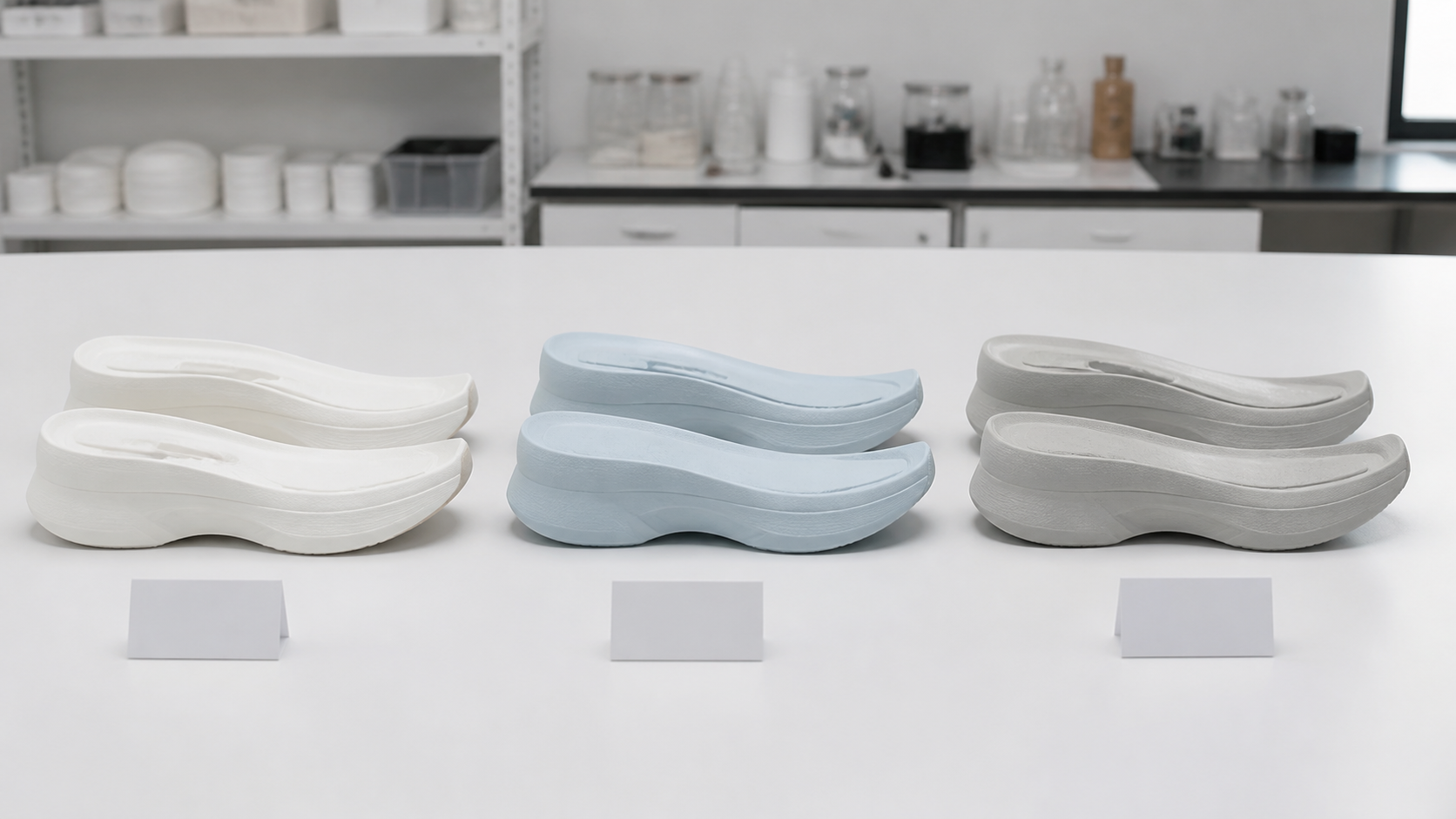
A golden sample is the approved physical reference representing acceptable construction, dimensions, color, finish, and feel. It should be linked to measured test results and stored under controlled conditions. It supports comparison but does not replace numerical specifications.
Why should test specimens be conditioned before measurement?
Foam properties can change with temperature, humidity, and time after molding. Standard conditioning reduces measurement noise and makes results comparable across days, batches, and laboratories. The agreed test method should define conditioning conditions and timing.
Should a footwear brand audit the factory’s measurement system?
For performance-critical or high-volume programs, yes. Calibration records alone do not prove that different inspectors and instruments produce repeatable results. A measurement-system review can confirm suitable equipment, documented methods, operator training, reference standards, and reproducibility.