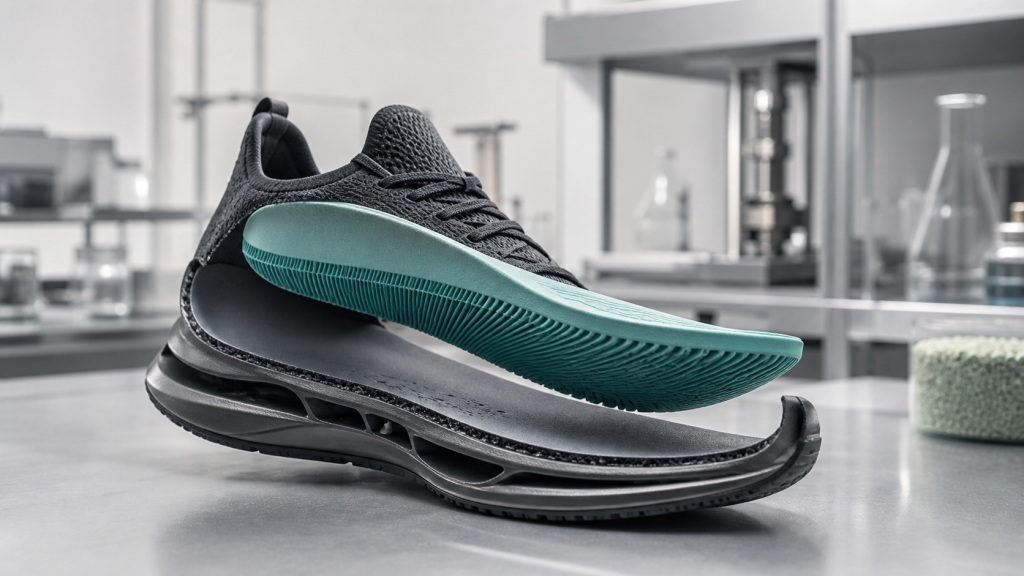
Can an insole feel protective at landing without becoming slow or overly soft at push-off? This is the design challenge behind many performance and all-day footwear programs. Cushioning needs controlled deformation to reduce peak impact, while energy return needs fast elastic recovery. If the material only absorbs energy, the ride can feel flat. If it returns energy without enough control, the foot may feel unstable.
TPEE insoles offer footwear developers another way to manage this balance. TPEE—thermoplastic polyester elastomer, also called TPC-ET—combines elastic soft segments with stronger polyester segments. The resulting material can flex, recover, and withstand repeated loading. However, the resin name alone does not guarantee a performance result. Grade, foaming method, density, geometry, thickness, and the complete shoe construction must be engineered and tested together.
What Are TPEE Insoles?
TPEE insoles are footbed components made fully or partly from a thermoplastic polyester elastomer. A design may use solid TPEE, foamed TPEE, an engineered lattice, or a TPEE layer combined with a cover, support shell, or another cushioning material. These constructions should not be treated as interchangeable.
TPEE behaves like rubber under load but can be processed as a thermoplastic. Its hard segments help provide strength and dimensional control, while its soft segments enable elastic deformation and recovery. Material suppliers offer multiple grades with different hardness, flow, resilience, heat resistance, and chemical resistance. That range gives designers room to tune an insole, but it also makes grade selection and sample validation essential.
TPEE is not the same as TPU, EVA, PEBA, or ordinary PU foam. Each material family has a different molecular structure and processing window. A useful comparison therefore starts with the finished component at matched thickness, geometry, hardness, and test conditions—not a general claim that one resin always performs better.
For a broader view of how materials and constructions are combined, see FX Footwear’s custom insole manufacturing services.
How TPEE Insoles Return Energy
Elastic recovery reduces wasted motion
During heel strike and loading, an insole deforms and stores part of the applied mechanical energy. Some energy is lost as heat through hysteresis; the rest is released as the material recovers. TPEE is known for elastic recovery and relatively low hysteresis in suitable grades, so a properly engineered component can rebound quickly after compression.
This recovery does not propel a wearer on its own. The insole is only one layer in the footwear system, and its contribution is smaller than that of a thick performance midsole. Still, a responsive TPEE element can make the transition from loading to toe-off feel less sluggish, especially when the geometry places it under the heel or forefoot where repeated compression occurs.
Flex-fatigue resistance supports repeatable response
Initial rebound is not enough. An insole also needs to maintain its response after many loading cycles. TPEE grades are widely selected for flex-fatigue resistance, toughness, and recovery, which can support a more consistent feel over time. The finished construction should nevertheless undergo cyclic compression and flex testing because thin sections, sharp transitions, bonding, and processing history can change fatigue behavior.
Structure controls where energy is stored
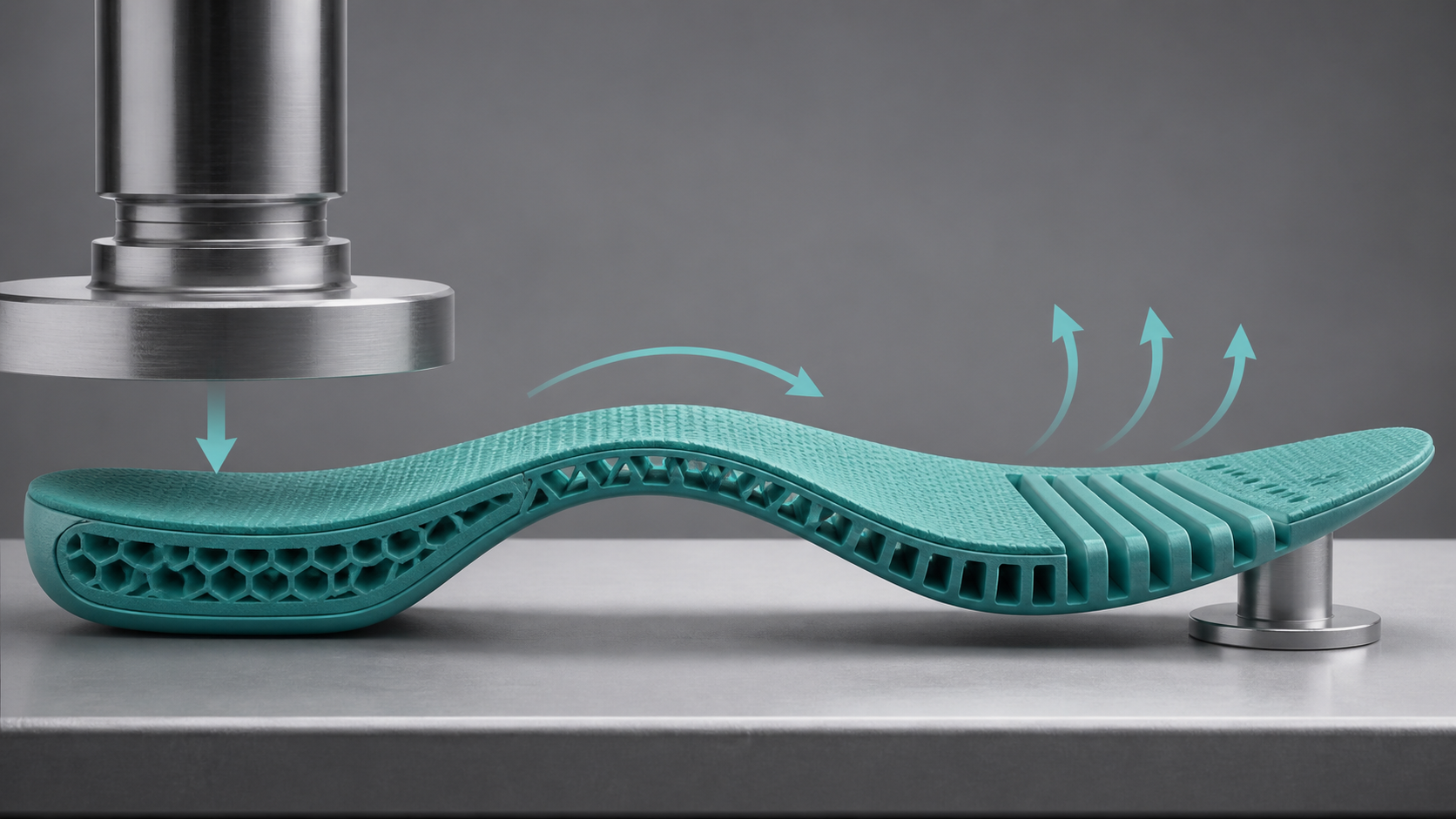
A solid sheet, a foamed layer, and a molded lattice can use the same polymer family yet feel very different. Rib height, cell structure, wall thickness, vent openings, and zonal density determine how far the component deflects and how rapidly it returns. Geometry is therefore a performance tool, not decoration.
How TPEE Insoles Improve Cushioning
Controlled deformation manages impact
Cushioning is the controlled reduction and distribution of load, not simply maximum softness. TPEE insoles can be engineered to compress within a target range and recover without bottoming out. A softer grade or more open structure may increase deformation, while thicker walls, higher hardness, or support ribs can limit movement.
This tunability lets developers create a softer heel zone, a more responsive forefoot zone, or a stable perimeter around the foot. The aim is to keep the foot supported while reducing localized pressure. Final performance depends on the relationship between the TPEE layer, sockliner cover, strobel board, midsole, and outsole.
Zonal designs balance softness and stability
Uniform softness can allow excessive movement. Molded TPEE structures can place compliant elements where cushioning is needed and firmer structures where stability matters. For example, a heel crash pad may use deeper flexible ribs, while the arch and edge use lower-deflection geometry.
This approach can complement FX Footwear’s performance insole development and the wider OEM footwear component process, where material selection, tooling, lamination, and finished-shoe requirements are considered together.
Layering can refine step-in comfort
TPEE does not need to be the surface touching the sock. A textile, open-cell foam, or comfort layer can add softness and moisture management above a responsive TPEE structure. The lower layer provides recovery and shape control; the upper layer refines step-in feel. This hybrid approach may be more practical than asking one material to provide every function.
TPEE Insoles vs Other Insole Materials
No single material is best for every shoe. The table below frames development questions rather than universal rankings.
| Material route | Potential strength in an insole | Development consideration |
|---|---|---|
| TPEE structure or foam | Elastic recovery, flex durability, geometry control | Grade and processing can strongly affect feel, weight, and bonding |
| EVA foam | Lightweight cushioning, broad hardness range, mature processing | Compression behavior and rebound vary widely by formulation and foaming method |
| PU foam | Soft step-in comfort and pressure distribution | Open-cell grades may need moisture and compression-set evaluation |
| TPU element | Toughness, abrasion resistance, molded detail | Solid constructions may add weight; foamed and lattice forms behave differently |
| PEBA-based foam | Low weight and high resilience in performance applications | Premium resin cost and specialized processing may limit program fit |
The correct comparison uses production-representative samples. Match thickness, mass, hardness, cover fabric, bonding method, and test temperature. If one sample is thicker or uses a more open geometry, a simple rebound number can hide the actual material difference.
FX Footwear’s overview of material-driven midsoles also shows why cushioning choices must be evaluated within the complete underfoot stack.
How to Specify TPEE Insoles
Define the use case before selecting a grade
Start with the shoe category, wearer, expected duration, climate, target weight, available volume, and desired feel. A running insole may prioritize fast recovery and low mass. A work-shoe insole may prioritize stable cushioning and long-duration compression resistance. Casual footwear may need softer step-in comfort and cost control.
Set measurable performance targets
Replace descriptions such as “bouncy” or “comfortable” with an approved test plan. Depending on the construction, useful checks can include:
- Finished-component mass and thickness
- Hardness or stiffness at defined locations
- Compression force-deflection behavior
- Rebound or energy-return method
- Compression set after controlled time, load, and temperature
- Cyclic compression and flex fatigue
- Tear or structural failure around ribs and openings
- Peel strength for covers and bonded layers
- Dimensional stability after heat and humidity conditioning
- Wearer trials in the intended shoe construction
The supplier and brand should agree on specimen conditioning, equipment, method, and pass/fail tolerance before comparing results. A material value from a resin data sheet is not a finished-insole guarantee.
Validate manufacturing and assembly
TPEE processing requires control of material drying, melt temperature, mold temperature, cycle conditions, and part cooling. Poor control can affect dimensions, surface appearance, internal structure, and mechanical response. If the insole uses lamination or adhesive, bond compatibility must also be checked after humidity, heat, and flex exposure.
Before bulk production, confirm the approved golden sample, measurement points, color limits, material traceability, inspection frequency, and change-control procedure. Brands can discuss these requirements through FX Footwear’s contact and development team.
TPEE Insoles FAQs
Are TPEE insoles always more responsive than EVA insoles?
No. TPEE can provide strong elastic recovery, but finished response depends on grade, foam or lattice structure, density, thickness, hardness, and the rest of the shoe. A well-engineered EVA construction may outperform a poorly matched TPEE design. Compare finished samples under the same method.
Are TPEE insoles soft enough for everyday shoes?
They can be, but softness is grade- and structure-dependent. A TPEE support layer may also be paired with a softer textile or foam top layer to improve step-in comfort while retaining recovery and shape control.
Do TPEE insoles replace the midsole?
Usually not. An insole can influence underfoot feel, localized cushioning, and recovery, but the midsole remains the primary cushioning structure in most athletic shoes. The two components should be tuned as one system.
Can TPEE insoles be recycled?
TPEE is thermoplastic and clean production scrap may be reprocessable in suitable streams. A finished multi-material insole can be harder to recycle because fabrics, adhesives, foams, and support parts must be separated. Recyclability claims should reflect the actual construction and collection system.
What should brands request from a TPEE insole supplier?
Request the resin grade or material specification, component drawing, target tolerances, test methods, production-representative samples, bonding validation, quality-control plan, and documented change control. Ask for project-specific evidence rather than relying on a generic material claim.