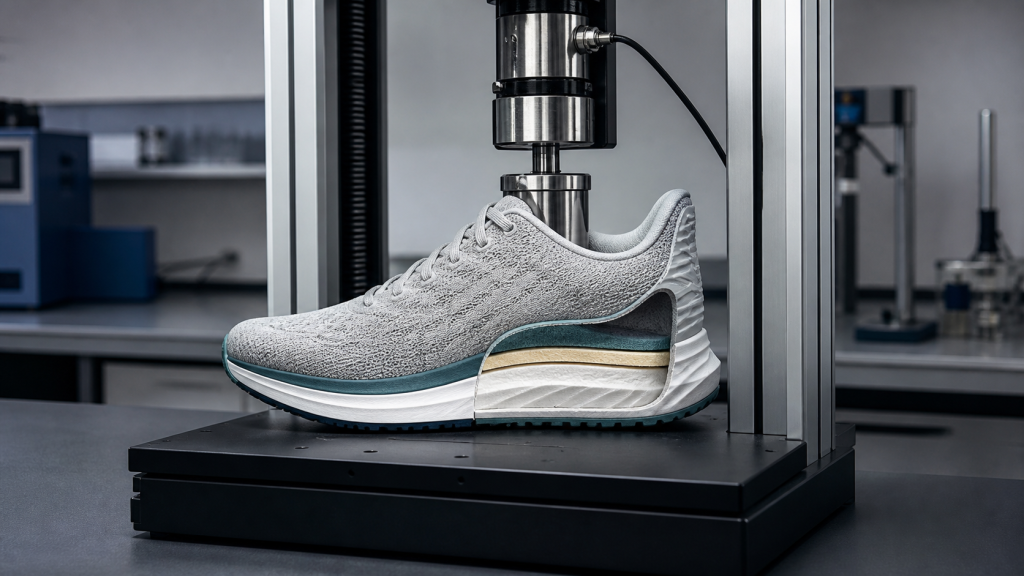
How much impact should a shoe absorb before it feels protective but not unstable? There is no single percentage, force value, or softness rating that is correct for every shoe. A recovery running shoe, a court shoe, a work boot, and an everyday sneaker face different impact patterns and performance priorities.
For footwear brands, shoe shock absorption is therefore a target-setting problem, not a search for one universal number. The useful question is whether a finished construction reduces impact appropriately for its intended user while preserving stability, fit, durability, and the desired ride. This guide explains how development teams can turn that question into a practical test plan.
What Shoe Shock Absorption Actually Means
Shoe shock absorption describes the ability of a footwear system to attenuate impact and reduce the load transmitted through the shoe during contact with the ground. The system deforms under load, dissipates part of the input energy, and may return part of it as the foot moves through the gait cycle.
That definition matters because three commonly discussed properties are related but not interchangeable.
Impact attenuation is not simply softness
A softer foam may compress easily under a finger, yet bottom out under a higher dynamic load. A firmer construction may attenuate impact effectively because its thickness, geometry, cell structure, and support zones control deformation. Hand feel is useful during sampling, but it cannot replace an impact test.
Shock absorption and energy return are different targets
Shock absorption concerns how the construction manages impact. Energy return concerns how much stored energy is released during recovery. A highly damped material can feel protective but less responsive; a resilient foam can feel lively but may transmit impact differently. Performance footwear often requires a deliberate balance rather than maximization of either property alone.
The whole shoe controls the measured response
The insole, strobel board, midsole, outsole, plate, heel geometry, stack height, and bonding layers interact. Even upper fit can affect how consistently the foot engages with the platform. Testing only a foam sheet helps screen materials, but it does not prove finished-shoe performance.
How Much Shoe Shock Absorption Is Enough?
There is no universal pass value for all footwear. “Enough” means the result meets a defined product brief under a named method and does so without creating unacceptable trade-offs. A meaningful requirement should identify the shoe category, target user, strike zone, test setup, conditioning, and comparison baseline.
Start with the footwear category
Running shoes repeatedly experience dynamic impacts and may prioritize heel or forefoot attenuation depending on the intended gait and geometry. Work shoes may need long-duration protection while retaining stability on hard floors. Court and training shoes must combine cushioning with lateral control. Casual shoes often balance comfort, low weight, cost, and limited internal volume.
The same test result can therefore be suitable for one program and inappropriate for another. A maximum-cushion model might allow more displacement, while a low-profile court shoe may require a firmer, more controlled response.
Define the wearer and use conditions
Body mass, pace, task, surface, exposure time, temperature, and footwear size can change the load placed on a shoe. Instead of claiming that one result protects every wearer, development teams should define a realistic use envelope. A specification can then include representative loads and conditions for the target market.
Use a benchmark rather than an isolated number
When a brand has a successful reference shoe, it provides a practical starting point. Test the candidate and reference under the same method, equipment settings, size, conditioning, and impact location. The goal may be to match the benchmark, reduce peak impact, adjust deformation, or maintain the response longer after repeated loading.
Without this context, a reported value is difficult to interpret. Test reports should therefore identify the method and units rather than presenting an unlabeled “shock absorption percentage.”
How Shoe Shock Absorption Is Measured
A controlled impact test applies a known load or impact to a material, component, or finished shoe and records its mechanical response. FX Footwear’s laboratory testing overview lists shock absorption testing under SATRA TM142, alongside hardness, rebound resilience, compression set, abrasion, and flex tests. The appropriate method and acceptance criteria still need to be agreed for each project.
Record the complete test setup
Comparable testing requires more than a test name. The report should identify specimen type, shoe size, impact location, impact energy or mass and velocity, number of impacts, environmental conditioning, equipment configuration, and result units. If any of these change, the result may no longer support a direct comparison.
Evaluate force and deformation together
Depending on the method and equipment, teams may examine maximum transmitted force, peak deceleration, energy-related calculations, displacement, or a force-time response. No single output tells the whole story. Large deformation can reduce a peak but may create instability or bottoming out; limited deformation may feel controlled but transmit more impact.
Test heel and forefoot where relevant
Impact is not uniform across the shoe. Heel-strike and forefoot-loading conditions involve different geometry, material thickness, outsole contact, and movement. A program should test the zones that reflect its intended use rather than assuming a heel result represents the entire platform.
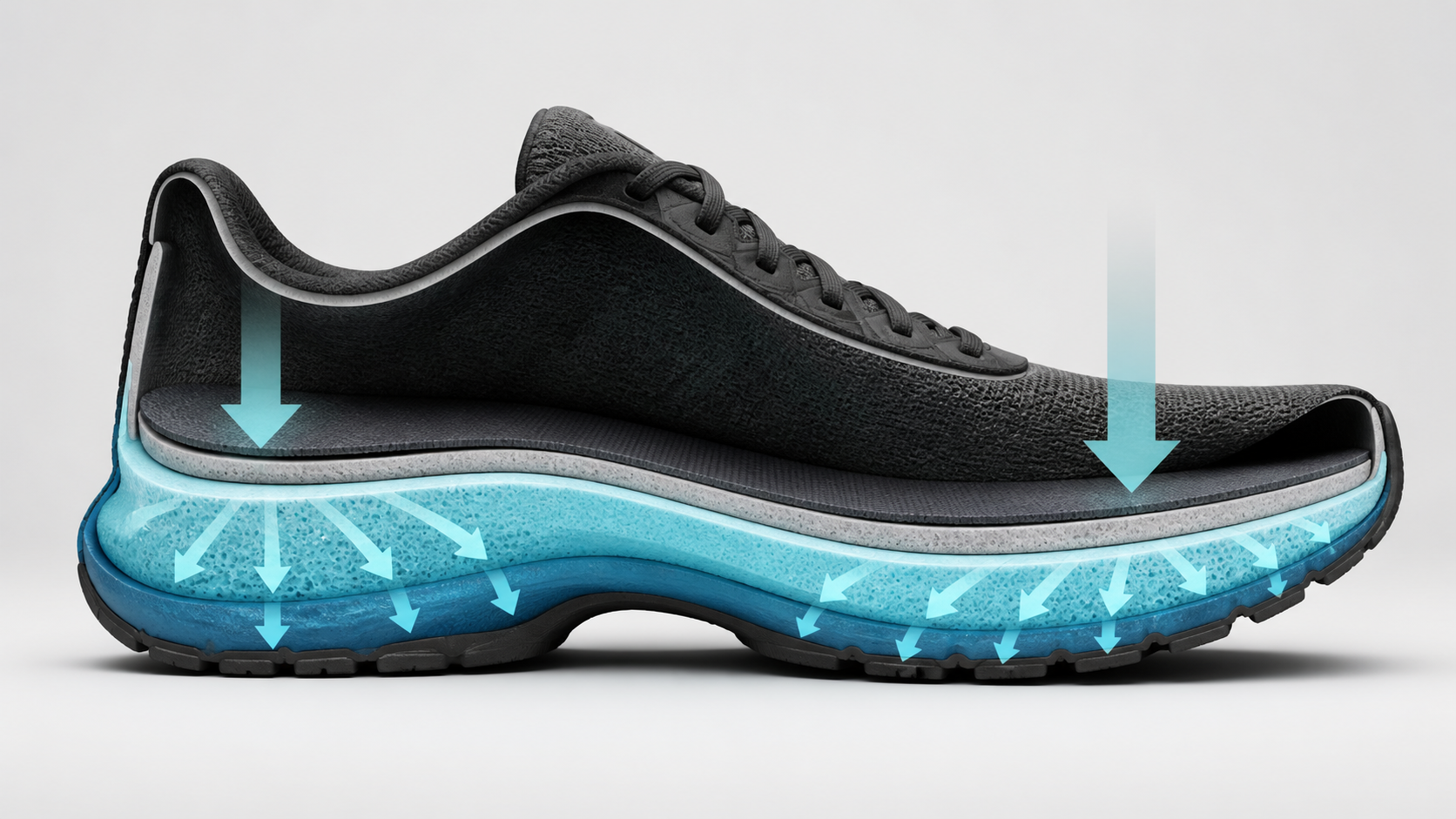
Which Shoe Layers Control Shock Absorption?
Shoe shock absorption is distributed across a layered system. Understanding each layer helps teams change the right variable when a prototype misses its target.
Insoles tune contact comfort and local loading
An insole can influence initial underfoot feel, pressure distribution, heel cushioning, and fit. Thickness, density, hardness, contour, perforation, and localized inserts all matter. FX Footwear’s insole platform overview shows how different material families can be selected around application needs. However, an insole should not be treated as a substitute for an underperforming midsole in a high-impact design.
Midsoles manage the main cushioning structure
The midsole usually supplies most of the available deformation volume and structural cushioning. Material family, foam density, hardness, cell morphology, wall geometry, stack height, and zonal design influence impact response. The midsole solutions page provides a useful starting point for discussing material-driven development without assuming that one foam is best for every shoe.
Outsoles and structural parts alter the result
Outsole rubber thickness and hardness can change the initial impact response. Plates, shanks, sidewalls, cavities, bonding films, and strobel materials can spread or concentrate load. This is why a material that performs well as a laboratory slab may behave differently after molding and assembly.
How Shoe Shock Absorption Changes with Wear
An acceptable new-shoe result is only the first checkpoint. Repeated compression, flexing, moisture, heat, and storage can change foam response and bonding over time. A robust development plan tests whether cushioning remains within the agreed range after relevant conditioning.
Pair impact testing with durability tests
Compression set helps indicate whether a foam recovers after being held under compression. Rebound resilience describes elastic recovery under a defined test, while flex and abrasion tests address other failure modes. These measurements do not replace shock absorption testing, but together they help explain why a construction changes during use.
Re-test after repeated loading and conditioning
Brands can compare impact response before and after a defined loading cycle, aging condition, or environmental exposure. The protocol must reflect the product brief; it should not be chosen merely to create an impressive result. Record thickness loss, visual damage, deformation, and changes in impact response so that material and structural causes can be separated.
Control production variation
Density, hardness, thickness, molding conditions, and bonding consistency can shift the finished response. Development approval should therefore lead to measurable material and component tolerances. Pilot and production samples can then be checked against the approved construction rather than against a vague description such as “soft cushioning.”
Setting a Shoe Shock Absorption Specification
A useful specification connects wearer needs to a repeatable verification process. The following workflow keeps the discussion focused on the finished shoe.
- Define the use case. State footwear type, intended user, surface, duration, and priority zones.
- Select a reference. Choose an approved shoe or an internally accepted performance range.
- Freeze the method. Document test standard, specimen condition, size, location, impact settings, repetitions, and units.
- Set balanced targets. Include shock absorption together with stability, mass, thickness, rebound, compression set, fit, and durability requirements.
- Screen materials and structures. Compare candidate foams, densities, hardness levels, geometries, and layer combinations.
- Validate the finished shoe. Confirm performance after molding, lamination, bonding, and full assembly.
- Verify durability and production. Re-test conditioned samples and check pilot-run variation before mass production.
Teams developing running products can use FX Footwear’s running footwear solution to frame the relationship between cushioning, stability, and application-specific component selection. For broader programs, its OEM footwear component services connect material selection with finished-component development.
Shoe Shock Absorption FAQs
Is more shock absorption always better for shoes?
No. Greater impact attenuation can be useful, but excessive softness or deformation may reduce stability, ground feel, or durability. The right balance depends on footwear category, wearer, structure, and test method.
Can foam hardness predict shoe shock absorption?
Not by itself. Hardness measures resistance to indentation under a defined test. Shock absorption also depends on thickness, density, cell structure, geometry, loading rate, outsole, and the complete shoe assembly.
Should an insole or midsole provide most of the cushioning?
In many athletic constructions, the midsole supplies the main cushioning volume while the insole tunes contact comfort and local pressure. The allocation differs by shoe design, so the completed system should be tested.
What should a shoe shock absorption test report include?
It should state the method, specimen, size, conditioning, impact location, equipment settings, repetitions, units, and measured outputs. Benchmark and post-conditioning results add useful context.
How can brands compare two shoe constructions fairly?
Test matched sizes and representative samples under the same setup. Compare both impact response and deformation, then review durability, stability, weight, fit, and production consistency before approval.