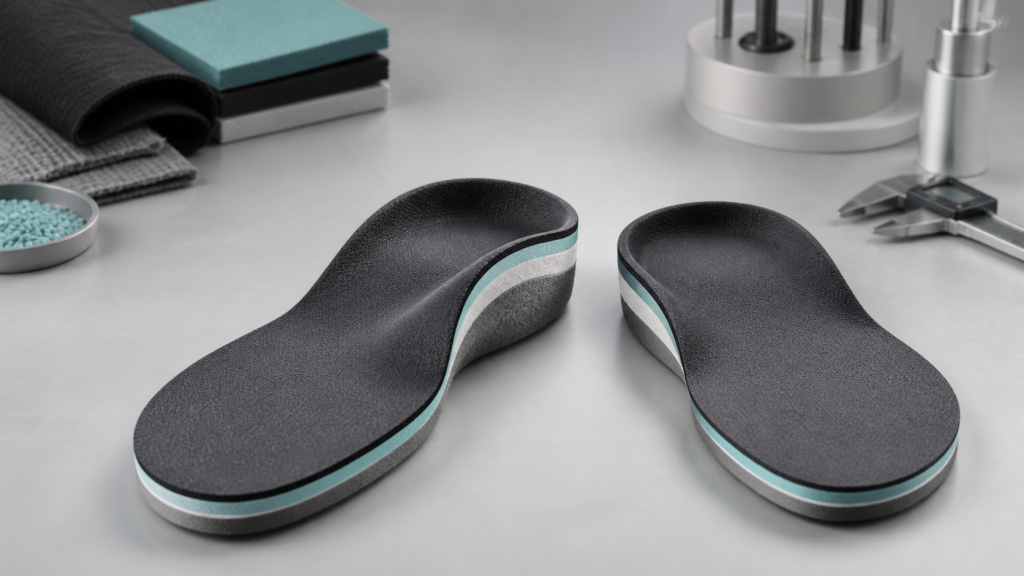
What actually changes when a shoe brand moves from a standard footbed to a High Arch Footbed? The answer is more than adding a taller bump under the midfoot. Arch position, heel geometry, cushioning zones, shoe volume, and validation all need to work together.
For product teams, the practical difference is fit intent. A standard footbed aims to serve a broad range of neutral foot shapes. A High Arch Footbed targets a narrower geometry and should be developed as a matched component for a specific last, upper, and use case. This guide explains five design differences that buyers should define before sampling.
High Arch Footbed vs Standard Footbed Comparison
A High Arch Footbed uses a more pronounced, carefully positioned contour to increase contact beneath a high-arched foot. A standard footbed usually has a lower, more gradual profile intended for general comfort. Neither design is automatically better: the correct option depends on foot shape, shoe volume, activity, and verified in-shoe performance.
| Design area | High Arch Footbed | Standard footbed | Buyer check |
|---|---|---|---|
| Arch geometry | Higher and more defined | Lower and more gradual | Match the target foot and last |
| Heel structure | Often deeper or more contoured | Usually moderate | Check rearfoot fit and edge pressure |
| Cushioning | May use targeted zones | Often uniform or broadly zoned | Test pressure and bottoming-out |
| Shoe volume | Needs more vertical allowance | Fits more general footwear | Confirm toe-box and instep space |
| Validation | Requires tighter geometry review | Broader fit tolerance | Test all sizes in the intended shoe |
The comparison should begin with a written specification rather than visual judgment alone. FX Footwear’s footwear component development services include new-mold development, material validation, sample approval, and tolerance documentation for shape-sensitive components.
1. High Arch Geometry and Contact
The first difference is the height, length, and location of the arch contour. A standard footbed normally uses a moderate curve to avoid feeling intrusive across a broad user group. A High Arch Footbed raises the contour and may extend the supported contact area, but the peak cannot be placed by height alone.
Brands should define where the arch apex sits relative to heel center, foot length, and the shoe last. A contour that peaks too far forward can feel like a hard ridge. One positioned too far back may fail to meet the intended midfoot area. Medial and lateral edge transitions also need smooth radii so the support does not end abruptly.
The design objective is appropriate contact, not maximum height. Research on cavus foot types has found different plantar-loading patterns compared with normal arches, while a 2024 running study found that personalized arch-support insoles redistributed pressure in a small group with subtle cavus feet. Those findings support pressure testing, but they do not define one universal contour for every wearer (PubMed: Ma et al., 2024).
2. High Arch Heel Cup Design
A high-arch footbed often pairs its raised midfoot contour with a deeper or more shaped heel cup. This creates a continuous geometry from heel to arch and can help the foot sit consistently over the intended support area. A standard footbed usually uses a shallower cup that is easier to fit across general footwear.
Deeper does not always mean more secure. The cup must match heel width, collar construction, and rearfoot space in the shoe. Walls that are too high can press against the heel or lift the foot toward the collar. A cup that is too wide may allow the foot to shift away from the designed arch position.
During development, review heel-seat width, cup depth, sidewall flare, and the transition into the medial arch. FX Footwear’s manufacturing capabilities include hot and cold shaping for complex geometries such as high arches and deep heel cups, as described in its footwear innovation capabilities.
3. High Arch Cushioning and Density
The third difference is how cushioning is distributed around the High Arch Footbed. A standard footbed may use one foam grade or a simple uniform layer because the contour is moderate. A higher profile can require a firmer structural base, a softer contact layer, or local zones that balance shape retention with underfoot comfort.
Material choice and geometry cannot be separated. A very soft, tall arch may collapse under load and change its contact position. A hard arch insert may preserve shape but feel abrupt if the cover and transition zones are too thin. Product teams should compare density, hardness, compression set, resilience, thickness, and bonding under the same test conditions.
For volume programs, FX Footwear’s EVERYDAY EVA insole platform provides an internal starting point for evaluating lightweight cushioning grades. Multi-density construction can also be considered when one material cannot meet both support and comfort targets.
4. High Arch Footbed Volume and Fit
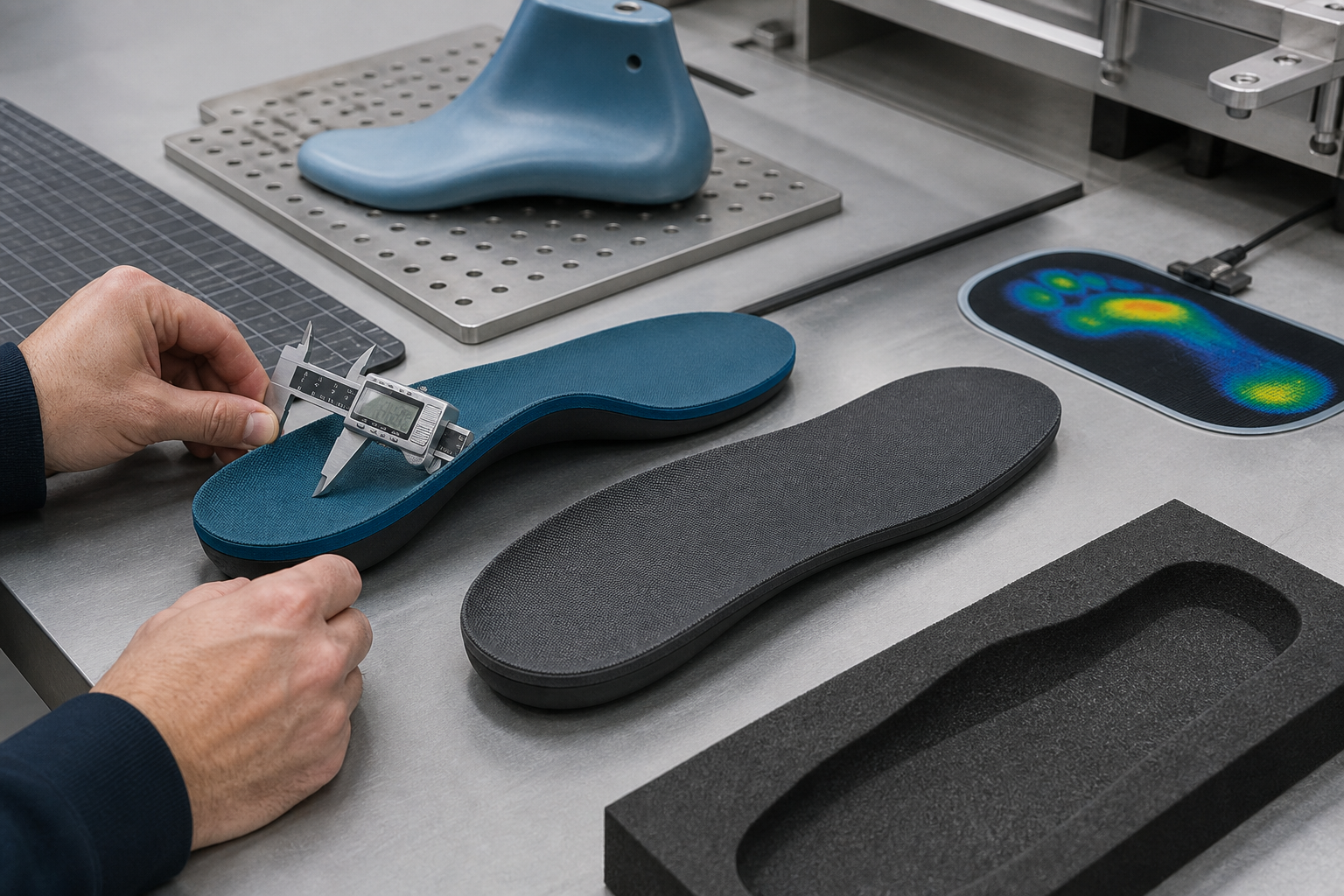
A High Arch Footbed occupies more space inside the shoe than a flatter standard design. This can raise the foot, reduce instep clearance, crowd the toe box, or change how the heel meets the collar. A footbed that feels correct on a bench may therefore fail when installed in a low-volume shoe.
Thickness should be controlled at the heel, arch, forefoot, and toe rather than stated as one average number. Full-length designs also need a toe taper and edge profile that do not wrinkle the lining or interfere with lasting geometry. Removable and cemented constructions require different allowances.
The intended shoe category matters. A roomy work boot can accept a different High Arch Footbed stack from a close-fitting running shoe or dress shoe. Brands planning a broader high-arch range can use the earlier article on custom insoles for high arches for product-line context; this comparison stays focused on the component specification.
5. High Arch Footbed Testing
The fifth difference is the validation burden. A standard footbed can often use wider comfort tolerances because its contour is less pronounced. A High Arch Footbed needs tighter review of geometry, size grading, left-right symmetry, material consistency, and in-shoe fit because small changes can shift the point of contact.
Start with dimensional inspection of the molded part. Then check hardness or density where relevant, compression behavior, bonding, flex, abrasion, and aging based on the construction and market requirements. In-shoe wear trials and pressure mapping can reveal issues that a caliper cannot, but pressure results should be interpreted by qualified specialists when medical or clinical claims are involved.
Size grading also deserves its own approval step. Simply scaling one mold uniformly can move the arch apex relative to the foot and last. Establish control points for each size or size group, keep approved golden samples, and document the revision history before mass production.
High Arch Footbed FAQs
Is a higher arch always better?
No. A High Arch Footbed should match the target foot shape and shoe. Excessive height or poor arch placement can create concentrated contact and an intrusive feel.
Can one high-arch mold fit every shoe?
Usually not without review. Last shape, internal volume, heel width, toe taper, and footwear activity can require changes to the same basic High Arch Footbed concept.
Which foam suits a high arch?
There is no single best foam. EVA, PU, and other constructions can work when density, hardness, compression behavior, thickness, and geometry are validated as a finished stack.
How should brands test fit?
Test the footbed inside the intended shoe across the size range. Combine dimensional checks, wear feedback, and relevant mechanical or pressure tests under a documented method.
Is this a medical device guide?
No. This article covers footwear component design and manufacturing. Foot pain, neurological symptoms, or suspected deformity should be assessed by a qualified healthcare professional.