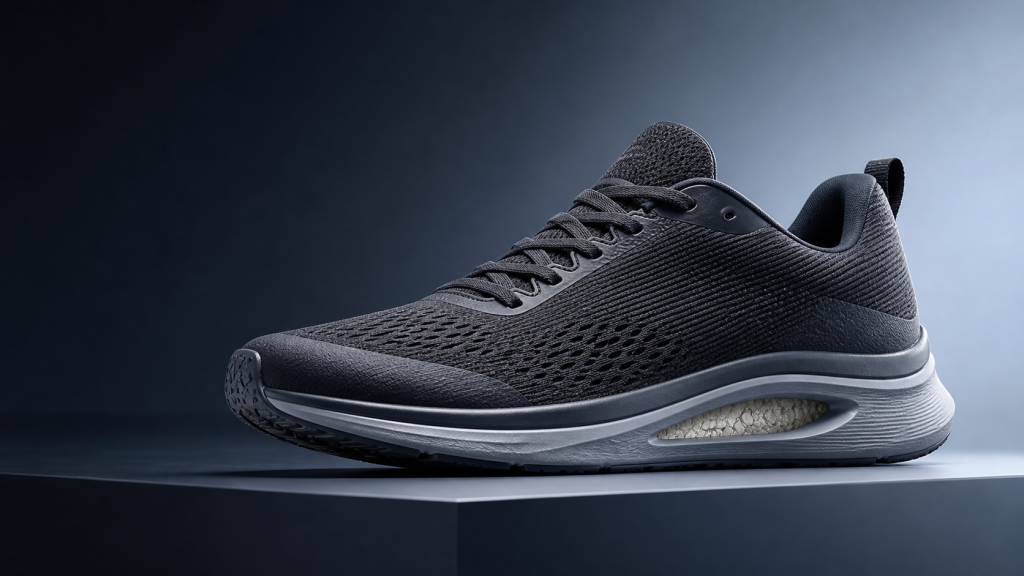
Why can an unworn shoe look fine in its box, then have its midsole crack or crumble on the first walk? For susceptible polyurethane midsoles, the likely cause is hydrolysis: water gradually breaks vulnerable chemical bonds in the PU, lowering the foam’s strength until normal flexing finishes the damage.
This failure is not proof that all PU is short-lived. Formulation, PU type, heat, humidity, storage history, and component design all affect the result. Footwear brands can manage the risk by specifying the right chemistry, testing aged specimens, and controlling production rather than relying on a generic “PU” description.
Why Polyurethane Midsoles Crumble
Polyurethane hydrolysis is a moisture-driven chain-scission process. Water reacts with susceptible bonds in the polymer, cutting long molecular chains into shorter fragments. As molecular weight and network integrity fall, the foam loses tensile and tear strength. A midsole may become soft, sticky, cracked, powdery, or crumbly depending on its formulation and aging conditions.
The damage often develops inside the component before it is obvious outside. The shoe may remain presentable while stored because the midsole is under little load. Once a wearer bends and compresses the aged foam, weakened cell walls and polymer chains can no longer carry the stress. That is why failure can appear sudden even though chemical aging has been progressing for years.
Hydrolysis also differs from ordinary abrasion. Abrasion removes material through contact with the ground. Hydrolysis changes the polymer itself and can affect protected areas that never touch the floor. It is also different from EVA compression set, in which cushioning gradually flattens under repeated loading.
How Polyurethane Midsole Chemistry Matters
PU is a family of materials, not one fixed formula. Footwear systems are produced by reacting isocyanates with polyols and other formulation components. The polyol backbone is especially relevant to hydrolysis resistance.
Polyester polyurethane midsoles
Polyester-based PU contains ester groups in its soft segments. These groups can be cleaved by water, so this material family requires careful hydrolysis evaluation. Polyester PU can still be a sound footwear choice: it is valued for mechanical strength and wear resistance, and modern systems can be formulated for improved hydrolysis performance. The correct question is not “Is polyester PU bad?” but “Does this exact formulation pass the aging requirement for the target market?”
Polyether polyurethane midsoles
Polyether-based PU is generally more resistant to hydrolysis because its soft segment does not contain the same hydrolysis-sensitive ester linkages. A 2021 footwear study reported the familiar tradeoff: polyether PU soles offer higher hydrolysis resistance, while polyester PU provides better oil resistance. Polyether chemistry is therefore a useful option for hot, humid markets, but oil exposure, bond performance, density, feel, cost, and processing must still be considered.
Formulation and processing variables
The polyol family is only the start. Isocyanate index, catalysts, stabilizers, cell structure, skin quality, density, moisture in raw materials, cure conditions, and mix accuracy can change the finished midsole. A promising resin cannot compensate for poor metering or incomplete process control. Brands should approve the finished component, not a supplier’s raw-material brochure.
What Accelerates Polyurethane Midsole Hydrolysis
Hydrolysis needs water, and heat speeds the chemical reaction. Risk rises when polyurethane midsoles spend long periods in warm, humid storage or move through an uncontrolled supply chain.
| Risk factor | Why it matters | Brand control |
|---|---|---|
| High relative humidity | Supplies moisture for bond cleavage | Define storage and transport conditions |
| Elevated temperature | Accelerates reaction rate | Avoid hot warehouses and containers where practical |
| Long storage time | Extends cumulative exposure | Use date-coded inventory and first-in, first-out control |
| Polyester-based PU | Contains hydrolysis-sensitive ester groups | Select a resistant system and validate it |
| Poor process control | Can create weak or inconsistent foam | Audit ratio control, curing, density, and records |
| Water entry or damaged skin | Increases moisture access | Check molded skin, bonds, and component design |
Perspiration, wet use, and repeated drying can contribute to moisture exposure, but consumer use is only one part of the story. Raw materials, finished components, assembled shoes, ocean freight, and retail storage all add time to the aging clock. A brand selling into Southeast Asia or other hot, humid regions should set a tougher qualification plan than a program intended for cool, dry conditions.
Storage advice should stay realistic. A cool, dry, ventilated area can reduce risk; sealed damp boxes, wet footwear, direct heat, and prolonged hot storage can increase it. No storage tip can restore polymer chains after hydrolysis has occurred, and wearing shoes periodically is not a substitute for material qualification.
Signs Polyurethane Midsoles Are Failing
Hydrolysis can produce several warning signs, but appearance alone cannot confirm the mechanism. Product teams should examine the midsole and verify the cause with material and mechanical testing.
- Cracks at flex zones: fissures appear near the forefoot or sidewall when weakened foam bends.
- Powder or flakes: the midsole sheds particles and loses coherent structure.
- Soft, tacky surfaces: degraded material or additives may migrate to the surface.
- Loss of strength: a component tears or splits under loads that an unaged control survives.
- Bond-line failure: weakened PU near an adhesive interface can resemble simple delamination.
- Unexpected collapse: the foam deforms after storage even if outsole wear is low.
These signs can overlap with oxidation, heat damage, adhesive failure, plasticizer migration, microbial attack, or a molding defect. Failure analysis should compare an affected shoe with production retains, unused controls, and batch records. Chemical tools such as FTIR can support root-cause work, while tensile, tear, flex, and abrasion results show whether the aged material still performs.
Testing Polyurethane Midsoles for Hydrolysis
Accelerated aging gives footwear teams useful comparative evidence before bulk production. SATRA TM344 stores specimens in a warm, humid environment for defined periods, then compares their mechanical performance with untreated reference specimens. SATRA lists flex cracking, tensile strength, split tear strength, and abrasion resistance among the relevant tests for PU solings.
FX Footwear’s in-house lab testing page includes SATRA TM344 hydrolysis evaluation for polyurethane-based materials. A useful approval plan should go beyond a simple “pass” statement:
- Identify the PU system, component density, color, and production batch.
- Record the aging temperature, relative humidity, duration, and conditioning procedure.
- Test unaged controls and aged specimens using the same method.
- Report retained tensile, tear, flex, and abrasion performance where relevant.
- Inspect the whole molded component, including skin, thin edges, bond zones, and flex lines.
- Repeat testing after formulation, color, density, supplier, or process changes.
Brands should set acceptance criteria before testing. BASF, for example, reported a footwear PU system with less than 15% relative hardness loss and less than 30% tensile-strength reduction after 21 days at 70°C and 100% relative humidity. Those are product-specific results, not universal limits for every midsole. They show why retained properties and stated conditions are more informative than an unsupported “hydrolysis resistant” claim.
Preventing Polyurethane Midsole Failures
Hydrolysis risk is best controlled at specification, production, and logistics stages. Consumer care instructions help, but they cannot correct a weak formulation.
Match PU chemistry to the use case
Define climate, expected service life, storage duration, oil or chemical exposure, target density, hardness, and cushioning. Consider polyether-based PU where hydrolysis resistance is the main concern. If polyester PU is needed for its other properties, qualify a system designed for the required humid-aging performance.
Control polyurethane midsole production
Require documented mixing ratios, raw-material moisture control, mold temperature, demolding time, curing, density tolerance, and hardness tolerance. Use statistical batch records so an abnormal result can be traced. Visual inspection should include voids, incomplete fill, skin defects, contamination, and uneven cell structure.
Validate bonds and finished shoes
A midsole is part of a system. Adhesives, primers, outsole compounds, decorative films, and molding geometry can create new weak points. Test the assembled bottom unit after humid aging, not only a laboratory foam plaque. Pay close attention to thin sections and high-flex areas.
Manage logistics and change control
Use first-in, first-out inventory, lot identification, and defined warehouse conditions. Requalification should follow material substitutions, new pigments, recycled-content changes, density adjustments, tooling changes, or factory transfers. Even a small formulation change can alter the aging response.
Sourcing Reliable Polyurethane Midsoles
A supplier should be able to translate “hydrolysis resistance” into a measurable test plan. Ask for the PU chemistry family, intended applications, test conditions, aged-versus-unaged results, manufacturing tolerances, and change-control procedure. Confirm that the supplier can investigate failures rather than only replace rejected parts.
FX Footwear’s material-driven midsole services include PU processing, microcellular PU molding, component customization, and in-house testing. Brands comparing PU with other material families can also use the site’s EVA, PU, and TPU midsole guide to frame weight, cushioning, durability, and processing tradeoffs.
Before approving polyurethane midsoles for production, request representative molded samples from the intended formula, color, density, tooling, and factory. Then age and mechanically test those samples against written limits. Contact FX Footwear to discuss PU midsole requirements, humid-aging targets, sampling, and test documentation.
Polyurethane Midsoles FAQ
Why do PU midsoles crumble?
Susceptible polyurethane midsoles crumble when moisture-driven hydrolysis cuts polymer chains and weakens the foam. Heat and time accelerate the damage, while flexing often reveals a failure that developed during storage.
Do unused PU shoes deteriorate?
Yes. Hydrolysis does not require walking; it requires susceptible PU chemistry, moisture, and time. An unused shoe can look intact until its weakened midsole is flexed or loaded.
Is all polyurethane hydrolysis-prone?
No. Hydrolysis resistance varies with polyol chemistry, formulation, stabilizers, processing, and exposure. Polyether-based PU is generally more resistant than polyester-based PU, but the finished component still needs validation.
Can crumbling PU be repaired?
The degraded polymer cannot be restored with glue or conditioning. A specialist may replace the sole unit if the upper and construction permit it; safety footwear with structural failure should be removed from service.