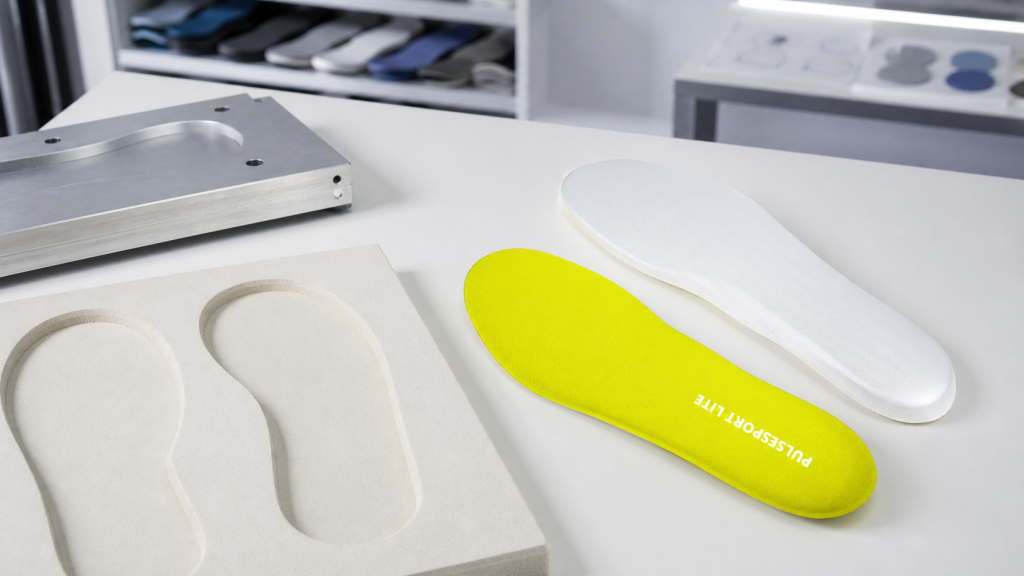
Why can two running-shoe components made from the same PEBA, TPU, TPEE, or EVA material family feel completely different? The resin matters, but it is only part of the answer. How the SCF material is supplied, cut, heated, pressed, and finished can change its geometry, surface, tolerance, weight, and cost.
That distinction is easy to miss when every supplier uses the phrase “supercritical foam.” In this guide, we compare SCF sheet with SCF compression molding so you can decide which route fits your drawing, performance target, volume, and tooling budget.
One clarification comes first: these terms do not always describe two competing foaming technologies. SCF sheet is a material format. SCF compression molding is a downstream forming process. In some production programs, sheet made earlier in the supply chain is cut into a controlled blank and then compression molded into the finished footwear component.
SCF Sheet and Compression Molding Start at Different Stages
SCF processing uses nitrogen, carbon dioxide, or a combination, depending on the resin, equipment, and performance target. It creates microcellular foam with predominantly closed cells without traditional chemical blowing agents. For a broader introduction, see our supercritical fluid foaming materials guide.
The practical sourcing question is what happens after the foam is produced. Do you convert a sheet mainly by cutting, or do you use controlled heat and pressure to shape the material in a mold?
What Is SCF Sheet?
SCF sheet is a supercritical-foamed material supplied in a flat sheet or slab format. Depending on the resin and the material producer’s process, it may be made as a foamed polymer stock or consolidated from expanded material. It is then converted into a footwear component by die cutting, knife cutting, CNC cutting, skiving, lamination, or a combination of these operations.
For you as a buyer, the practical feature is the flat starting format. A die-cut insole, flat cushioning insert, tongue pad, or simple footbed layer can often be nested across a sheet without committing to a dedicated three-dimensional mold. Thickness remains linked to the available sheet specification and any secondary skiving or forming operation.
This route can work well for flat or lightly contoured parts, early prototypes, size trials, and programs that need design changes before tooling is frozen. But a cut edge remains visible unless it is covered or finished, and a flat blank cannot reproduce every radius, sidewall, heel cup, texture, or thickness transition in a complex molded design. Surface skin and appearance also depend on the upstream sheet process; you should not assume one universal finish for every SCF sheet.
What Is SCF Compression Molding?
SCF compression molding is the downstream shaping of qualified SCF material with a matched mold, controlled heat, pressure, and time. The input may be an engineered sheet blank, a preform, expanded beads, or another qualified SCF material format. The right route depends on the supplier’s equipment and the exact material system.
This definition matters because “compression molded” does not automatically mean that the same factory also makes the SCF sheet or synthesizes the resin. At FX Footwear, for example, our Indonesia site compression molds SCF material supplied as sheet from our Vietnam manufacturing network; the Indonesia site does not manufacture SCF sheet.
A mold gives your development team more control over the finished outline, heel cup, edge profile, local thickness, texture, logo position, and assembly features. It can also reduce secondary cutting on a suitably designed component. The tradeoff is tooling: each geometry and size plan must be reviewed, sampled, and approved before bulk production.
Bead-based molding is one possible industry route, but it is not the definition of every SCF compression molding program. A peer-reviewed study on compression molding expanded TPU beads found that molding temperature, pressure, time, and bead condition affect bonding, surface quality, hardness, and resilience. The practical lesson is to ask your supplier for the actual input format and process controls instead of approving a part based only on the word “SCF.”
SCF Compression Molding Comparison Table
| Comparison factor | SCF sheet converted by cutting | SCF compression molding |
|---|---|---|
| Process role | Converts a flat foam sheet through cutting and secondary finishing | Forms qualified SCF material into a defined 3D component under heat and pressure |
| Material use | Nesting can be efficient for simple outlines; trim waste depends on part shape and sheet layout | A controlled blank or preform is placed into the required geometry; flash and trial loss depend on setup |
| Product precision | Suits controlled length, width, and flat thickness; complex contours require added operations | Suits molded contours, edge profiles, heel cups, textures, and repeatable 3D geometry |
| Design freedom | Best for flat or lightly contoured components and laminated stacks | Better for integrated geometry and local thickness changes within material and mold limits |
| Surface result | Preserves the supplied sheet surface; cut edges remain visible unless covered or finished | Mold surface and process settings influence texture, definition, and appearance |
| Production cost | Often avoids dedicated 3D tooling for simple parts; cost depends on yield, cutting, lamination, and finishing | Adds mold development and sampling; unit cost depends on sizes, volume, cycle, yield, and finishing |
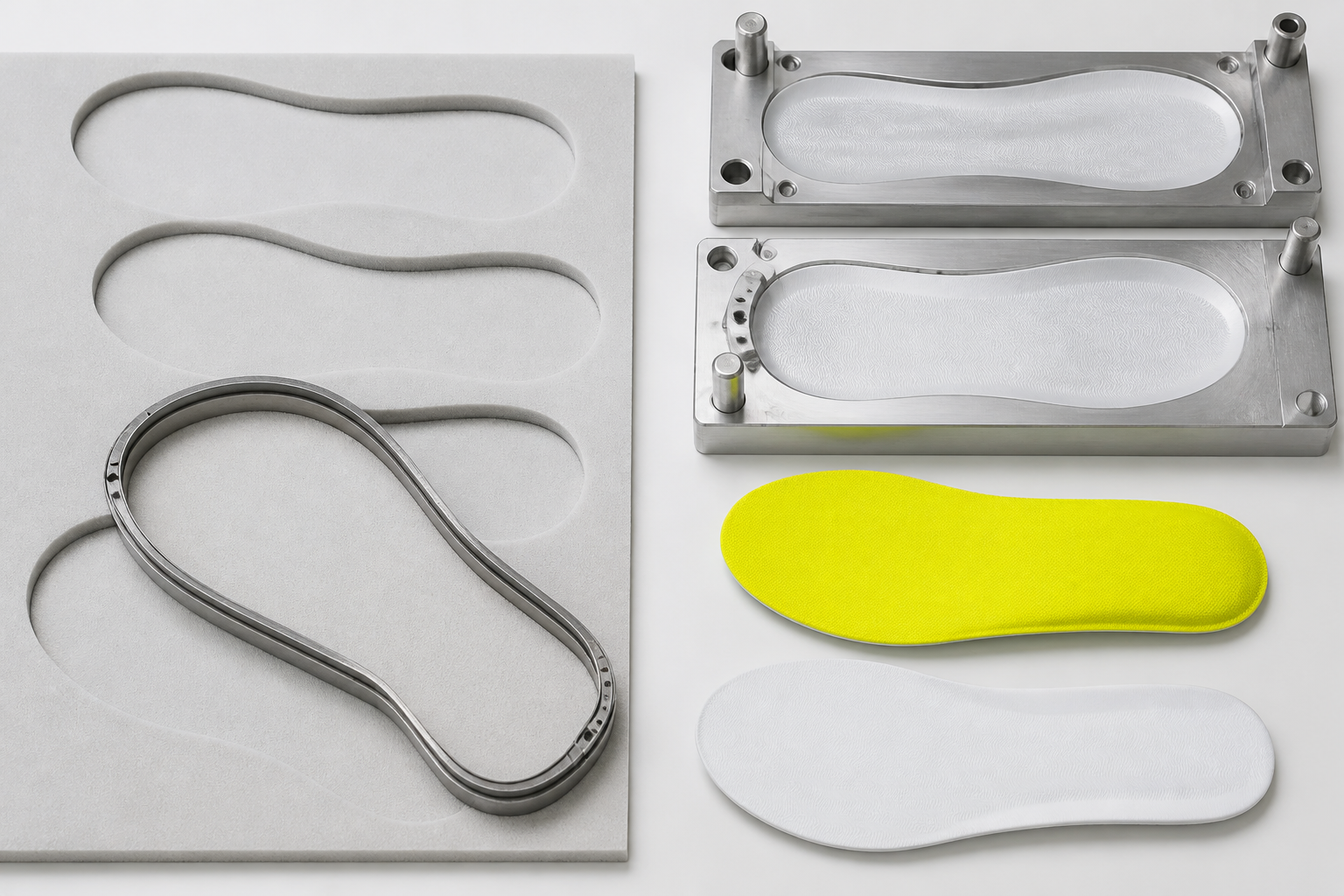
These are development tendencies, not guaranteed results. Resin grade, foam density, thickness, mold design, conditioning, test method, and finished shoe construction can change the outcome. Compare approved samples under the same test plan rather than comparing supplier adjectives.
SCF Sheet and Compression Molding Applications
When SCF Sheet Is the Practical Choice
Choose sheet conversion when your component is mostly flat, when you need a fast geometry trial, or when the forecast does not yet justify size-specific tooling. Typical applications include die-cut insoles, flat cushioning layers, inserts, tongue or collar padding, and development samples whose outline may still change.
Sheet also makes sense when you want to combine an SCF layer with textile, mesh, microfiber, leather, or another project-specified top cover. Your supplier still needs to validate lamination, peel strength, finished thickness, density, hardness, resilience, and compression set for the exact construction. A good raw sheet does not guarantee a good component after adhesive, cover material, skiving, or heat exposure is added.
When SCF Compression Molding Fits Better
Choose SCF compression molding when your drawing depends on three-dimensional geometry. A defined heel cup, raised support area, wrapped edge, local thickness change, molded surface texture, or repeatable interface with another shoe component usually favors a molded route.
Compression molding can also simplify a component that would otherwise require several cut-and-laminate layers. That does not mean every molded design is cheaper. You need to compare tooling cost, number of sizes, material yield, cycle time, finishing, inspection, and expected order volume. Multi-density or zoned constructions may be developed through controlled material placement or multi-material engineering, but they are not an automatic result of compression molding and must be validated for bonding and consistency.
At FX Footwear, we support die cutting, compression molding, hot and cold pressing, lamination, assembly, and single-, dual-, or multi-density constructions. Our PulseSport supercritical foam platform covers documented SCF options based on sourced EVA, TPU, TPEE, and PEBA materials. We select and process these materials for footwear programs; we do not synthesize the polymers.
Choosing an SCF Compression Molding Supplier
Before requesting a quote, send the supplier a controlled brief rather than a material name alone. Include the component drawing, size range, target weight, thickness map, hardness scale and method, density method, resilience method, compression-set requirement, surface specification, top-cover or bonding requirement, color, forecast volume, and assembly location.
Then ask five direct questions: What material format enters the molding process? Which factory makes or supplies the sheet, and which factory performs downstream molding? What mold and size tooling is required? Which properties are tested on the finished component rather than the raw sheet? How will a material, mold, or process change be documented and reapproved?
FX Footwear operates a manufacturing network across China, northern and southern Vietnam, and Indonesia. Both Vietnam production bases support SCF compression molding. Our Indonesia site also performs SCF compression molding using supplied sheet. We allocate production around the approved process, project requirements, and factory capability.
For quality approval, we can build a project test plan around applicable methods for hardness, density, resilience, compression set, abrasion, flex, shock absorption, and lamination peel strength. The exact method, conditioning, specimen, tolerance, and acceptance limit should appear in your approved specification. See our footwear manufacturing services for the wider development and production scope.
Finding the Right SCF Process for Your Footwear Program
SCF sheet and SCF compression molding are not a simple “good versus better” choice. Sheet conversion can be the efficient answer for a flat component, an early sample, or a flexible size plan. Compression molding can be the stronger answer when your design needs controlled three-dimensional geometry, integrated features, and a repeatable molded surface.
Our job is to help you connect the process to the product. We review your drawing, material target, test plan, size range, and forecast before recommending a conversion route. If you are developing a running shoe or athletic footwear program and are unsure which SCF route fits it, contact FX Footwear to discuss your specification and request a project sample.
SCF Compression Molding FAQ
Is SCF Sheet the Same Process?
No. SCF sheet describes the foam’s supplied format, while SCF compression molding describes a downstream forming operation. A production route may use SCF sheet as the input for compression molding, so the two terms are not always mutually exclusive.
Does Molding Always Use Beads?
No. Expanded-bead molding is one documented industry route, but a supplier may also use a qualified sheet blank or another preform. Ask the supplier to state the actual input material and molding sequence for your component.
Can Molding Change SCF Performance?
Yes. Thickness, geometry, heat history, pressure, time, surface design, and conditioning can affect the finished result. Approve performance on the finished component using the same test method and tolerance required for bulk production.
Can Molding Create Multiple Densities?
It can support engineered zoned or multi-material constructions when the equipment, material placement, bonding, and mold design allow it. Multi-density performance is not automatic and requires sampling and validation for the specific construction.
Which Polymers Work With SCF?
Documented options include EVA, TPU, TPEE, and PEBA material systems. Their behavior depends on resin grade, formulation, SCF route, density, geometry, and test method.
What Should We Send for Sampling?
Provide a 2D or 3D drawing, size range, thickness map, target weight, material preference, hardness and performance requirements, top-cover or bonding details, color, forecast volume, and intended footwear application.