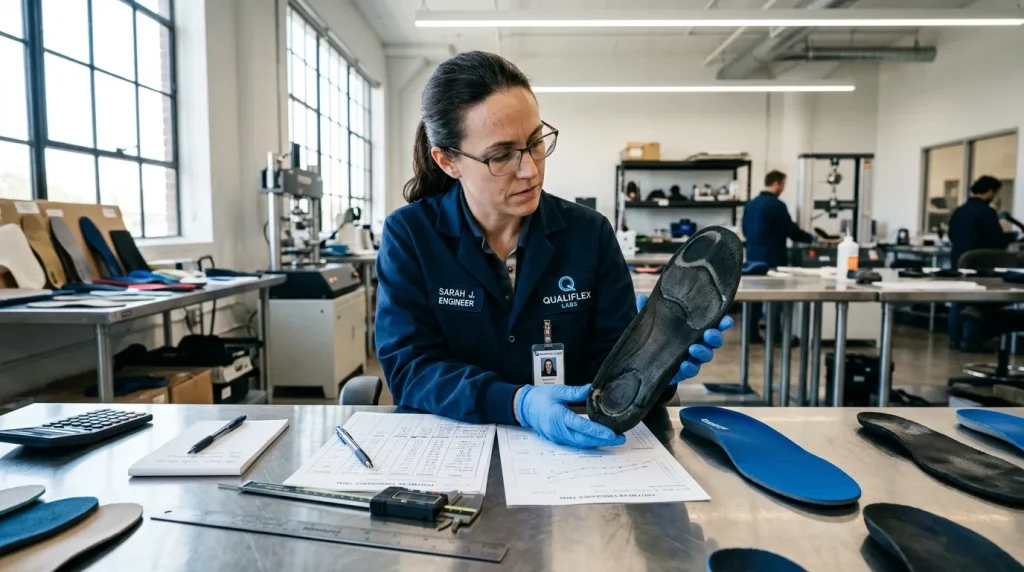
When you’re sourcing durable insoles for athletic footwear, workwear, or everyday shoes, the promise of long-lasting comfort is easy to make — but much harder to verify. How do you know if an insole will hold up after weeks of real-world use, not just a single quality-control check? The answer lies in structured durability testing, and one of the most revealing benchmarks in the industry is the 10,000-step simulation. What happens to foam density, arch support, and surface integrity after that kind of load? This article breaks it all down, explaining exactly how manufacturers stress-test insoles, what the data reveals, and why these tests should be a non-negotiable part of your sourcing conversations.
Why 10K Steps Is the Benchmark
The 10,000-step figure isn’t arbitrary. For the average adult in the United States, 10,000 steps represents roughly four to five miles of walking — approximately one full day of moderate activity. For footwear engineers, this milestone serves as a reliable early-stage predictor of long-term product performance. It’s enough repetition to expose early fatigue in foam cells, adhesive bonds, and fabric coverings, without requiring months of field testing.

Durability protocols typically compress this load into controlled mechanical testing using weighted pendulums, repetitive compression rigs, or robotic gait simulators. These machines apply consistent pressure in cycles that mimic heel-strike and toe-off mechanics. The advantage over real-world trials is repeatability — every test cycle applies the same force at the same angle, isolating material behavior rather than user variability.
From a sourcing perspective, what makes 10K-step data so valuable is its comparability. When a shoe insole manufacturer runs the same protocol across different foam formulations — say, standard EVA versus memory foam versus supercritical CO₂-expanded foam — you can directly compare compression set, rebound speed, and surface wear under identical conditions. That kind of side-by-side data is what transforms a subjective “feels supportive” claim into a measurable, defensible specification.
Compression Set: The Core Durability Metric
Of all the measurements taken during insole durability testing, compression set is the one that matters most. It quantifies how much an insole permanently deforms after repeated loading — essentially, how much “spring” the material loses over time. An insole that starts at 10mm of cushioning but compresses to 7mm and stays there has a compression set of 30%. For durable insoles, keeping that number low is the primary engineering challenge.
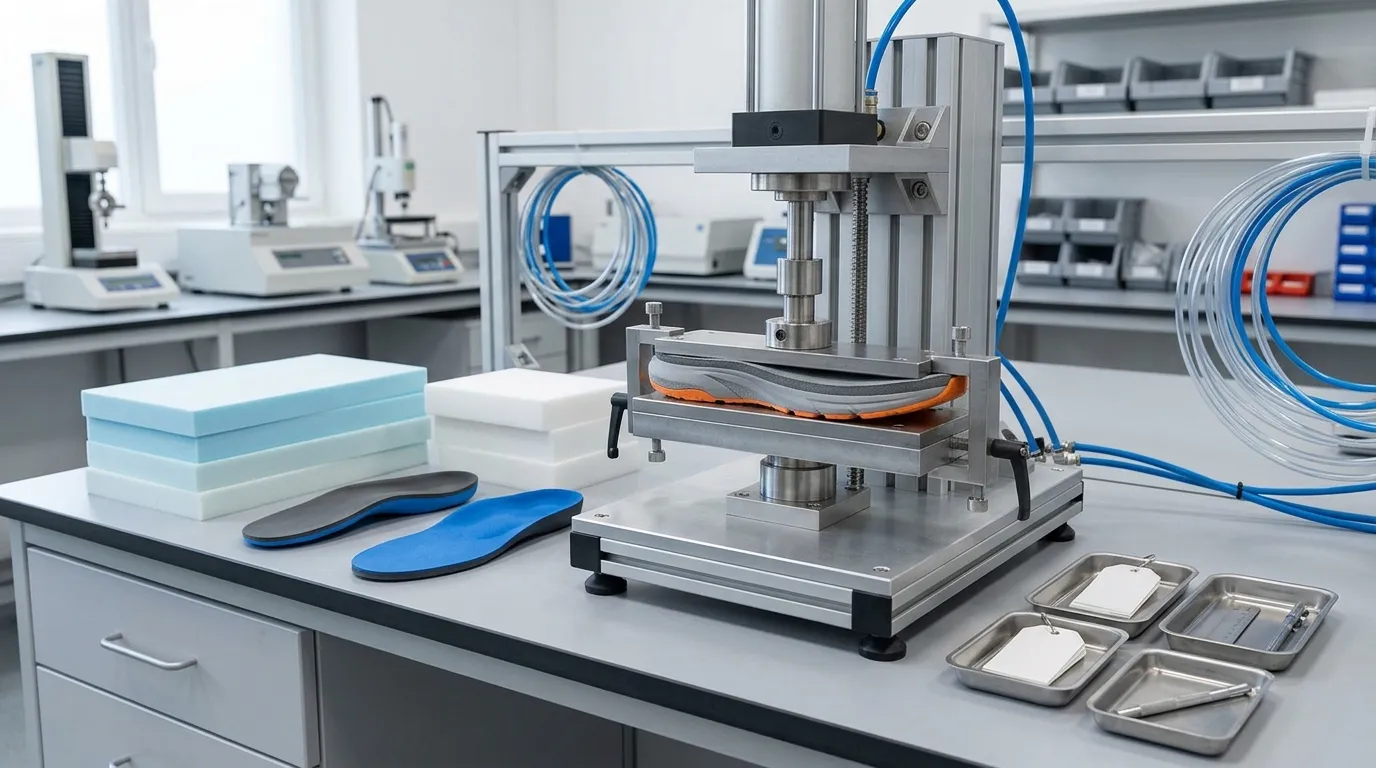
After 10,000 simulated steps, standard EVA foam typically shows a compression set ranging from 15% to 35%, depending on density and crosslink structure. Higher-density EVA performs better on this metric, but it often trades off against initial softness — a common dilemma in insole formulation. Memory foam (viscoelastic polyurethane) tends to show lower early compression set but can struggle in high-heat environments, where its response time slows and cumulative deformation increases.
One of the more exciting developments in this space is the performance of supercritical CO₂-expanded foams under compression testing. If you haven’t read our deep dive into what makes supercritical CO₂ foaming different, the short version is that this process creates a more uniform, closed-cell foam structure — and that uniformity shows up clearly in post-10K compression data, with set values consistently lower than comparable conventional foams.
Surface Wear & Fabric Integrity
Compression data tells you about the structural foam core, but durability testing also has to account for what’s happening on the surface — the fabric or film that your customer’s foot actually contacts. Surface delamination, pilling, and edge fraying might not compromise cushioning performance directly, but they do accelerate overall product failure and generate returns, complaints, and brand damage.
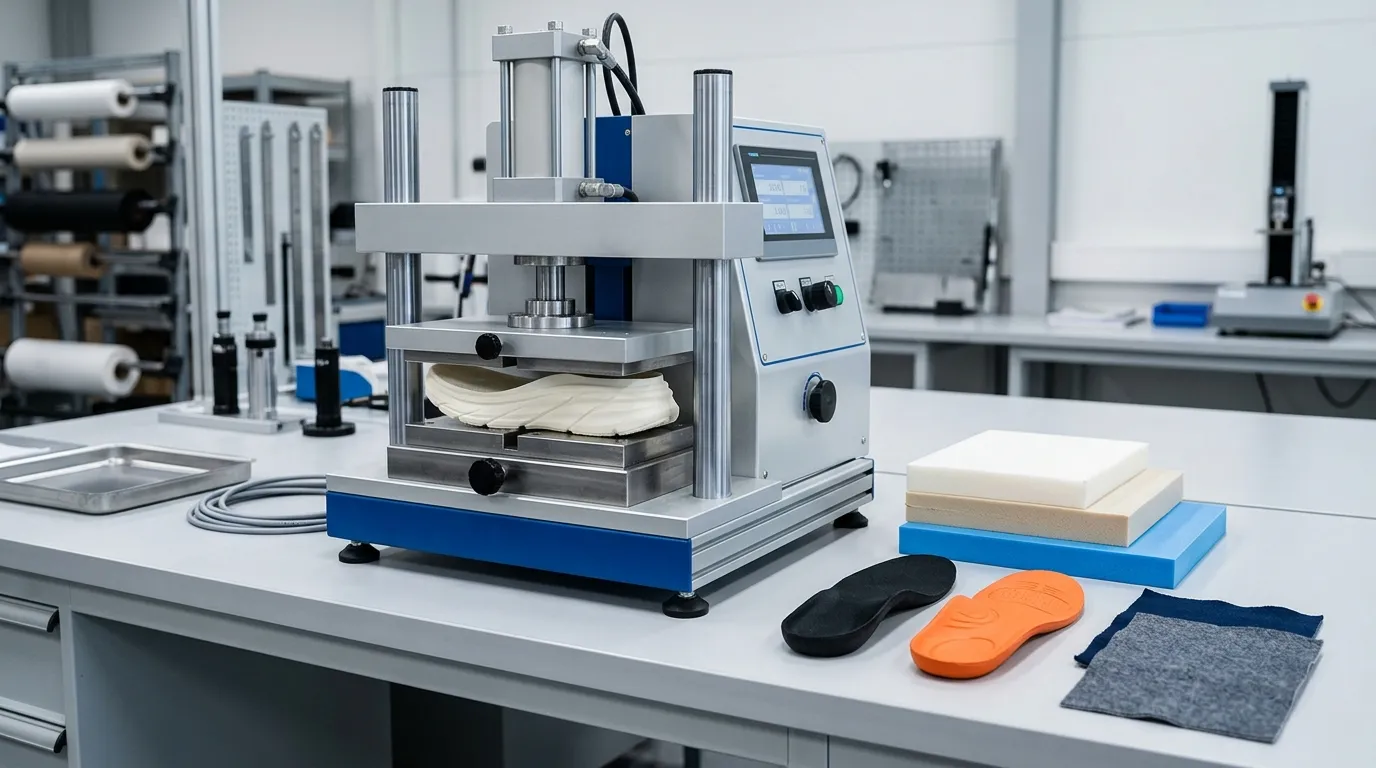
Standard surface wear protocols use a Martindale abrasion tester or a modified Taber abraser, running the insole’s top cover through hundreds of friction cycles while measuring fiber loss and surface degradation. After the equivalent of 10K steps in high-friction conditions, low-quality nonwoven covers often show visible pilling, and bonded fabric layers can begin separating at the heel and forefoot zones — the highest-pressure areas.
Well-engineered insoles built for outdoor use — explore our outdoor solutions — use either heat-bonded or ultrasonic-welded fabric attachment rather than adhesive-only bonding. This matters because adhesives, particularly solvent-based ones, become less effective as foam cell walls fatigue and micro-movement increases. For B2B buyers specifying insoles for athletic or workwear applications, asking specifically about the bonding method and requesting post-wear fabric pull-strength data is a smart quality checkpoint that separates commodity suppliers from serious manufacturing partners.
Arch Support Retention After Load
Cushioning is only half the durability story. Arch support — the structural contour that maintains the insole’s three-dimensional shape — is equally critical, especially for products marketed toward runners, workers who stand for extended shifts, or anyone with pronation concerns. After 10K steps, does the arch still sit where it’s supposed to, or has it flattened to the point of functional uselessness?
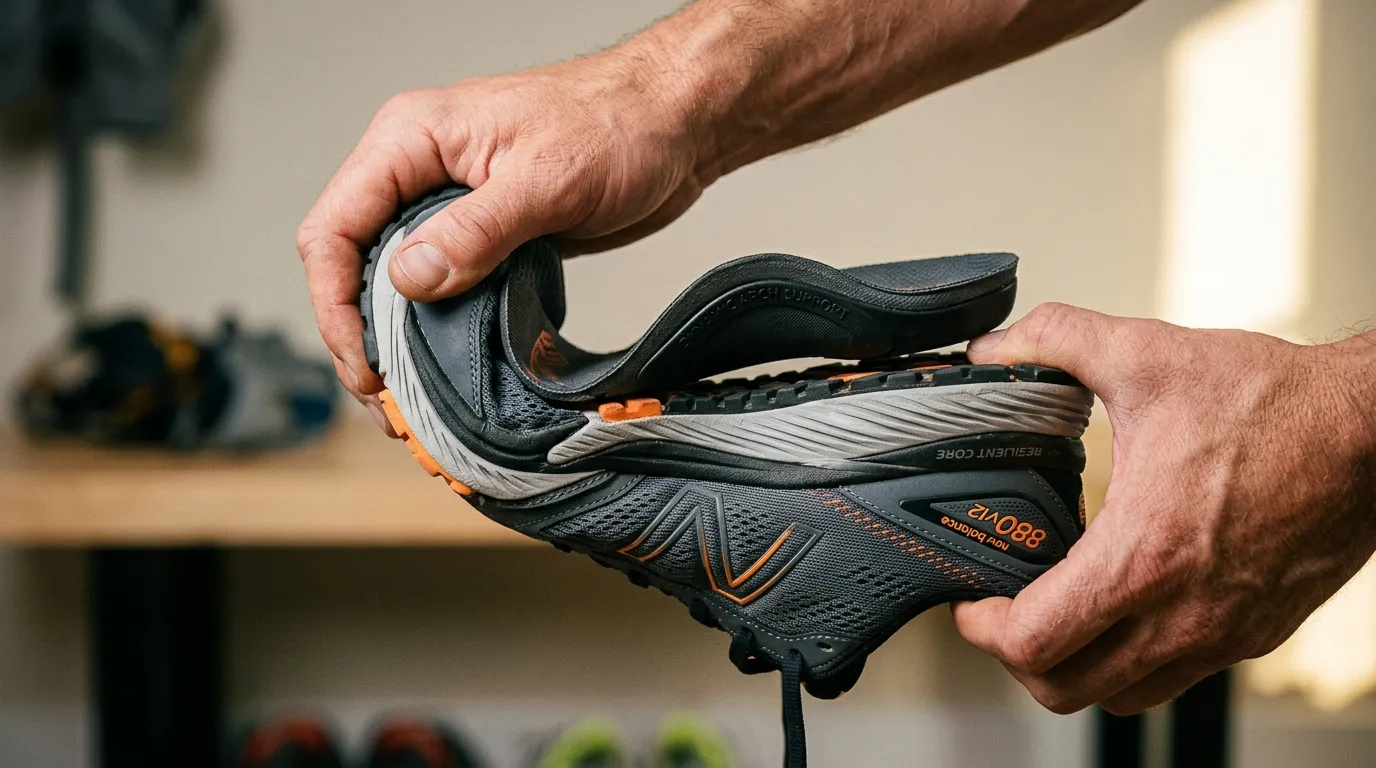
This is tested by measuring arch height before and after the compression simulation, using a calibrated height gauge at defined medial positions. For insoles with a molded EVA base, arch height retention above 90% is considered the industry benchmark for a product that will realistically serve the consumer through several months of use. Products falling below 80% retention are flagged as likely to draw complaints within the first four to six weeks of wear.
Thermoformed insoles — where heat and pressure shape the arch into a rigid or semi-rigid substructure — consistently outperform flat-cut insoles on this metric. The arch is literally molded into the geometry of the material rather than just contoured into a soft foam that can rebound to flat. If your product line includes orthotic insoles for running or high-performance athletic applications, arch height retention data after stress simulation should be a standard item in your supplier’s technical documentation package.
Lab Reports: What to Request
Understanding that durability testing exists is step one. Knowing how to evaluate the data you receive from a supplier is step two — and this is where many B2B buyers leave performance on the table. Lab reports for insole durability can vary widely in format, methodology disclosure, and data completeness. Not all 10K-step tests are created equal.
The first thing to verify is the test standard referenced. ASTM D395 (compression set), ISO 20871 (outsole abrasion), and EN 12772 (insole flex resistance) are common benchmarks, but some manufacturers reference proprietary internal protocols that may be less rigorous. Ask specifically which ASTM or ISO standard was used, and whether testing was conducted by an accredited third-party lab or in-house. Third-party validation, like the kind detailed at FX Footwear’s high quality insoles testing page, provides a level of credibility that self-reported internal testing simply cannot match.
Second, look for the full dataset rather than cherry-picked pass/fail summaries. A comprehensive durability report should include pre-test and post-test measurements for compression set, arch height, surface peel strength, and foam rebound speed. Rebound speed — how quickly the insole recovers between steps — is particularly important for athletic applications, where a slow-recovering insole effectively reduces energy return and increases fatigue. As a custom shoe insole manufacturer with full in-house lab capabilities, FX Footwear (Fuxiang Group) provides clients with complete test documentation rather than summary scorecards, so buyers can make genuinely informed sourcing decisions.
FAQ
FAQ: What does compression set mean for buyers?
Compression set is the percentage of permanent thickness loss a foam material retains after being compressed and released. For insole buyers, it translates directly to product lifespan — a high compression set means the insole will flatten and lose cushioning faster. When comparing supplier samples, request post-compression thickness measurements at 10K-step equivalent loading, and prioritize materials that maintain at least 85–90% of their original thickness.
FAQ: How many steps should a durable insole last?
High-quality durable insoles are generally engineered to maintain functional performance — defined as acceptable cushioning, arch retention, and surface integrity — for between 300 and 500 miles of walking, which translates roughly to 600,000 to 1,000,000 steps. The 10K-step test is an early-stage screening benchmark, not a lifespan measurement. It helps identify materials and constructions that will fail early, before they reach that long-term threshold.
FAQ: Is in-house testing as reliable as third-party?
In-house testing can be reliable if the equipment is properly calibrated and the protocols align with recognized standards. However, third-party accredited lab testing provides independent verification that eliminates confirmation bias and gives B2B buyers an auditable quality record. For product liability purposes, particularly in the US market, having third-party test documentation is a meaningful risk-management advantage worth requesting from any insole supplier.
FAQ: Which foam types perform best at 10K steps?
In side-by-side testing, supercritical CO₂-expanded foams and high-density crosslinked EVA consistently outperform standard EVA and basic PU memory foam on compression set and rebound retention metrics. Thermoplastic polyurethane (TPU) foam is also emerging as a strong durability performer, especially for insoles that need to maintain performance across a wide temperature range, such as workwear insoles used in outdoor or cold-storage environments.
FAQ: How does insole thickness affect durability test results?
Thicker insoles don’t automatically last longer — material quality and construction method matter far more than raw thickness. A well-formulated 4mm EVA insole can outperform a poorly crosslinked 8mm insole in compression set testing. That said, thickness does influence the insole’s ability to absorb load without bottoming out. For high-impact applications, a combination of adequate thickness and high-resilience foam is the most reliable durability formula.
Durability testing isn’t just a quality-control formality — it’s the clearest window into whether an insole will actually deliver on its performance promises in the field. If you’re sourcing insoles for a new product line or evaluating whether your current supplier’s materials are holding up to standard, the 10K-step benchmark gives you a concrete, data-driven place to start that conversation. FX Footwear (Fuxiang Group) brings full lab testing infrastructure, transparent third-party documentation, and deep material engineering expertise to every client engagement. Whether you need standard EVA cushioning or advanced foam constructions for specialized applications, reach out to the FX Footwear team to request sample testing data and explore what genuinely durable insoles look like at the material level.