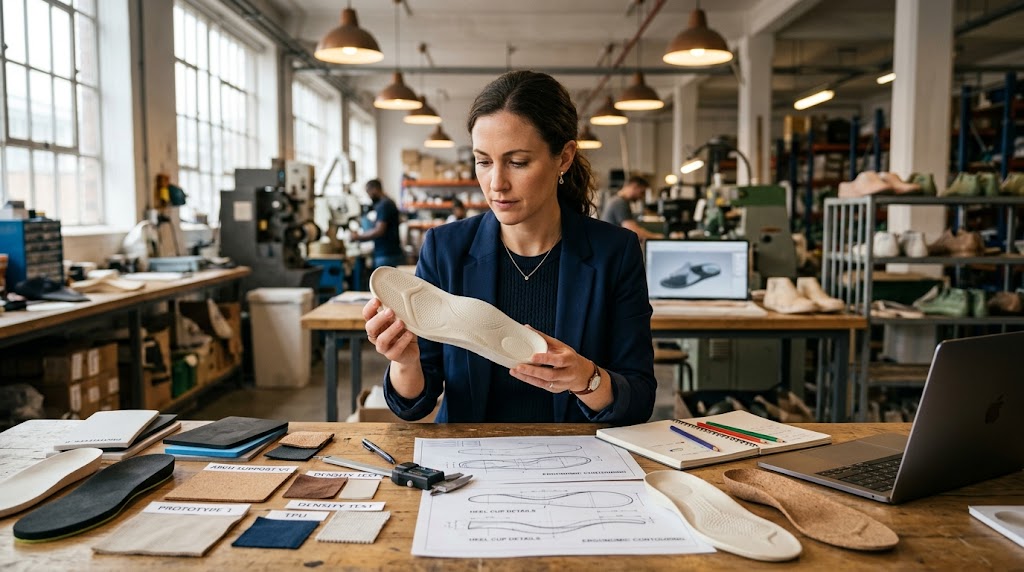
Choosing the right footbed manufacturer can make or break a footwear product. The footbed — the shaped surface your foot rests on inside the shoe — directly influences comfort, support, and how consumers perceive overall quality. Whether you’re developing an athletic trainer, a casual lifestyle shoe, or a therapeutic product, the footbed is a performance-critical component that deserves serious attention during the sourcing process.
For custom footwear brands looking to differentiate on comfort and build long-term consumer loyalty, partnering with a capable footbed manufacturer isn’t just a procurement decision — it’s a strategic one. This guide breaks down what footbeds are, the types available, the materials that matter, and exactly what to evaluate when selecting an OEM partner. We’ll also explain why FX Footwear (Fuxiang Group) has become a preferred footbed manufacturer for brands across the United States and beyond.
Footbed Types for Footwear
Before sourcing begins, it’s important to understand that “footbed” is an umbrella term covering several distinct product categories. Each serves a different purpose, and the right choice depends on your target consumer, price point, and product positioning.
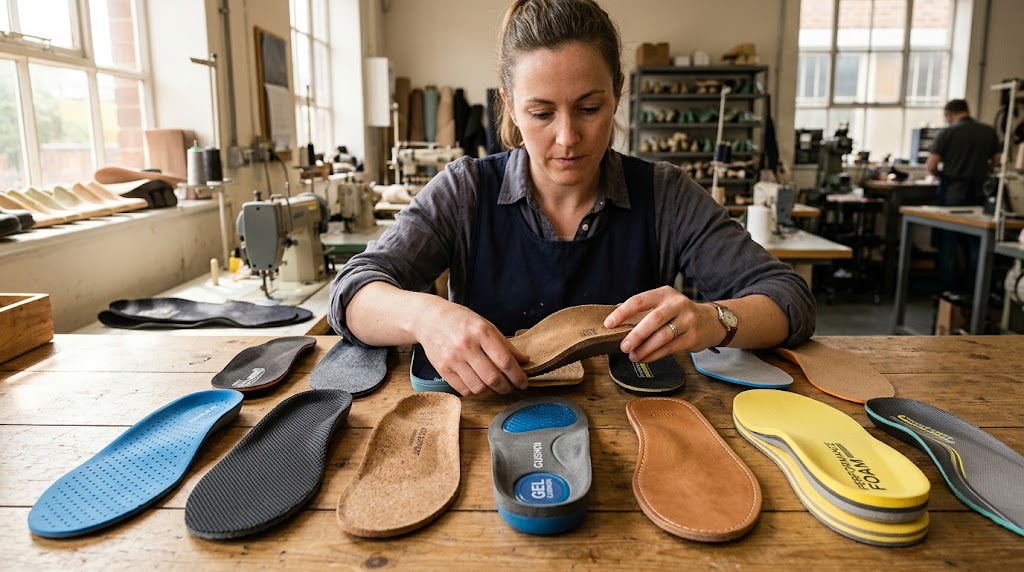
Flat insoles are the most basic footbed format — a simple cushioning layer placed inside the shoe. These are common in casual and fashion footwear where cost efficiency matters and the shoe’s lasting provides most of the structural support. Materials range from die-cut EVA foam to open-cell PU cushioning, and they can be customized with top cloth, branding, and varying densities.
Contoured footbeds feature a molded shape that mirrors the foot’s natural arch and heel cup geometry. These are widely used in athletic shoes, hiking boots, and comfort-focused lifestyle brands. Compression-molded or injection-molded EVA, as well as PU, are common materials for contoured footbeds. The contouring provides passive arch support and improved heel stability without requiring a rigid structural element.
Structural or functional footbeds incorporate rigid or semi-rigid components — such as TPU plates, carbon fiber plates, or multi-material layered constructions — to provide targeted biomechanical support. These are used in orthotic-grade products, performance running shoes, and therapeutic footwear. Brands entering this space should look for a footbed manufacturer with demonstrated capability in complex, multi-component assemblies, not just simple foam cutting. FX Footwear, for example, produces orthotic insoles for running that combine structural elements with advanced cushioning layers.
Removable vs. bonded footbeds is another important distinction. Removable footbeds allow end consumers to replace the insole with custom orthotics, which is a strong selling point in comfort and medical footwear. Bonded footbeds are cemented directly to the lasting board and are more common in fashion and athletic shoes where cost and assembly speed are priorities.
Footbed Materials Compared
Material selection is where footbed performance is won or lost. Each material brings different trade-offs across cushioning, durability, weight, cost, and sustainability — and your footbed manufacturer needs to guide you through these choices with technical precision.
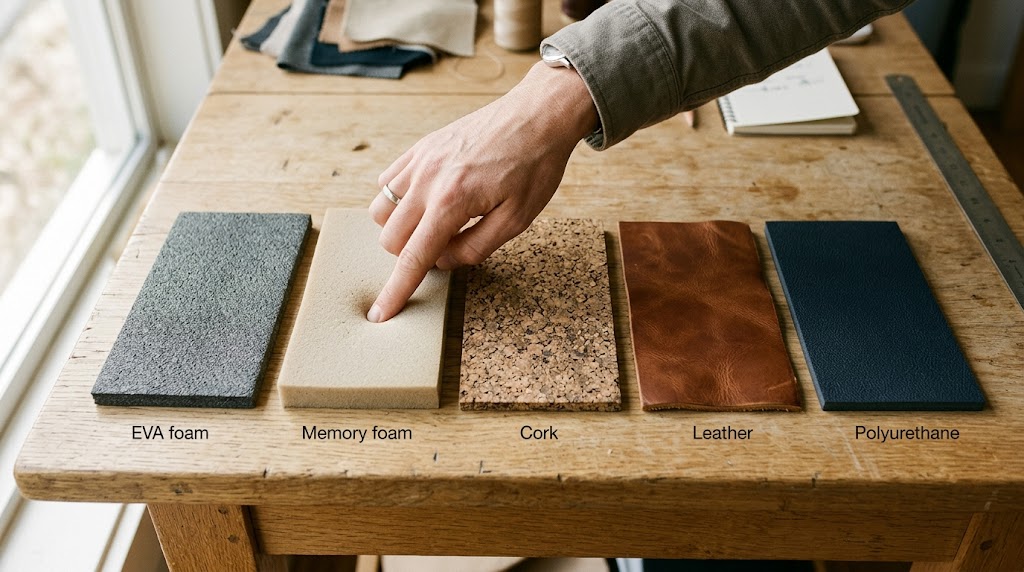
EVA (Ethylene-Vinyl Acetate) remains the workhorse of the footbed industry. It’s lightweight, cost-effective, and available across a wide hardness range — typically 20–45 Asker C (±3 tolerance) for insole applications. EVA footbeds can be produced via compression molding, injection molding, or die-cutting, making them versatile for everything from budget casual shoes to mid-tier athletic products. Single-layer and multi-density constructions are both standard. For brands exploring sustainability, sugarcane-based EVA, algae-based EVA, and recycled EVA compounds are now commercially available through GRS-certified supply chains. You can learn more about these options in our overview of eco-friendly shoe materials that are shaping the industry.
PU (Polyurethane) is the go-to material when long-term compression resistance and shape retention are priorities. PU footbeds maintain their cushioning feel over months of daily wear — making them ideal for work boots, comfort shoes, and lifestyle products where longevity matters. Open-cell PU offers better breathability than closed-cell foams, which is a meaningful advantage in warm-weather or all-day-wear applications. Bio-based PU options using Susterra®-based formulations are also available for brands with sustainability commitments. However, PU is heavier than EVA and does not deliver the same level of energy return, so it’s not the best choice for performance running or high-impact athletic footbeds.
Supercritical CO₂ foam represents the current frontier in footbed performance. This material is produced using supercritical carbon dioxide as the blowing agent — without traditional chemical blowing agents — resulting in a microcellular structure with predominantly closed cells. The outcome is consistent energy return and impact absorption across repeated use cycles, outperforming both EVA and PU in rebound metrics. For brands developing performance athletic footwear, supercritical foam footbeds — like FX Footwear’s supercritical CO₂ foam insole — deliver a measurable competitive advantage. Lead times are longer (30–45 days for production), but the performance differentiation justifies the investment for the right product category.
OrthoLite-style open-cell cushioning is another option that many brands request. FX Footwear offers OrthoLite alternatives — open-cell foam constructions that provide similar breathability and cushioning characteristics, produced under competitive pricing and flexible MOQ terms.
Choosing a Footbed Manufacturer
Not all footbed suppliers are created equal, and choosing poorly creates problems that ripple through your entire product development timeline. Here’s a structured framework for evaluating potential OEM partners.
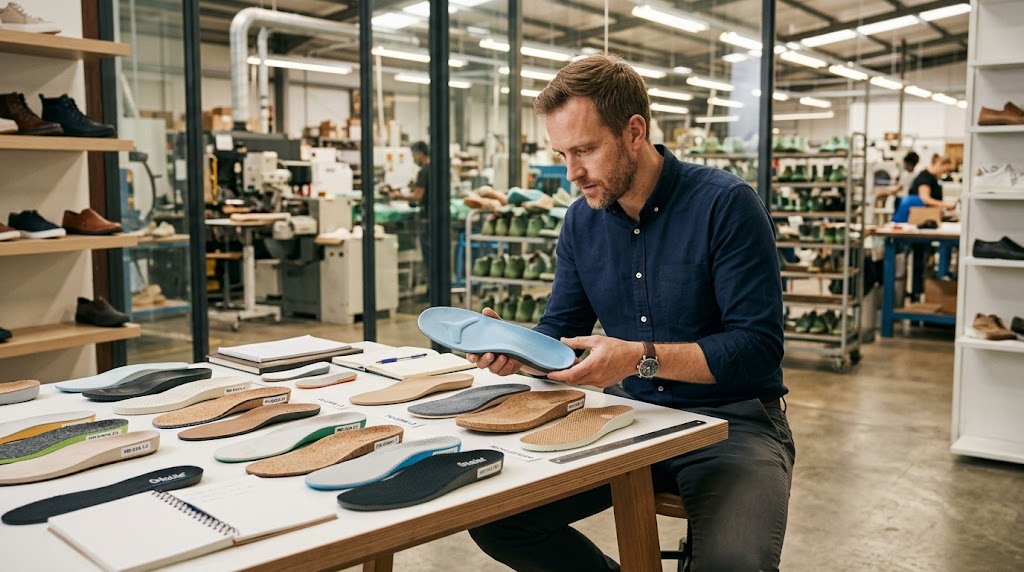
Technical capability breadth matters. A footbed manufacturer that can only produce die-cut EVA will hit a wall when you need compression-molded contoured footbeds, multi-density constructions, or structural insoles with TPU plates. Ideally, your partner covers the full spectrum — from simple flat insoles to complex functional footbeds — so you don’t need to manage multiple suppliers as your product line evolves. Working with a shoe insole manufacturer that also produces midsoles, uppers, and other components gives you the additional advantage of consolidated sourcing and streamlined communication.
Material expertise and formulation control separate commodity suppliers from genuine manufacturing partners. Your footbed manufacturer should be able to discuss EVA hardness in Asker C (not Shore C — a common red flag), explain the trade-offs between open-cell and closed-cell PU, and offer multiple sustainable material options with proper traceability documentation. If they can’t answer detailed technical questions about foam density, compression set, rebound resilience, and material sourcing, they’re likely a trading company, not a manufacturer.
In-house testing capability accelerates your development cycle. Manufacturers with their own material testing labs can validate hardness, compression set, abrasion resistance, and other performance specs without waiting for external lab results. This is especially valuable during the sampling phase when rapid iteration is needed to hit your target specs. Look for partners who can also coordinate third-party testing through recognized bodies like SATRA, SGS, or Intertek when formal test reports are required for retail compliance.
Certifications and compliance alignment should match your market. For US-focused brands, the relevant compliance framework includes CPSC requirements, California Proposition 65, and social audit standards like BSCI or SMETA. If your brand has sustainability commitments, GRS (Global Recycled Standard) certification is the credible benchmark for recycled-material supply chains. For therapeutic or orthotic footwear applications, ISO 13485:2016 certification demonstrates medical-device-grade quality management — a distinction that very few footbed manufacturers hold. The Higg Index provides supply chain sustainability measurement that many major retailers now require from their vendor base.
OEM Partnership Evaluation
Beyond technical capability, the commercial and operational side of the partnership deserves equal scrutiny. The best material in the world doesn’t help if your supplier can’t deliver on time, communicate clearly, or scale with your growth.

Manufacturing footprint and geographic positioning directly affect lead times, logistics costs, and duty exposure. A footbed manufacturer with facilities in multiple regions — such as China plus Vietnam and Indonesia — gives you built-in flexibility. You can place production closer to your Tier 1 footwear assembly factory, reduce inbound shipping time for components, and navigate tariff changes more nimbly. This regional manufacturing model is particularly valuable for US brands managing complex multi-country supply chains.
Sampling speed and accuracy are leading indicators of production quality. A competent footbed manufacturer should deliver die-cut or knife-cut samples within approximately 3 days when no new tooling is required, and samples requiring new molds within roughly 10 business days. Pay attention to how closely samples match your approved specs — dimensional accuracy, hardness consistency, surface finish quality, and branding placement all matter. If sampling is sloppy, bulk production will be worse.
Production lead times vary by product complexity and should be clearly communicated upfront. Standard EVA insoles typically require 20–35 days after payment confirmation. Supercritical CO₂ foam insoles run 30–45 days. Custom orders — from spec finalization through bulk production — generally land in the 45–70 day range. Factor in ocean freight to US ports (18–30 days from East Asia) and your total sourcing cycle for a first-time custom order is approximately 65–100 days. Any supplier promising dramatically shorter timelines without qualification should be questioned.
Payment terms and commercial flexibility are practical considerations that affect your cash flow. Industry standard for new customers is typically a 30% deposit upfront with the 70% balance due before shipment. Sampling costs are generally paid upfront as well. As order volumes grow and trust builds, more flexible terms can often be negotiated. Quotation responsiveness is another signal — a well-organized manufacturer should return initial quotations within 48 hours for standard constructions with existing tooling and materials.
Branding and Customization
Your footbed is a branding touchpoint that consumers interact with every time they put on or take off a shoe. Maximizing this surface for brand communication requires understanding what’s technically feasible and what delivers the best visual result.
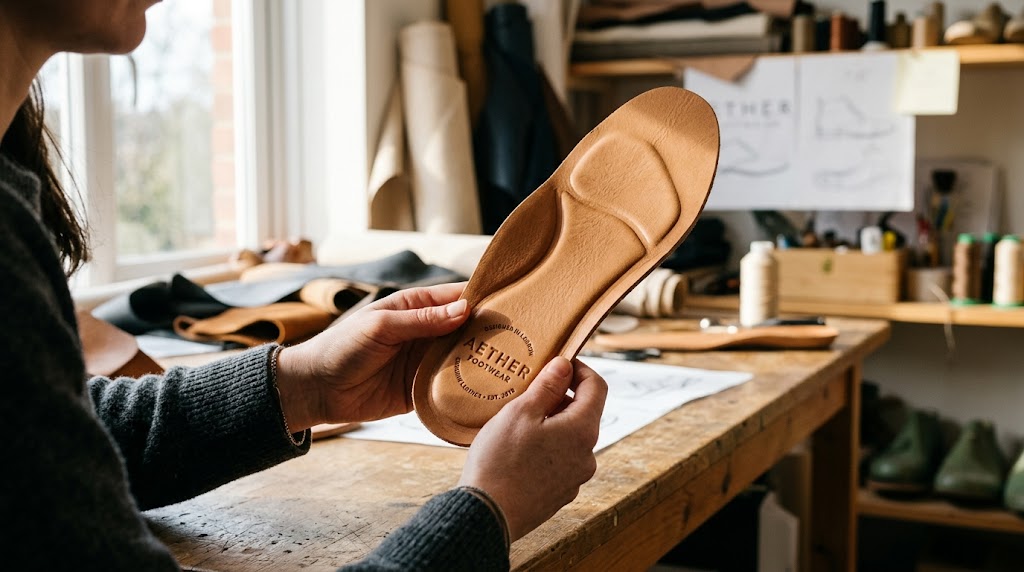
Heat transfer printing is the most common method for applying graphics, logos, and patterns to insole top cloth surfaces. It offers excellent color reproduction and durability, and is suitable for complex multi-color designs. This is the go-to method for most brand partners.
Screen printing is another reliable option for logo application on top cloth, particularly for simpler designs or single-color branding elements. It’s cost-effective at scale and integrates well into high-volume production workflows.
Embossing and debossing are used for structural components such as heel cups and contoured footbed surfaces. These methods create a tactile, premium feel and work well for brands that want a subtle, textured branding approach rather than printed graphics.
Beyond surface branding, footbed customization extends to material selection, density tuning, contour profiling, top cloth texture and color, and even fragrance or antimicrobial treatments. A capable footbed manufacturer will offer a structured customization menu rather than treating every request as a one-off project. This is where having end-to-end production control — from material foaming through final assembly — becomes a genuine advantage, because it means your OEM partner can adjust formulations, densities, and construction methods without relying on upstream third parties.
For brands exploring sustainable product lines, the integration of materials like algae-based EVA (which reduces reliance on petroleum-based materials) or Susterra®-based bio-PU into standard footbed constructions provides a compelling marketing story backed by measurable environmental improvements. These options are available within existing product types, not as a separate specialty line, which makes them easy to incorporate without overhauling your supply chain.
Why FX Footwear Stands Out
FX Footwear (Fuxiang Group) has built its reputation as a footbed manufacturer by addressing the specific pain points that custom footwear brands face during sourcing.
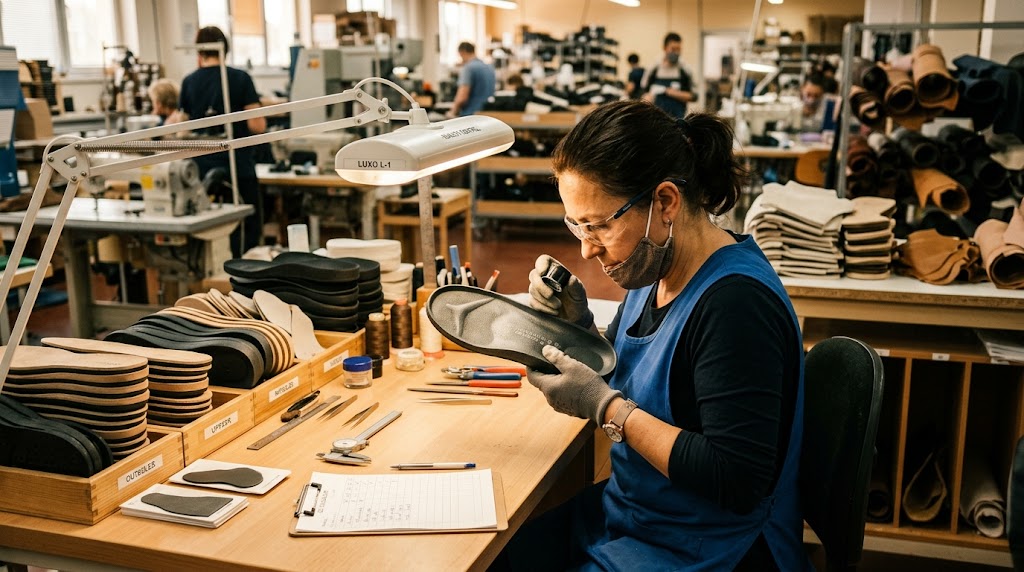
One-stop component manufacturing is the most immediate differentiator. FX produces not just insoles and footbeds, but also midsoles, uppers, and other key footwear components. This means brands can consolidate suppliers across multiple component categories — reducing vendor management overhead, improving cross-component quality consistency, and simplifying logistics coordination. When your insole and midsole come from the same manufacturer, dimensional tolerances align more reliably and material compatibility is guaranteed.
Regional manufacturing across China, Northern Vietnam, Southern Vietnam, and Indonesia positions FX’s facilities alongside the major Tier 1 footwear manufacturing hubs. This geographic alignment enables faster component delivery to assembly factories, localized technical coordination, and reduced duty exposure through country-of-origin diversification. For US brands navigating evolving trade policies, this flexibility is strategically important.
End-to-end production control — from raw material foaming through final component assembly — gives FX consistent quality output and stable supply chain performance. Brands working with FX get better control over performance specs across batches, which reduces the reject rate and rework costs that plague brands sourcing from fragmented supply chains.
FX’s in-house testing lab enables rapid material validation and product iteration during the development phase, reducing reliance on external testing timelines. When formal third-party verification is needed, FX coordinates testing through partners including Intertek and BETA, and maintains GRS, ISO 13485:2016, and Higg Index certifications that meet the compliance requirements of major US brands and retailers. Confirmed brand partners including HOKA, Clarks, KEEN, UGG, On, Arjat, and Teva have trusted FX as part of their component supply chain.
Cost efficiency at scale rounds out the value proposition. Integrated production and regional manufacturing across Asia deliver competitive pricing without compromising quality or lead time — a balance that’s difficult for single-facility or trading-company suppliers to match.
FAQ
What is a footbed in footwear?
A footbed is the shaped surface inside a shoe that your foot rests on, providing cushioning, support, and comfort. It can be a simple flat insole or a contoured, multi-material component with structural support elements.
How long does footbed sampling take?
Die-cut samples with no new tooling take approximately 3 days, while samples requiring new molds typically take around 10 business days.
What materials are best for footbeds?
EVA is best for lightweight, versatile applications; PU excels in compression resistance and long-term shape retention; supercritical CO₂ foam delivers the highest energy return for performance footwear.
Can footbeds include sustainable materials?
Yes — options like sugarcane-based EVA, algae-based EVA, recycled EVA compounds, and Susterra®-based bio-PU are commercially available through GRS-certified supply chains.
What certifications should a footbed manufacturer have?
For US market brands, look for GRS (sustainability), ISO 13485 (medical/orthotic applications), Higg Index (supply chain sustainability), plus CPSC compliance and California Prop 65 adherence.
Ready to develop custom footbeds that elevate your next footwear collection? FX Footwear (Fuxiang Group) combines one-stop component manufacturing, regional production across Asia, in-house testing, and proven partnerships with leading global brands to deliver footbed solutions tailored to your specs. Reach out to the FX team to start your project — from material selection through bulk delivery, you’ll have a dedicated manufacturing partner at every step.