
Footwear material cost performance in 2026 comes down to one question: can you keep the same target cost while improving rebound, hand feel, appearance, or durability? Often, yes, but the right swap depends on whether the buyer is paying for energy return, softness, molded shape, sustainability documentation, or fewer supply chain headaches.
Footwear Material Cost Performance Short Answer
A shoe R&D team can often move to a similar-cost material with better rebound or hand feel, but only when the target is narrow. EVA is still the cost floor. PU improves comfort and shape retention. Supercritical CO₂ foam raises rebound. The wrong upgrade adds cost without changing the consumer’s first try-on impression.

That last point matters. A runner feels rebound in the first 30 seconds. A workwear buyer notices underfoot fatigue after a full shift. A casual sneaker customer may care more about surface feel and a clean top-cloth graphic than foam chemistry.
So the material question can’t be “Which foam is best?”
It should be: “Which material improves the one thing this shoe is failing at, without forcing us to redesign the whole construction?”
| R&D Goal | Better First Choice | Why It Usually Works | Watch-Out |
|---|---|---|---|
| Lower cost | EVA | Mature supply, fast tooling, wide hardness range | Can feel flat in premium claims |
| Softer step-in | PU | Soft hand feel and long-term shape retention | Lower rebound than EVA or SCF |
| Better rebound | Supercritical CO₂ foam | High rebound is possible in supplier specs; verify the exact datasheet | Higher material and process cost |
| Cleaner graphics | Top cloth + heat transfer print | Better appearance without changing foam core | Print durability still needs testing |
| Sustainability story | Recycled EVA, sugarcane EVA, algae-based EVA, Susterra® PU | Fits existing product types | Needs traceability documents |
In recent FX Footwear sourcing discussions, the repeated buyer request has been oddly specific: “Can we get better bounce, a softer touch, or a cleaner look without moving into a premium bill of materials?” That is the real footwear material cost performance problem. Buyers aren’t asking for a science project. They want a practical replacement that still works inside a margin sheet.
For insoles, the quickest win is often construction-based, not material-based. A single-layer EVA footbed may become a dual-density EVA insole. A PU comfort layer may stay thin and targeted under the heel. A supercritical foam insert may be placed only where rebound matters. When an R&D team works with a custom shoe insole manufacturer that controls foaming, molding, assembly, and testing, those options are easier to cost out before the sample round burns two weeks.
Footwear Material Cost Performance Foam Choices
EVA is still the default answer when cost, weight, and production speed are the main goals. For footwear components, EVA insole hardness is normally specified in Asker C, with a common range of 20-45 Asker C and a tolerance of about ±3. That small unit detail saves confusion. Shore C is the wrong language for this category.

EVA can be compression-molded, injection-molded, or die-cut. Die-cut EVA is the fast route when you don’t need new tooling. Compression molding gives you better shape and edge definition. Injection molding helps when the geometry needs repeatability at scale.
A mid-price athletic shoe, a school shoe program, and a basic workwear footbed may all use EVA, but they shouldn’t use the same EVA. The performance target changes.
| EVA Format | Best Use | Cost Behavior | R&D Note |
|---|---|---|---|
| Die-cut EVA | Flat footbeds, liners, simple replacements | Lowest tooling burden | Sampling can be around 3 days when no new tooling is needed |
| Compression-molded EVA | Contoured insoles, heel cups, arch shape | Moderate | Good for visible shape and fit control |
| Injection-molded EVA | Repeatable geometry at scale | Depends on mold and volume | Better when geometry is locked early |
PU sits in a different lane. It gives compression resistance, long-term shape retention, and a soft, comfortable feel. Open-cell PU also improves breathability. Use PU when the customer cares about comfort over time and a plush step-in, especially in casual, comfort, therapeutic, or orthotic-adjacent footwear.
But don’t sell PU as high rebound. In energy return, the normal ranking is supercritical foam first, EVA second, PU third. PU can feel expensive underfoot because it holds shape and absorbs load well. It doesn’t give the springy response that performance footwear teams usually mean when they say “rebound.”
Supercritical CO₂ foam is the performance answer. The material has a microcellular structure with predominantly closed cells and is made without traditional chemical blowing agents. In supercritical fluid foaming, CO₂ or N₂ is used as the blowing agent. Treat low-density and high-rebound figures as datasheet-specific claims, not universal promises.
That isn’t needed for every shoe.
A $39.99 casual sneaker doesn’t need PEBA-level bounce. A training shoe may benefit from supercritical EVA or TPU-blend foam. A race-day product is where PEBA becomes a serious option, especially when every gram and every percentage point of rebound gets discussed in the product meeting.
For FX Footwear’s PulseSport line, the correct framing is performance-focused impact absorption and consistent energy feedback across repeated use. If you’re comparing performance insoles for a running, court, or training project, supercritical CO₂ foam belongs in the early R&D conversation, not as a late upgrade after tooling is already approved.
Footwear Material Cost Performance Material Swaps
A similar-cost swap usually works when you change one variable at a time. Change foam, thickness, top cloth, heel cup structure, and logo method all at once, and nobody can tell what made the sample better or worse.
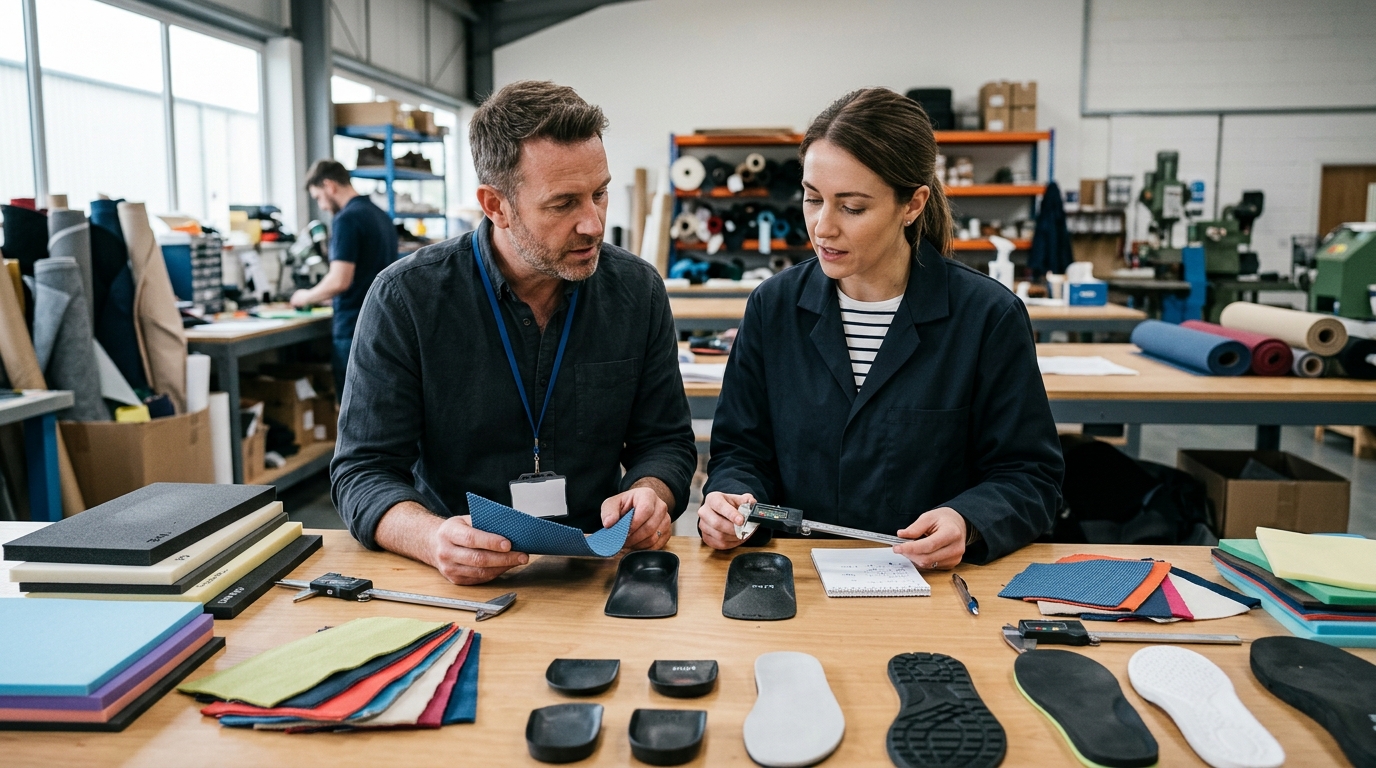
Start with the failure point.
If the current insole feels dead after wear testing, look at EVA density, multi-density EVA, or a targeted supercritical insert. If the top surface feels cheap, change the textile and printing method before changing the foam. If the heel collapses too fast, PU or a structured heel component may solve the issue better than a rebound upgrade.
| Current Problem | Practical Swap | Expected Improvement | Cost Risk |
|---|---|---|---|
| EVA feels too firm | Softer EVA within 20-45 Asker C range | Better step-in comfort | May reduce support |
| EVA packs out too fast | PU layer or higher-grade EVA | Better shape retention | PU may add weight |
| PU feels too flat | EVA or SCF insert in forefoot/heel | More responsive feel | Needs construction testing |
| Basic foam looks low-end | Better top cloth + heat transfer print | Cleaner retail appearance | Print durability testing needed |
| Sustainability request | Recycled EVA or sugarcane-based EVA | Better sourcing story | Traceability documents required |
| Premium running brief | SCF EVA, TPU blend, or PEBA blend | Higher rebound | Price jumps quickly |
Here is the useful order for supercritical fluid foaming base resins: EVA < TPU < TPEE < PEBA by cost. EVA is the most mature and cost-effective SCF base material. TPU brings elasticity, abrasion resistance, mechanical strength, and oil resistance, but it is denser and is often blended with EVA to balance weight and rebound. TPEE is useful when heat resistance and chemical resistance matter, usually in outdoor or sole applications. PEBA is the premium option for elite running footwear.
The rebound hierarchy in SCF applications is PEBA > TPEE > TPU-blend > EVA. Keep that sentence close to your brief.
Industry buyers know PEBA because elite racing shoes have made high-energy-return foam stories visible. That market context helps explain why PEBA has a premium reputation, but it also explains why PEBA shouldn’t be treated as a normal entry-level material.
A more grounded approach is usually better: SCF EVA for value-tier performance, TPU-blend foam for more resilience, and PEBA only when the shoe’s price point can carry it.
Sustainable materials need the same discipline. Sugarcane-based EVA, algae-based foam that reduces reliance on petroleum-based materials, recycled EVA compounds, Susterra®-based PU formulations, and OrthoLite alternatives are material options within existing product types. They are not a separate finished-product category by themselves. For GRS-related programs, FX Footwear can support traceable supply chains for recycled-material inputs.
Latex doesn’t belong in the FX Footwear insole material list. FX Footwear doesn’t produce latex insoles.
Footwear Material Cost Performance Hand Feel
Buyers often say “better material” when they mean “better first touch.” That can be foam, but it can also be the textile, lamination, edge finish, surface print, or molded detail.

Pick up two insoles on a sample table. One has a decent foam core with a rough top cloth and a weak logo print. The other has a similar foam, tighter fabric, clean heat transfer print, and a heel cup with a crisp debossed mark. The second one feels more expensive before anyone compresses the foam.
Branding methods matter here. For insole surfaces, heat transfer print is the most common method for top cloth graphics, and screen print works for logo application on top cloth. Embossing or debossing fits structural components such as heel cups. Laser etching should be reserved for TPU or rubber outsole and bottom components, not insole top surfaces.
| Surface Goal | Better Method | Best Placement |
|---|---|---|
| Full-surface graphic | Heat transfer print | Top cloth |
| Simple logo | Screen print | Top cloth |
| Premium molded detail | Emboss or deboss | Heel cup or structural piece |
| Bottom-component marking | Laser etching | TPU or rubber outsole/bottom part |
Appearance upgrades are often cheaper than foam upgrades. If the target shoe sells through retail photography or marketplace thumbnails, a sharper top cloth and cleaner logo may create more perceived value than moving from EVA to PU. This is especially true for comfort, casual, and lifestyle footwear where the buyer’s first impression comes from the product page or unboxing.
Hand feel has its own traps. A very soft top layer can feel great in a showroom and fail after compression cycling. A rougher textile may test better for moisture and abrasion. A premium-looking print may crack if the fabric stretch and adhesive system are mismatched.
FX Footwear’s in-house lab is useful because these tradeoffs show up early. You can compare compression, rebound, abrasion, bonding, and surface finish before sending the sample to external labs such as SGS, SATRA, ASTM-based test programs, Intertek, or BETA when the customer specification calls for it.
Footwear Material Cost Performance Compliance Reports
For US brands and retailers, compliance should start with the US market. The United States Consumer Product Safety Commission states that children’s products with more than 100 ppm lead in an accessible component are banned hazardous substances under CPSIA rules. That matters for kids’ footwear, trims, coatings, prints, and accessible components, not only toys.

California Proposition 65 is another practical checkpoint. The California Office of Environmental Health Hazard Assessment explains that businesses may need warnings when products expose California consumers to listed chemicals above safe harbor levels. For footwear teams, this often means checking adhesives, coatings, pigments, plasticizers, and packaging claims before the purchase order is placed.
| Requirement Area | Main Market | What R&D Should Ask |
|---|---|---|
| CPSC / CPSIA | United States | Is this children’s footwear or an accessible child-use component? |
| California Prop 65 | California / US retail | Are any listed chemicals present above relevant exposure thresholds? |
| REACH | European Union | Is EU entry part of this program? |
| GRS | Recycled-material supply chain | Can recycled content be traced and documented? |
| ISO 13485:2016 | Therapeutic / orthotic applications | Does the product sit near medical-device quality expectations? |
REACH needs careful wording. REACH is an EU chemical regulation. It is not a certification, and it is not a test standard. FX Footwear can source materials to meet REACH requirements when a customer specifies EU market entry, but the primary FX Footwear market is the United States, so REACH shouldn’t be presented as a routine baseline for every program.
FX Footwear’s confirmed certifications and verification framework include GRS, ISO 13485:2016, Higg Index, Intertek, and BETA. For the insole and footwear OEM space, a serious compliance conversation should also cover CPSC, California Prop 65, SATRA, SGS, ASTM test reports, and social audits such as BSCI or SMETA when requested by the buyer.
Do not treat certification as a decoration line in a catalog. It affects material choice. A recycled EVA program needs traceability. A therapeutic footwear application may require ISO 13485:2016 alignment. A kids’ footwear order headed to a US retailer needs a different testing mindset from a men’s casual insole for an adult lifestyle shoe.
Lead time also belongs in compliance planning. Standard EVA insoles with no customization usually run 20-35 days after payment confirmation. Supercritical CO₂ foam insoles are closer to 30-45 days. Custom insoles often need 7-14 days for sampling and about 30-40 days for bulk production after sample approval. First-time custom sourcing can easily become a 65-100 day cycle once development, production, and freight are counted.
Footwear Material Cost Performance R&D Checklist
Use a decision sheet before you ask for the next sample. It doesn’t need to be fancy. One page is enough.

The first line should be the target failure: rebound, softness, weight, compression set, breathability, appearance, sustainability documentation, or cost. If you can’t name the failure, the supplier has to guess. Guessing is expensive.
| Question | Why It Matters |
|---|---|
| What is the current material and hardness? | EVA at 25 Asker C behaves very differently from EVA at 40 Asker C |
| Which performance target matters most? | Rebound, hand feel, and shape retention point to different materials |
| Is the product adult, children’s, or therapeutic? | Compliance and documentation change fast |
| Does the shoe need new tooling? | Sampling shifts from about 3 days to about 10 business days when new molds are needed |
| Is sustainability a claim or a requirement? | GRS traceability needs to be planned, not added at shipment |
| Which market receives the goods? | US-first programs should lead with CPSC and Prop 65, EU programs bring REACH into scope |
For a value-tier athletic shoe, start with EVA. If rebound is the concern, test SCF EVA before jumping to PEBA. For a comfort shoe, compare PU against a dual-density EVA construction before changing the whole insole architecture. For a premium running brief, put SCF TPU-blend or PEBA-blend materials into the first prototype round, because late-stage performance upgrades usually disturb thickness, weight, fit, and costing.
For appearance, don’t overpay for chemistry. Change the top cloth, refine the print, or use a cleaner heel-cup deboss. For sustainability, choose the material option inside the product type: sugarcane-based EVA, algae-based EVA, recycled EVA compounds, Susterra®-based PU, or open-cell cushioning alternatives.
The best R&D teams ask for two sample paths: a low-risk cost-controlled path and a performance path. Path A protects margin. Path B shows the buyer what improvement costs. When both samples arrive, the decision becomes physical. You compress the heel. You bend the arch. You look at the print under bad office lighting. Then the spreadsheet makes more sense.
Payment and quotation timing should be just as clear. For new customers, FX Footwear’s standard payment term is 30% deposit upfront and 70% before shipment, with sampling costs paid upfront. Initial quotations for standard constructions with existing tooling and materials are usually provided within 48 hours. Detailed cost breakdowns come after technical evaluation.
FX Footwear’s regional manufacturing footprint in China, Northern Vietnam, Southern Vietnam, and Indonesia helps when brands want to align components near Tier 1 footwear hubs. That can reduce coordination time, support localized production planning, and limit duty exposure depending on the final program structure.
FAQ
Can EVA replace PU?
Yes, EVA can replace PU when lower cost, lighter weight, or higher rebound matters more than long-term plush comfort. PU is still better for compression resistance, shape retention, and a softer comfort feel.
Is supercritical foam worth it?
Supercritical CO₂ foam is worth it for athletic footwear where rebound, impact absorption, and low density affect the product story. It is usually excessive for basic casual or low-price comfort shoes.
Which foam has best rebound?
In normal footwear comparisons, supercritical foam has the best rebound, followed by EVA, then PU. In SCF resin choices, the rebound order is PEBA, TPEE, TPU-blend, then EVA.
Does FX offer latex insoles?
No. FX Footwear doesn’t produce latex insoles, so latex shouldn’t be included in FX Footwear material lists or sourcing briefs.
Is REACH a certification?
No. REACH is an EU chemical regulation, not a certification or test standard. FX Footwear can coordinate REACH-related compliance for EU-destined projects when the customer specifies that requirement.
Send FX Footwear (Fuxiang Group) your current material, target cost, shoe category, market, and the one performance problem you want to fix. We can compare footwear material cost performance across EVA, PU, supercritical CO₂ foam, sustainable material options, and component construction before you commit to tooling or bulk production.