PEBA Midsole Foam: The Material Science Behind the Sub-2 Marathon
On April 27, 2025, Sebastian Sawe crossed the London Marathon finish line in 1:59:30. A human ran 26.2 miles in under two hours on an officially sanctioned course — only the second time in history. And beneath his feet, a slab of PEBA midsole foam called EVO 3 was doing work that no other material can replicate at that weight.
If you’re a footwear brand trying to understand what PEBA foam actually is, why it outperforms EVA and TPU at the elite level, and whether you can access the same supercritical fluid (SCF) foaming technology for your own product line — this is the article. We’ll unpack the material science, trace the Chinese innovation behind EVO’s three generations, and show you where FX Footwear fits into this supply chain.
What Happened in London
Sawe’s sub-2 wasn’t just a physiological feat. It was an equipment story.
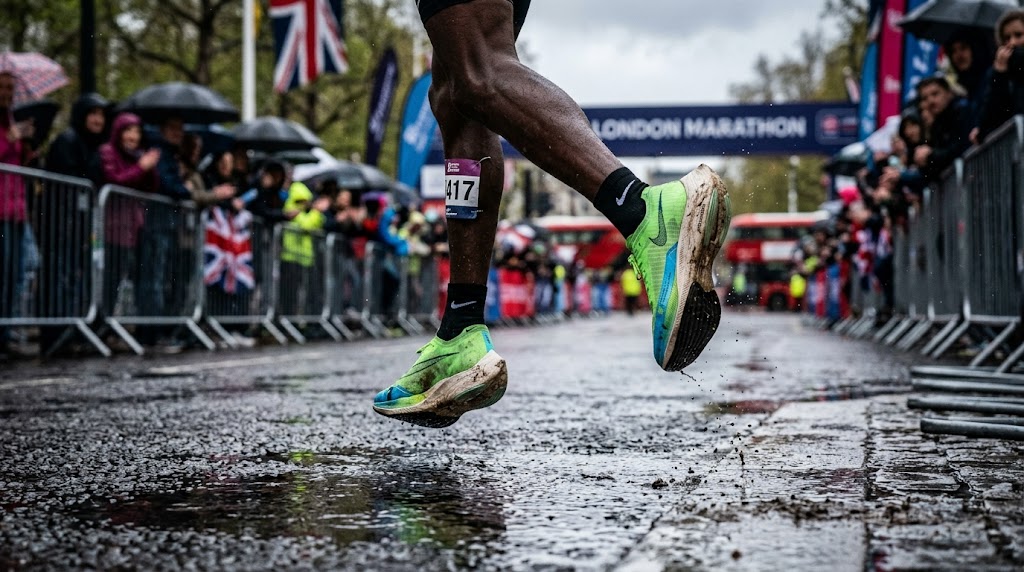
The shoe on his feet — the Adidas Adizero Adios EVO 3 — used a PEBA-based midsole foamed through supercritical nitrogen (N₂) processing. Adidas published the shoe’s specs: 138 grams in a US men’s size 8.5, with a midsole stack height of roughly 40mm. That’s absurdly light. For context, a typical performance racing flat from 2018 weighed around 200–220 grams. The EVO 3 stripped nearly 40% of that weight while increasing energy return.
The key metric racing shoe designers obsess over is rebound rate — what percentage of impact energy the foam gives back to the runner. Standard EVA midsoles return roughly 55–65%. Nike’s ZoomX (also PEBA-based) pushed that toward 70–75%. The EVO 3’s foam reportedly exceeds 80% rebound at a density near 0.07 g/cm³. Those two numbers together — 80%+ rebound at sub-0.1 density — are the material science equivalent of breaking a four-minute mile.
But here’s the part most articles skip: who actually made the foam?
Shincell’s EVO 1→2→3 Arc
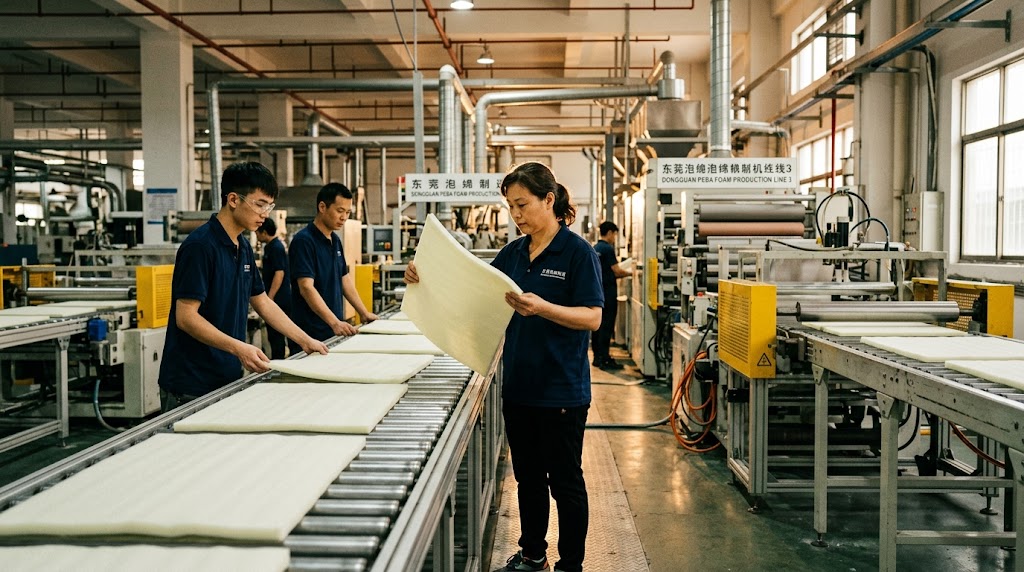
The PEBA foam inside Adidas’s EVO series comes from Shincell (申赛新材料), a Chinese specialty foam supplier based in Suzhou, Jiangsu Province. Shincell has been developing supercritical fluid foaming technology specifically for high-performance footwear applications since the mid-2010s, and the EVO partnership with Adidas represents their most visible commercial output.
EVO 1 (2023) debuted as a proof-of-concept distance racer. The midsole used a first-generation PEBA SCF foam — lighter than Adidas’s previous Lightstrike Pro (a TPU-based foam) but still relatively stiff at initial foot strike. Runners noted a firm ride that rewarded high cadence.
EVO 2 (2024) refined the cell structure. Shincell adjusted the foaming parameters — pressure, temperature, CO₂/N₂ saturation levels — to produce a more uniform microcellular structure. The result felt softer at ground contact while maintaining the same rebound characteristics. Weight dropped further.
EVO 3 (2025) is where everything clicked. The 138-gram weight at 80%+ energy return represents the current ceiling of what PEBA SCF foam can achieve in mass production. Shincell’s contribution here isn’t just the resin (PEBA is commercially available from suppliers like Arkema under the Pebax brand). Their contribution is process control — knowing exactly how to saturate, heat, and expand a PEBA preform so the resulting microcellular structure hits those density and rebound targets batch after batch.
This matters for brands evaluating PEBA midsoles. The resin is available. The physics is published. The hard part is process engineering at scale.
PEBA SCF Foam: Material Science
PEBA midsole foam is created through supercritical fluid foaming — a physical foaming process that uses CO₂ or N₂ as the blowing agent, without traditional chemical blowing agents. Here’s what that means in practice.
The base resin: PEBA (Polyether Block Amide). PEBA is a nylon elastomer — a block copolymer with rigid polyamide segments and flexible polyether segments. That dual-phase structure gives it an unusual combination: very high elastic recovery (the rigid blocks snap back) with very low hysteresis loss (the flexible blocks absorb and release energy efficiently). Arkema’s Pebax Rnew grades, derived partially from castor oil, are the most commonly specified PEBA resins in athletic footwear. (Arkema Pebax product page)
The foaming process: supercritical fluid (SCF). The PEBA resin is placed in a pressure vessel and saturated with CO₂ or N₂ at supercritical conditions (above the gas’s critical temperature and pressure, where it behaves as both a liquid and a gas simultaneously). When pressure is rapidly released, the dissolved gas nucleates into millions of tiny bubbles within the polymer matrix. The result is a microcellular structure with predominantly closed cells — foam that’s extremely light but retains mechanical integrity.
| Property | EVA (SCF) | TPU-Blend (SCF) | PEBA (SCF) |
|---|---|---|---|
| Achievable foam density | 0.10–0.15 g/cm³ | 0.08–0.12 g/cm³ | As low as 0.07 g/cm³ |
| Rebound rate | 55–65% | 65–75% | 80%+ |
| Relative cost (resin) | Lowest | Mid | Highest |
| Best application | Casual, value athletic | Premium daily trainers | Elite racing, performance |
Why PEBA beats EVA and TPU on energy return. It comes down to molecular architecture. EVA is a semi-crystalline copolymer with relatively high hysteresis — each compression cycle converts more energy to heat, which the runner never gets back. TPU is better (the urethane hard segments store energy more elastically), but its density is inherently higher, so TPU-based foams tend to be heavier at equivalent softness. PEBA’s polyamide hard blocks are stiffer per unit mass than TPU’s urethane segments, meaning you need less material to achieve the same structural rebound. Less material = lower density = lighter shoe.
That said, PEBA’s material cost is 3–5× higher than EVA resin, and the foaming process requires tighter parameter control. You wouldn’t spec PEBA for a $60 casual sneaker. The material makes economic sense when the product’s retail price justifies the premium — typically $150+ performance shoes — or when the weight/rebound requirement simply can’t be met any other way.
SCF Technology Beyond PEBA
PEBA gets the headlines, but the supercritical fluid foaming platform supports four base resins, and most commercial volume actually runs through the less glamorous ones.
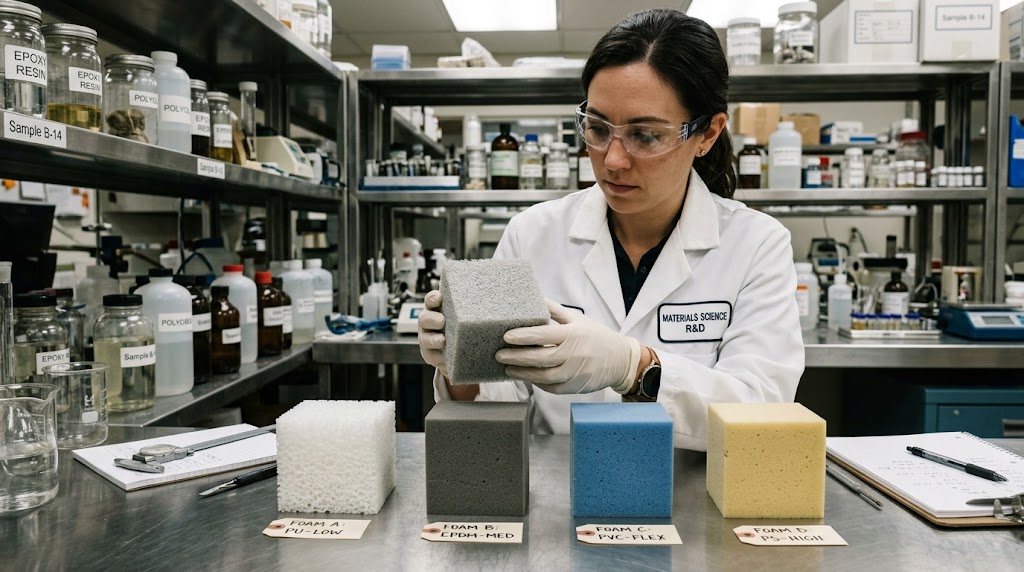
EVA remains the most widely used SCF base material. It’s the cheapest resin, the most mature process, and it covers the vast majority of athletic and casual midsole applications. If you’re exploring the top EVA midsole manufacturers for your supply chain, understand that many of them are now running SCF lines alongside traditional compression molding.
TPU is the workhorse for premium daily trainers. Brands like On (with their CloudTec midsoles) and HOKA use TPU or TPU-blend SCF foams extensively. After foaming, TPU pellets expand into soft, lightweight beads that can be steam-molded into midsole shapes. The tradeoff: TPU foam is denser than EVA foam at equivalent softness, so it’s often blended with EVA to balance weight and rebound.
TPEE (Thermoplastic Polyester Elastomer) occupies a niche — good heat resistance and chemical resistance make it suitable for athletic outsoles and outdoor performance soles that face thermal stress. Higher price than EVA or TPU, lower than PEBA.
PEBA sits at the top. The fastest-growing, highest-performance SCF base material, positioned exclusively for elite-level athletic footwear. Typically blended with EVA or TPU before foaming to optimize the cost-to-performance ratio — very few production shoes use 100% PEBA foam.
The rebound hierarchy in SCF applications runs: PEBA > TPEE > TPU-blend > EVA. The cost hierarchy runs the same direction.
All four resins share the same core SCF advantage: the blowing agents are CO₂ or N₂ only. No VOCs. No chemical residue. That environmental profile matters for brands targeting sustainability-conscious consumers and for meeting increasingly strict chemical regulations in the US (CPSC, California Prop 65) and EU markets.
At production scale, the achievable foam density across all SCF materials can reach as low as 0.07 g/cm³, with rebound rates of 80%+ for the best PEBA formulations. Those benchmarks come from material supplier specifications and represent the current state of the art as of 2025.
FX Footwear’s SCF Capability
Here’s where this shifts from interesting material science to something you can actually act on.
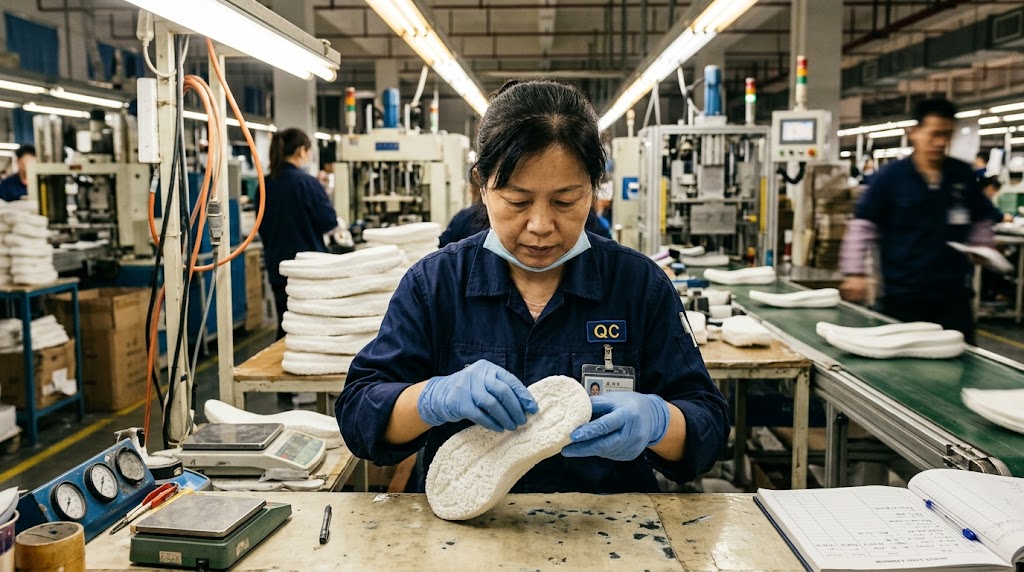
FX Footwear (Fuxiang Group) operates the same supercritical fluid foaming technology stack used in elite performance footwear — available for brands at production scale. We’re a one-stop footwear component manufacturer with facilities across China, Northern Vietnam, Southern Vietnam, and Indonesia, positioned alongside major Tier 1 footwear manufacturing hubs like Pou Chen and Feng Tay.
Our supercritical CO₂ foam insole line (the PulseSport series) already delivers SCF-foamed components to established performance brands. The same foaming equipment and process engineering applies to midsoles.
What does that mean practically?
You don’t need to be Adidas to access SCF foam. The equipment exists. The process knowledge exists. What mid-market brands typically lack is a component supplier who can run EVA, TPU-blend, and PEBA formulations on the same SCF platform, produce samples quickly, and scale to bulk production without requiring a 500,000-pair MOQ.
As a custom midsole supplier, FX provides end-to-end production control — from material foaming to final component assembly. Our in-house lab handles rapid material testing and product validation, which means we’re not waiting weeks for external lab results during the development cycle. For a new SCF midsole project, expect roughly 10 business days from confirmed specs to first samples when new tooling is required.
One thing we don’t do: we don’t produce TPEE or PEBA resins in-house. These are sourced from specialty chemical suppliers (Arkema, BASF, and Chinese resin producers) and processed through our SCF equipment. What FX controls is the foaming process, the tooling, the QC, and the multi-component assembly — which is where most production problems actually occur.
The regional manufacturing footprint matters here too. If your Tier 1 factory is in Vietnam or Indonesia, having your midsole components produced in the same region cuts lead times, reduces freight cost, and lowers your exposure to single-country tariff risk. Standard SCF midsole production runs 30–45 days after payment confirmation, with ocean freight to US ports adding 18–30 days.
When to Spec PEBA vs. TPU vs. EVA
Not every shoe needs PEBA foam. Here’s a material selection framework based on what we see across our customer base.
Choose EVA (SCF) when:
- Retail price target is under $120
- The shoe is a casual lifestyle, walking, or value-tier athletic model
- Weight savings matter but aren’t the primary purchase driver
- You need the most cost-effective SCF option with reliable shape retention
Choose TPU-blend (SCF) when:
- Retail price target is $120–$180
- Durability and abrasion resistance matter (trail running, work-to-gym shoes)
- You want higher rebound than EVA but can tolerate slightly higher density
- The midsole will be a hero feature in your marketing (“energy return technology”)
Choose PEBA or PEBA-blend (SCF) when:
- Retail price target is $180+, typically $200–$250 racing shoes
- Weight is the single most important spec (competition marathon, track spikes, racing flats)
- You need 75%+ energy return and are willing to pay 3–5× the EVA resin cost
- Your marketing story centers on elite performance credentials
A common mistake: brands spec pure PEBA when a PEBA-EVA or PEBA-TPU blend would deliver 90% of the performance at 60% of the cost. The blending approach is how most production shoes actually use PEBA — only the most extreme race-day models (like the EVO 3) justify a high-purity PEBA midsole.
For brands exploring supercritical foam cushioning options across their product line, a tiered approach works well: EVA SCF for your entry-level models, TPU-blend SCF for your mid-range hero product, and PEBA-blend SCF for a limited-edition performance shoe that drives brand credibility.
FAQ
What is PEBA midsole foam?
PEBA midsole foam is a polyether block amide elastomer expanded using supercritical fluid (CO₂ or N₂) foaming. It delivers the highest energy return (80%+) and lowest density (as low as 0.07 g/cm³) among commercial midsole foams, making it the preferred material for elite racing shoes.
Why is PEBA better than EVA for running shoes?
PEBA’s molecular structure — rigid polyamide blocks paired with flexible polyether segments — produces less hysteresis loss per compression cycle than EVA. That means more energy returns to the runner rather than converting to heat. PEBA also achieves lower foam density, reducing shoe weight.
How much does PEBA foam cost compared to EVA?
PEBA resin costs approximately 3–5× more than EVA resin. This is why PEBA foam is typically reserved for premium performance shoes retailing above $180, or blended with EVA/TPU to reduce cost while retaining most of the rebound benefit.
Can mid-size brands access PEBA SCF foam technology?
Yes. SCF foaming equipment is commercially available through component manufacturers like FX Footwear. Brands don’t need Adidas-scale volume to order PEBA or PEBA-blend SCF midsoles — the key is working with a supplier who controls the foaming process at production scale.
What is supercritical fluid foaming in footwear?
Supercritical fluid foaming uses CO₂ or N₂ pressurized above their critical point to expand polymer resins into lightweight microcellular foam. The process uses no chemical blowing agents, produces no VOCs, and works with EVA, TPU, TPEE, and PEBA base materials.
Ready to develop SCF midsoles for your next performance shoe? FX Footwear (Fuxiang Group) runs EVA, TPU-blend, and PEBA formulations on the same supercritical foaming platform — with facilities in China, Vietnam, and Indonesia. Whether you need a wholesale midsole supplier for 10,000 pairs or 500,000, reach out to our team for an initial quote within 48 hours. Let’s talk specs.
Browse more articles in Midsoles & Cushioning.