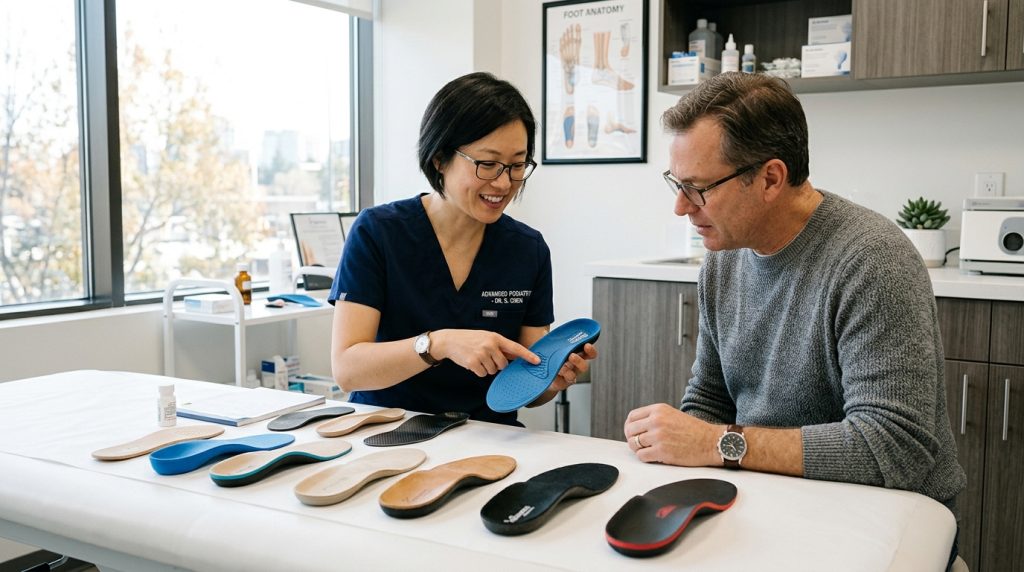
When you’re developing a footwear line, the insole specification is one of the most consequential decisions you’ll make — yet it’s also one of the most frequently underspecified. The insole directly determines how the shoe feels at first wear, how it holds up over the product lifecycle, and how much it contributes to your final landed cost. Choosing the wrong insole type for a given shoe category doesn’t just create comfort problems — it creates returns, warranty claims, and brand reputation damage that far outweigh whatever sourcing cost was saved upfront.
This guide is written for footwear brand managers, OEM buyers, and product developers who need a clear, specification-oriented overview of the seven most common types of insoles, what makes each one distinct, and how to match the right type to the demands of your product line.
1. Cushioning Insoles
Cushioning insoles are the highest-volume category in the global insole market, and the one most brands will work with at some point in their product lineup. Their core function is shock absorption and underfoot comfort — softening impact at heel strike, distributing pressure across the plantar surface, and reducing foot fatigue during extended wear.
Material specs. The dominant material is EVA (ethylene-vinyl acetate) foam, typically specified at 25-45 Asker C hardness and 0.12–0.20 g/cm³ density,depending on foaming process and application. Memory foam (viscoelastic PU) is used as a top lamination layer in premium configurations. Gel inserts — silicone or PU gel — are sometimes added at heel or forefoot zones for localized impact management.
Typical application. Casual footwear, fashion sneakers, everyday walking shoes, and lifestyle athletic shoes. This is the default insole type for any product where comfort is the primary brief and biomechanical correction is not required.
OEM customization notes. Cushioning insoles are the most flexible category for brand customization. Options include custom EVA hardness and color, top fabric selection (breathable mesh, microfiber, recycled textile), logo embossing or heel branding, and custom packaging for retail insertion. Full-length, 3/4-length, and forefoot-only configurations are all standard.
When a brand would choose this type. If your shoe category is everyday casual, lifestyle, or fashion and you need to maximize comfort performance within a defined cost structure, cushioning insoles are the right starting point. For evaluating a reliable EVA insole manufacturer for this category, pay close attention to compression set specifications and durability testing data — these parameters determine whether the cushioning lasts a season or collapses within the first month of wear.
2. Orthotic and Arch Support Insoles
Orthotic and arch support insoles are engineered to control foot motion and redistribute plantar pressure — not simply to add comfort. They feature a structured shell with defined arch geometry, heel cup depth, and forefoot flex characteristics that work together to address overpronation, supination, flat feet, or high-arch profiles.
Material specs. Shell materials include semi-rigid polypropylene (PP), glass-fiber-reinforced polypropylene (PP), or high-density EVA compression-molded to a contoured profile. Carbon fiber shells are used in premium performance and medical applications. A top layer of EVA or memory foam is laminated over the shell for comfort. Total thickness for a full orthotic profile ranges from 4–8 mm at the arch, tapering to 2–3 mm at the forefoot.
Typical application. Athletic performance footwear (running, hiking, trail), occupational safety shoes, medical and therapeutic footwear, and any brand positioning its product around biomechanical support claims.
OEM customization notes. This is the category where last-specific development is non-negotiable. Off-the-shelf arch profiles will not integrate cleanly into a proprietary last without modification. A capable shoe insole manufacturer will work directly from your last data or last scans to engineer an arch geometry that fits your shoe construction precisely — incorrect arch height or heel cup fit is one of the most common reasons orthotic insoles generate consumer complaints.
When a brand would choose this type. Choose orthotic insoles when your product brief includes biomechanical support claims, when your target consumer has specific foot type requirements, or when you’re building into a medical or clinical footwear segment. The development timeline is longer than for standard cushioning insoles — allow 4–6 weeks for last-specific tooling and sample iteration.
3. Sport and Running Insoles
Sport-specific insoles occupy a distinct performance tier from general cushioning. Running and athletic insoles must balance shock attenuation with energy return under cyclical, high-load conditions — a combination that standard EVA foam alone does not fully deliver at higher performance tiers.
Material specs. The material stack in this category is more complex than cushioning insoles. Common configurations include: dual-density EVA (softer heel, firmer midfoot), PU foam base with EVA or memory foam top, TPU heel and forefoot reinforcement plates, and advanced cell-structure foams with improved energy return characteristics. Heel strike zones typically run 5–8 mm finished thickness with higher-density foam; the forefoot is kept lighter and more flexible. Top cover materials must include moisture management (mesh or perforated nonwoven) and antimicrobial treatment as baseline specs.
Typical application. Running shoes, training footwear, outdoor performance shoes, and sports-specific footwear across court, trail, and field categories.
OEM customization notes. Sport insoles require more rigorous QC documentation than general cushioning insoles. Brands should require compression fatigue testing data across a defined loading cycle count — typically 100,000–200,000 cycles — in addition to standard compression set testing. Orthotic insoles for running that combine arch correction with sport-grade cushioning represent one of the fastest-growing sub-categories in performance footwear, and the best sourcing partners will have both the material expertise and the testing infrastructure to validate claims.
When a brand would choose this type. When your product targets athletic or performance consumers and you’re making durability and performance claims that will be tested in real use. Consumer reviews in this segment are performance-driven — insoles that compress out early or fail to deliver consistent energy return will generate measurable negative feedback.
4. Thermal and Insulating Insoles
Thermal insoles are purpose-engineered for cold-weather applications: winter boots, outdoor work boots, and performance footwear used in sub-zero or extreme cold environments. Their core function is to slow heat loss through the shoe sole, maintaining foot warmth even when the outsole is in sustained contact with frozen ground or snow.

Material specs. Thermal insoles typically use a layered construction: a reflective foil base layer (aluminized PET or similar) that returns radiant heat toward the foot, a closed-cell foam mid-layer (EVA or PE foam) that provides both insulation and cushioning, and a textile top cover in wool, wool-blend, or synthetic fleece that traps warm air at the skin level. Total thickness varies from 5–10 mm depending on the insulation performance target and available interior volume.
Typical application. Winter boots, cold-weather work boots, outdoor and hunting footwear, ski boot liners, and any product with a thermal performance rating as part of its feature set.
OEM customization notes. The key sourcing question for thermal insoles is whether the insole maintains its insulation performance after repeated compression cycles and moisture exposure — not just in a pristine initial state. Require lab test data on thermal resistance (CLO value or equivalent) both before and after simulated wear cycles. If the insole’s reflective layer delaminates or the foam compresses prematurely, insulation performance collapses without any visible sign that would trigger a quality hold.
When a brand would choose this type. Any cold-weather product category where thermal comfort is a stated feature. A well-specified thermal insole can allow the brand to reduce upper insulation weight without sacrificing the shoe’s warmth rating — a meaningful weight and cost saving in high-volume winter boot programs.
5. Specialty and Functional Insoles
This category covers insoles engineered for specific use cases that don’t fit cleanly into the broader cushioning or orthotic buckets. Sub-types include anti-fatigue insoles for occupational footwear, heel-lift insoles for leg-length discrepancy accommodation, metatarsal pad insoles for ball-of-foot pressure relief, and slim dress shoe liners designed for low-volume constructions.
Material specs. Specs vary significantly by sub-type. Anti-fatigue insoles for occupational use typically run 8–12 mm profile, combining a firmer support layer with a softer memory foam or gel top layer targeting heel and metatarsal zones. Dress shoe liners must operate within 2–4 mm total thickness, requiring higher-density materials and precision die-cutting. Metatarsal pads are often constructed from silicone gel or soft PU and can be integrated as a fixed feature or supplied as an adhesive-backed overlay.
Typical application. Work boots, occupational safety footwear, dress shoes, and any product category where a specific anatomical function is required beyond general cushioning.
OEM customization notes. For brands targeting occupational and safety footwear markets, anti-fatigue insoles are a high-value category. Procurement buyers in those segments evaluate performance documentation — compression fatigue data, shift-length wear test results, compliance with EN or ASTM standards — as a primary qualification criterion rather than an afterthought. Brands that supply this documentation alongside production samples move through the approval process significantly faster than those who cannot.
When a brand would choose this type. When a specific functional problem — extended standing fatigue, forefoot pain in dress shoe constructions, leg-length accommodation — is part of the product brief. These insoles are often specified for niche product lines rather than mass-market volume, but they carry higher per-unit margins and strong brand differentiation value in their target categories.
6. Work and Safety Insoles
Work and safety insoles operate under a fundamentally different specification framework than consumer footwear insoles. The primary performance requirements are durability under sustained compressive load, resistance to oils and industrial chemicals, and in some cases compliance with occupational safety certifications — not simply comfort or aesthetics.
Material specs. High-density EVA or PU foam base layers are standard, sized to resist compression set over 8–12 hour shift durations. Some constructions incorporate a rigid or semi-rigid puncture-resistant mid-layer (steel or composite plate equivalent at the insole level) for environments with debris or sharp-object exposure. Top fabrics must be antimicrobial, moisture-wicking, and chemically resistant to common industrial cleaning agents. Total finished thickness is typically 8–14 mm for full anti-fatigue designs.
Typical application. Steel-toe work boots, slip-resistant work shoes, and industrial footwear deployed in construction, manufacturing, logistics, food processing, and warehousing environments.
OEM customization notes. Performance documentation is as important as price in this category. B2B buyers — procurement departments at industrial employers, safety footwear distributors, and contract footwear managers — routinely request test data on compression fatigue across simulated shift durations, abrasion resistance of the top cover, and compliance with Martindale or SATRA TM31 performance standards before approving an insole for production integration. Private-label branding is also common in this category, with safety footwear brands specifying custom color coding and logo placement to reinforce brand identity.
When a brand would choose this type. Any occupational or safety footwear program where end users will wear the shoe for sustained shifts under load. Under-specifying the insole in this category — choosing a consumer-grade cushioning insole for a work boot application — is one of the most common and most visible product failures in the category.
7. Custom and 3D-Printed Insoles
Custom insoles represent the premium end of the types of insoles spectrum and are increasingly relevant to brands that want to offer personalized fit or proprietary geometry as a product differentiator. The manufacturing landscape has shifted considerably from the era of purely clinical custom orthotics — 3D printing and computational design have made it practical to produce insoles built to a proprietary geometric profile at commercial scale.
Material specs. 3D-printed insoles are most commonly produced in TPU (thermoplastic polyurethane) lattice structures or flexible nylon (PA12) via selective laser sintering (SLS) or multi-jet fusion (MJF) processes. Lattice geometry can be algorithmically tuned to vary stiffness zone by zone across the footbed — delivering different cushioning and support characteristics in the heel, midfoot, and forefoot from a single-material construction. Conventional custom insoles for performance or medical use continue to use compression-molded EVA, polypropylene, or carbon fiber.
Typical application. Premium performance sports footwear, made-to-order athletic insoles, medical and rehabilitation footwear, and premium lifestyle brands positioning personalized fit as a core product feature.
OEM customization notes. The key commercial consideration for 3D-printed insoles is scalability vs. turnaround time. Additive manufacturing is inherently slower per unit than injection molding or die-cutting, so the economics favor made-to-order business models rather than stock production runs. For brands evaluating this category, infrastructure decisions — foot scanning partnerships, algorithmic design software, and manufacturing relationships — determine how efficiently the category can operate at scale. As printing speeds and material options continue to improve, the cost gap versus conventional manufacturing is narrowing across the performance footwear market.
When a brand would choose this type. When personalized fit, proprietary geometry, or premium positioning is a core part of the product strategy — and when the target consumer’s price sensitivity supports a premium insole cost structure. Brands that invest in the infrastructure now are building lead time advantage in a category that is growing rapidly across both performance and medical footwear applications.
Matching Insole Type to Shoe Category: A Quick Reference for Product Developers
The seven categories above can be mapped directly to common footwear development briefs:
| Shoe Category | Primary Insole Type | Secondary Consideration |
|---|---|---|
| Everyday casual / lifestyle | Cushioning (EVA, 25–45 Asker C) | Top cover material, logo branding |
| Athletic / running | Sport insole (dual-density) | Compression fatigue testing, arch profile |
| Outdoor / hiking | Orthotic or sport insole | Moisture management, lateral stability |
| Winter / cold-weather boot | Thermal insole | CLO rating post-compression, layering |
| Work boot / occupational | Work & safety insole (high-density EVA or PU) | Compression set, chemical resistance |
| Dress shoe | Specialty slim liner (2–4 mm, high density) | Dimensional precision, adhesive bond |
| Premium / performance | Custom or 3D-printed | MOQ economics, scanning infrastructure |
Conclusion
Across all seven categories — cushioning, orthotic and arch support, running and sport, thermal, specialty and functional, work and safety, and custom — the foundational principle is the same: the correct insole type is determined by the demands of the end application, not by a generic default. Understanding the full range of types of insoles available allows brands to make more precise sourcing decisions, reduce development iteration cycles, and deliver a stronger in-shoe experience that holds up to real-world wear.
At FX Footwear (Fuxiang Group), we manufacture insoles across every one of these categories, working directly from brand specifications and last data to produce components that integrate cleanly into finished footwear. Whether you need a high-volume cushioning liner for a global retail program or a fully custom arch support profile built to your proprietary last geometry, our product development and QC teams support your program from initial spec through production approval.
FAQ
What are the main types of insoles available for OEM sourcing?
The seven primary categories for OEM sourcing are: cushioning insoles (EVA or memory foam, for casual and lifestyle footwear), orthotic and arch support insoles (structured shell with defined arch geometry), sport and running insoles (dual-density or PU foam with compression fatigue performance data), thermal insoles (layered reflective and foam construction for cold-weather applications), specialty functional insoles (anti-fatigue, metatarsal, dress shoe liners), work and safety insoles (high-density EVA or PU with occupational compliance documentation), and custom or 3D-printed insoles (lattice TPU or nylon for premium personalized-fit programs). Each category has distinct material specs, testing requirements, and MOQ structures.
How do I choose the right insole type for my footwear line?
Start by defining the primary use case of the shoe: everyday casual, athletic performance, outdoor or winter, occupational, or dress. Then layer in secondary requirements — does the design require arch correction? Is moisture management or thermal performance critical? What interior volume is available? Finally, assess your target market’s price sensitivity, since material choices directly affect landed cost. A qualified manufacturing partner with material expertise across multiple insole categories can help map these variables to a specific insole specification early in the development process, before tooling investment is committed.
Can insoles be fully customized for OEM projects?
Yes — professional insole manufacturers offer full OEM customization including last-specific arch geometry, material selection, top fabric, logo embossing, color, and retail packaging. The degree of customization available depends on the manufacturer’s tooling capabilities and MOQ structure. For brands developing proprietary footwear lines, working with an OEM insole manufacturer that can produce to your exact last profile ensures the insole integrates cleanly into the shoe construction rather than requiring post-production trimming or adjustment.
What minimum order quantities should I expect when sourcing insoles wholesale?
MOQ requirements vary depending on the manufacturer, the level of customization, and whether new tooling investment is required. Standard stock profiles with existing tooling typically have lower MOQs. Fully custom insoles with proprietary last-specific tooling generally require higher minimum commitments to amortize setup costs — commonly 500 to 2,000 pairs per size run. Always clarify tooling ownership before committing to a supplier relationship, and request a pre-production sample with full material data sheet before approving a production run.
What testing documentation should I require from an insole manufacturer before production approval?
At a minimum, require: hardness test results (Asker C, per ASTM D2240 or ISO 868), density (g/cm³), compression set percentage (ASTM D3574 , Method B or equivalent), finished thickness measurements, and top cover lamination adhesion data. For occupational or safety footwear insoles, add compression fatigue data across simulated shift durations and any relevant EN or ASTM compliance test results. For thermal insoles, require CLO rating data before and after simulated wear cycles. Physical samples without accompanying test data are not sufficient for production approval.
Selecting the right insole type is a foundational product development decision — one that affects comfort performance, manufacturing cost, QC complexity, and ultimately how your target buyer experiences your brand. At FX Footwear (Fuxiang Group), we work with footwear brands across the US and globally to develop and manufacture insoles across every category covered in this guide. Whether you need a high-volume cushioning solution, a sport-grade performance insert, or a fully custom orthotic profile built to your last, our team is ready to support your development process from initial specification through production. Contact our team to discuss your next insole program.