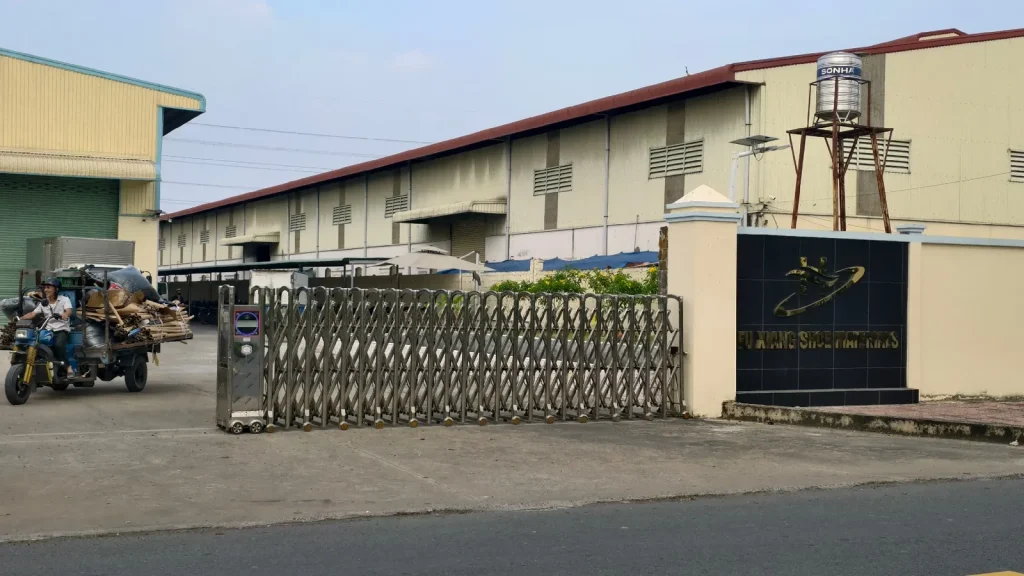
If you’re evaluating a footwear material supplier and manufacturer in Vietnam, FX Footwear offers two production bases in Tay Ninh and Ninh Binh with 41 million pairs of combined annual designed capacity. These bases make insoles, footbeds, upper components, heel counters, and related molded components for footwear brands and shoe assemblers.
FX Footwear is the international brand of Fuxiang Group. The operating figures below reflect client-approved records updated in July 2026 and separate component manufacturing from finished-shoe assembly.
Vietnam Manufacturing Network
FX Footwear’s Vietnam manufacturing network is centered on two production companies: Fuxiang Vietnam New Material Technology Co., Ltd. in Tay Ninh Province and Fuxiang Sports Materials Technology Co., Ltd. in Ninh Binh Province. Their combined annual designed capacity is 41 million pairs, split between 21 million in the south and 20 million in the north.
| Production company | Location | Area | Staff | Annual designed capacity |
|---|---|---|---|---|
| Fuxiang Vietnam New Material Technology Co., Ltd. | Tan Do Industrial Park, Duc Hoa, Tay Ninh Province | 12,000 m² | About 250 | 21 million pairs |
| Fuxiang Sports Materials Technology Co., Ltd. | Hoa Cong Industrial Zone, Ninh Binh Province | 9,000 m² | About 300 | 20 million pairs |
Southern and northern production coverage lets customers coordinate component supply closer to their shoe-assembly locations. When production allocation changes, molds can be transferred between qualified bases with planned shipping, scheduling, and process confirmation. Site-level capability still needs confirmation because individual facilities don’t carry identical upstream equipment.
Fuxiang Group runs eight factories across China, Vietnam, and Indonesia, with 130 million pairs of annual designed component capacity. For teams comparing a footwear OEM supplier, FX’s useful distinction is component breadth: insoles, midsoles, uppers, heel counters, eyelets, and molded parts under one group. Client-approved company records identify HOKA, Clarks, KEEN, and UGG as confirmed brand partners.
Supplier Roles and Sourcing
Supplier directories often place resin vendors, component factories, finished-shoe manufacturers, and sourcing agents in the same list. Those companies solve different procurement problems.
| Supplier role | What it supplies | When to use it | What to verify |
|---|---|---|---|
| Raw-material supplier | Resin, foam sheet, fabric, or additives | Your team controls conversion elsewhere | Grade consistency, traceability, test data, and minimum order |
| Component manufacturer | Molded or converted shoe parts | Performance or construction needs direct control | Site processes, tooling, tolerances, testing, and capacity |
| Finished-shoe manufacturer | Assembled footwear | You want one party managing the bill of materials | Approved subcontractors, component visibility, and final-shoe testing |
| Sourcing agent | Supplier search and coordination | You lack local purchasing staff | Factory identity, fee structure, audit access, and contract authority |
FX is a one-stop footwear component manufacturer. Direct component sourcing works well when hardness, density, compression set, material traceability, or country allocation must be controlled by the brand. Letting a finished-shoe factory manage the component purchase can be simpler for low-volume commodity parts or prototypes that are still changing.
Late samples, unclear material substitutions, and inconsistent quotations usually point to an incomplete specification or a mismatched supplier role. Our guide to solving footwear material sourcing headaches explains how to isolate those problems before bulk production.
Vietnam Materials and Processes
Supercritical fluid foaming (SCF) is a physical foaming process using N₂, CO₂, or a combined setup. It produces a microcellular structure with predominantly closed cells, without traditional chemical blowing agents. For most RFQs, mass-production density, rebound, compression set, hardness, aging, and bonding performance matter more than the chosen process gas.
| Material or process | Vietnam production scope | Procurement focus |
|---|---|---|
| Supercritical foam | Precision compression molding and downstream conversion into finished SCF insoles | Rebound, density, compression set, bonding, and batch consistency |
| EVA | Compression molding, die cutting, and single- or multi-density constructions | Standard hardness range of 20–45 Asker C with ±3 tolerance |
| PU | PU foaming and component production, including open-cell cushioning options | Shape retention, compression resistance, breathability, and hand feel |
| Forming and conversion | Heat-press forming, cold-press forming, die cutting, and heel-counter forming | Drawing tolerances, mold condition, lamination, and final dimensions |
The Vietnam manufacturing network produces high-volume supercritical foam insoles through precision compression molding alongside EVA and PU components. During an audit, evaluate incoming SCF material specifications and molding controls as separate checkpoints.
Indonesia has no SCF material-foaming factory. When FX’s Brebes base compression molds SCF insoles, the foam sheet is supplied from Vietnam for downstream molding and conversion in Indonesia.
Selected programs can specify recycled EVA compounds, sugarcane EVA, algae-based foam that reduces reliance on petroleum-based materials, or Susterra®-based bio-PU formulations. GRS applicability depends on the recycled material, recycled-content threshold, certified supply-chain scope, and project documentation. It doesn’t automatically cover every material or finished component.
Construction matters as much as foam chemistry. A molded footbed may combine a top cover, shaped foam, arch support, and localized cushioning; the related footbed manufacturer guide covers the specifications that should be fixed before tooling.
Commercial Terms and Verification
MOQs and unit prices can’t be compared without matching the construction, material grade, size range, color count, tooling requirement, and order volume. FX confirms project-specific commercial terms during quotation.
| Commercial item | FX reference point |
|---|---|
| Initial quotation | Within 48 hours for standard constructions using existing tooling and materials |
| Die-cut sample | About 3 days when no new tooling is required |
| New-tooling sample | About 10 business days after specifications and material approval |
| Standard production | Typically 20–35 days after order confirmation |
| SCF insole production | Typically 30–45 days |
| Custom bulk production | About 30–40 days after sample approval |
| MOQ and pricing | Quoted by construction, material, tooling, size range, and volume |
| Payment terms | Confirmed for each project and order during quotation |
A practical supplier check should cover six steps:
- Confirm the legal name, registration status, and production address through Vietnam’s official National Business Registration Portal.
- Map every required process to the intended production site.
- Approve a signed specification and physical reference sample.
- Audit production equipment, incoming inspection, in-process checks, final inspection, and SPC records.
- Review current test reports, material traceability, certification scope, and social-audit requirements.
- Match payment instructions to the quotation and registered beneficiary.
Certification checks also need scope. GRS applies only to qualifying recycled-material supply chains. ISO 13485:2016 is relevant to therapeutic or orthotic footwear programs, while the Higg Index supports supply-chain sustainability measurement. Intertek and BETA provide third-party verification or testing. REACH is an EU chemical regulation, so documentation is coordinated for European projects when the customer requests it.
Don’t apply a generic Vietnam duty rate to a footwear program. U.S. duty depends on the finished shoe’s HTS classification, upper and outsole materials, construction, value, and origin analysis. Check the current USITC Harmonized Tariff Schedule with your customs broker; Vietnamese component production alone doesn’t determine the finished shoe’s classification or origin.
Vietnam Sourcing Questions
What Shoes Are Made in Vietnam?
Vietnam produces athletic shoes, casual footwear, sandals, work footwear, and selected leather constructions. For a component buyer, the useful check is whether the Tier 1 factory’s bill of materials matches local Tier 2 capability for insoles, midsoles, uppers, heel counters, and required testing.
How Do You Find Vietnamese Suppliers?
Start with an exact component specification and supplier role, then verify the legal entity, production address, site-level process list, and current contact. Audit the intended factory, approve a physical sample, inspect test records, and confirm payment details against the quotation before placing a production order.
What Is Vietnam’s Footwear Market?
Vietnam is an export-focused footwear manufacturing base with major production clusters in the south and north, backed by Tier 2 material and component suppliers. Capacity can be deep in one process and absent in another, so country-level reputation never replaces site-level qualification.
Does Skechers Have a Vietnam Factory?
A site making Skechers footwear may be a contract manufacturer rather than a Skechers-owned factory. Public brand association also doesn’t prove that the site accepts independent orders. Check current corporate filings, the Vietnamese entity’s registration, and direct written confirmation from the factory before adding it to a shortlist.
Footwear Material RFQ Checklist
Send one controlled RFQ package to every shortlisted supplier. Include:
- Component type, footwear application, drawings, and size range
- Material composition, grade, layer structure, and approved alternatives
- Thickness, density, hardness unit, color, and dimensional tolerances
- Rebound, compression set, aging, bonding, and other required tests
- Top-cover fabric, surface treatment, and logo method
- Sample quantity, order quantity by SKU, and annual forecast
- Destination market, required reports, packaging, and delivery terms
- Preferred production country, target date, and tooling-transfer needs
FAQ
Where Are FX Footwear’s Vietnam Factories?
The network is centered on Fuxiang Vietnam New Material Technology Co., Ltd. in Tay Ninh Province and Fuxiang Sports Materials Technology Co., Ltd. in Ninh Binh Province.
What Do Your Vietnam Factories Produce?
They produce SCF, EVA, and PU insoles, footbeds, heel counters, upper components, and related molded footwear components. Processes include SCF compression molding, PU foaming, EVA compression molding, heat- and cold-press forming, die cutting, and heel-counter forming, with selected recycled or bio-based options.
How Much Capacity Do You Run in Vietnam?
Combined annual designed capacity is 41 million pairs: 21 million at Tan Do in southern Vietnam and 20 million at Hoa Cong in northern Vietnam.
Do You Mold Supercritical Foam in Vietnam?
Yes. The Vietnam network produces SCF insoles through precision compression molding alongside EVA and PU components.
How Do I Get Samples and Pricing?
Send your specification through the Contact Us page. Initial quotes arrive within 48 hours for standard constructions; die-cut samples take about 3 days, and new-tooling samples about 10 business days.
To assess FX Footwear as your footwear material supplier and manufacturer in Vietnam, send the RFQ checklist with your drawing, target performance, annual volume, destination market, and required delivery date. Standard constructions using existing materials and tooling receive initial pricing within 48 hours.