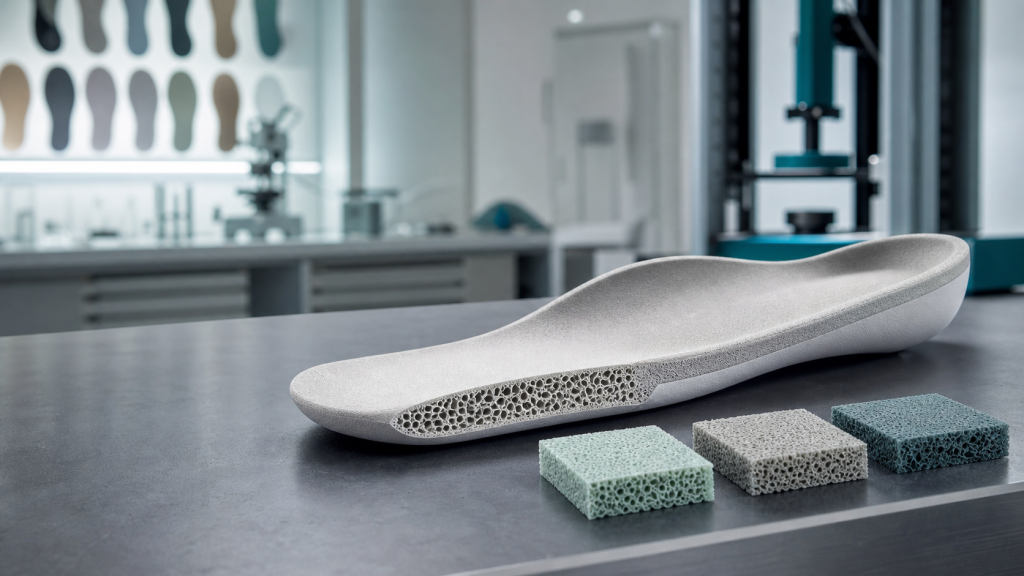
Are footwear brands too dependent on a single branded insole-foam source? As supply chains become more regional and product launches move faster, the market is looking for more diversified supply of OrthoLite®-type comfort materials. That does not mean copying a trademarked product or choosing the cheapest foam. It means finding an OrthoLite Alternative that starts from the same broad open-cell PU technology, can be tuned to a brand’s specification, and can prove its performance with samples and test data.
Open-cell polyurethane foam is one of the strongest candidates. Its connected pore structure supports airflow and moisture movement, while PU chemistry allows engineers to adjust cushioning, recovery, density, and hardness. The sections below explain where this technology comes from, how its key properties can be measured, and how to select a supplier that can turn a foam formula into a reliable production insole.
Open-Cell PU and OrthoLite: The Same Technical Roots
OrthoLite® is a proprietary brand, but the underlying material family described in its public product information is open-cell polyurethane foam. An independent OrthoLite Alternative can therefore share the same broad technical roots without being identical, licensed, or affiliated.
Why open cells matter in an alternative
In closed-cell foam, most gas pockets are sealed from one another. In open-cell PU, many pores connect into pathways. Those pathways can allow air and moisture vapor to move through the material more readily. For an insole, this can support a cooler, less humid shoe environment when the top cover, adhesive, and base construction are also permeable.
Why PU chemistry makes comparison possible
PU foam is not one fixed recipe. Formulators can change polyols, additives, catalysts, cell structure, and process conditions. Product engineers can then tune density, hardness, resilience, compression behavior, color, thickness, and molded geometry. This flexibility is why open-cell PU insoles can be developed around a benchmark instead of forcing every footwear program into one standard grade.
However, shared technical roots do not prove equal performance. The correct claim is that a specific formulation is a candidate for evaluation. It becomes a true alternative only after the finished insole meets the buyer’s approved specification and test plan.
Four OrthoLite Alternative Performance Benchmarks
A serious material comparison needs numbers. FX Footwear publishes the following series-level reference data for its PowerFrame open-cell PU range:
| PowerFrame series | Hardness | Density | Resilience | Compression set |
|---|---|---|---|---|
| Cloud | 18 or 25 Asker C | 0.16 or 0.18 g/cm³ | 30-35% | 10-12% |
| Airy (recycled open-cell PU) | 25 Asker C | 0.16 g/cm³ | 30% | 10% |
These values are useful starting points, not universal guarantees. Formula, thickness, top cover, specimen conditioning, test method, and footwear construction can change the result. A buyer should compare matched samples under the same method.
Breathability and moisture management
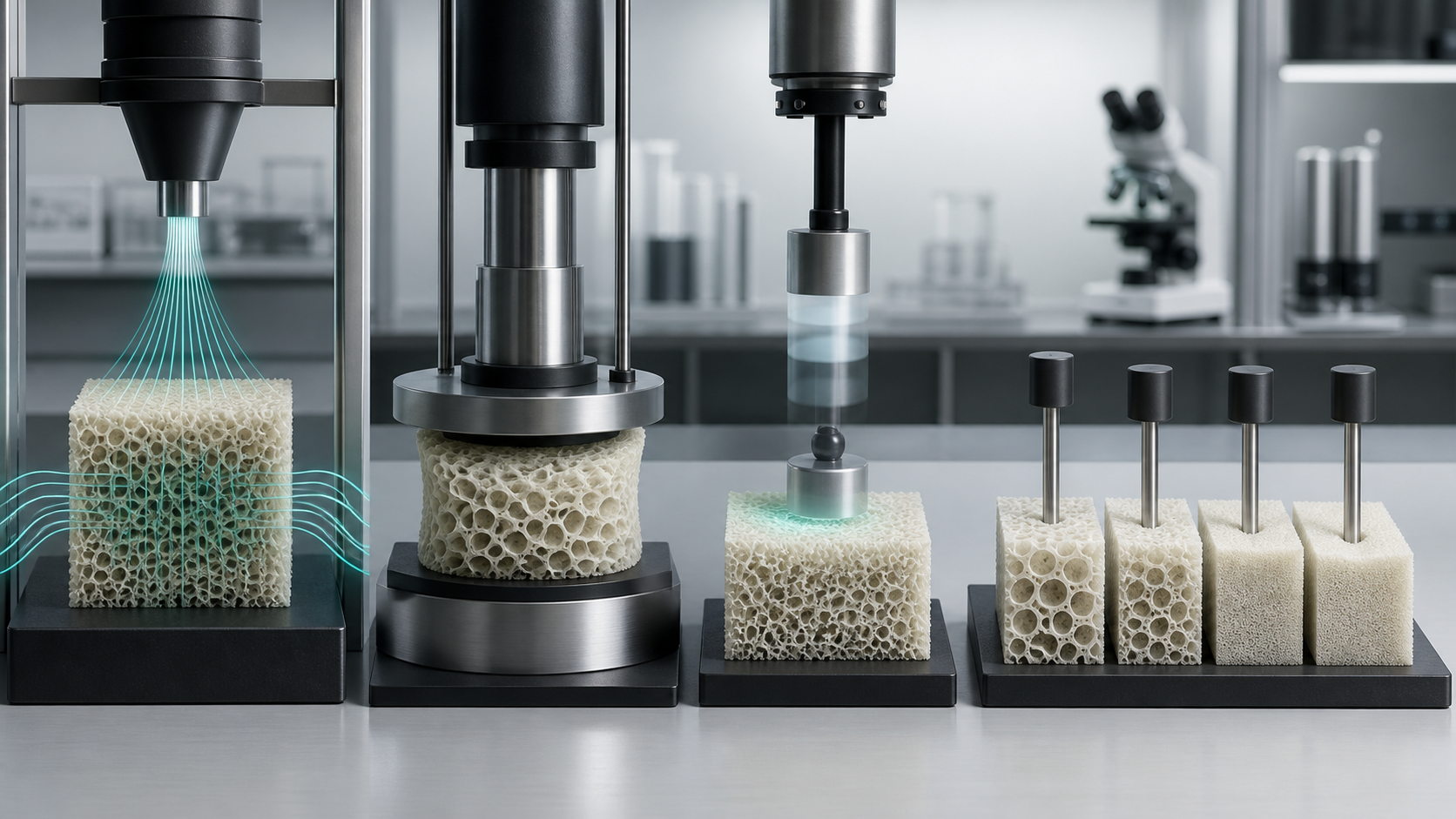
Open pores create potential airflow paths, but raw foam alone does not determine breathability. A dense textile or continuous adhesive film can restrict the finished assembly. Test air permeability or another agreed airflow method on the completed insole stack. If moisture management is important, also evaluate vapor transfer, liquid handling, drying behavior, and performance after repeated use.
Compression set and durability
Compression set measures the deformation that remains after a sample is compressed for a specified time and allowed to recover. Lower results generally indicate better shape recovery under that method. FX’s published 10-12% PowerFrame reference range shows why open-cell PU can be considered for lasting comfort, but buyers should define the load, temperature, time, specimen thickness, and recovery period before comparing suppliers. FX’s footwear material testing laboratory lists ASTM D3574 compression-set testing and project-specific documentation.
Resilience and energy feedback
Resilience describes how quickly a foam returns energy after impact. PowerFrame Cloud’s published 30-35% range supports soft comfort with controlled recovery rather than racing-shoe-level energy return. If maximum rebound and minimum weight are the leading objectives, a brand should also compare EVA or supercritical materials. The best OrthoLite Alternative is the one that fits the intended feel, not the one with the highest isolated number.
Adjustable density and hardness
Density affects mass and material use; hardness influences step-in feel and support. They must be evaluated together. The published PowerFrame open-cell range spans approximately 0.16-0.18 g/cm³ and 18-25 Asker C for Cloud and Airy reference grades. A supplier with formulation capability can adjust these properties, but changes must be rechecked for airflow, compression set, resilience, bonding, and finished-pair weight.
| Performance area | FX open-cell PU reference |
|---|---|
| Breathability | Open-cell Cloud/Airy construction; project testing required |
| Compression set | 10-12% series-level reference |
| Resilience | 30-35% series-level reference |
| Density and hardness | 0.16-0.18 g/cm³; 18-25 Asker C for Cloud/Airy references |
Why an OrthoLite Alternative Is More Than a Lower Price
A lower quotation may attract attention, but the real value of an OrthoLite Alternative is supply-chain flexibility. A qualified second source can reduce dependence on one material channel, support regional production, and give product teams more control over formula, color, top cover, geometry, and branding.
Customization is another advantage. Brands can develop a soft lifestyle insole, a more supportive work-shoe construction, or a recycled or bio-based PU option around different targets. They can also align the component with local assembly plants and a defined approval process. FX Footwear’s PowerFrame PU platform and multi-country manufacturing footprint are designed for this type of program-specific development.
Total cost still matters, but it includes more than raw foam price. Material yield, cutting waste, lamination, molding, tooling, inspection, rejects, packaging, freight, lead time, and change-control risk all affect landed cost. A reliable alternative creates value when it meets the specification repeatedly and reaches the shoe factory on time.
How to Evaluate an Open-Cell PU Alternative Supplier
The right supplier must do more than sell foam sheets. Use the following five checks to decide whether a company can develop and scale an OrthoLite Alternative.
1. Technical capability
Ask whether the supplier has an R&D team, in-house foaming knowledge, and the ability to adjust formulas. A capable team should translate a benchmark into targets for density, hardness, rebound, compression set, thickness, weight, and cell structure. It should also explain trade-offs instead of promising that one grade is best for every shoe.
2. Quality-control system
Confirm that compression set, hardness, density tolerance, resilience, thickness, weight, bonding, and appearance have documented inspection methods. Ask how approved samples are converted into production specifications, how batch records are kept, and what changes trigger revalidation.
3. Capacity and lead time
Request verified monthly capacity for the relevant process, not only total factory output. Confirm material lead time, sample cycle, tooling time, production cycle, and backup capacity. FX states a sample-to-approval target of up to 15 days on its website; actual timing should be confirmed for the formula, mold, size range, and testing plan.
4. Converting and finishing support
A production-ready partner should support die cutting, skiving, lamination, pressure-sensitive adhesive, perforation, top-cover application, logo treatment, and custom shapes where required. These processes can change airflow, thickness, bonding, and feel, so the supplier should validate the finished component rather than approve only raw foam.
5. Compliance and lower-impact options
Ask whether the exact formulation can support the brand’s restricted-substance list, factory audit, traceability, and target-market requirements. If the program needs recycled or bio-based content, request project-specific documentation rather than a general sustainability statement. FX offers recycled open-cell PU and bio-based PU routes, with content and performance confirmed by project.
A useful starting package includes the benchmark insole, shoe category, size range, thickness map, top cover, target weight and feel, annual volume, compliance market, cost target, and approval tests. FX’s footwear component development services can then turn those inputs into a sample and validation route.
OrthoLite Alternative FAQs
Is open-cell PU foam the same as OrthoLite®?
No. Open-cell PU is a material category, while OrthoLite® identifies proprietary branded products. A specific open-cell PU formulation can be evaluated as an alternative, but it should not be described as identical or affiliated.
What data should an OrthoLite Alternative supplier provide?
At minimum, request the test method and results for hardness, density, resilience, compression set, thickness, finished-pair weight, and relevant airflow or moisture behavior. Add bonding, abrasion, chemical compliance, and wear testing when the shoe requires them.
Can open-cell PU match every OrthoLite® formulation?
No single foam should be expected to match every branded formulation. Define the exact benchmark and footwear application, then test a project-specific candidate against the same targets.
How long does alternative insole sampling take?
Timing depends on formula development, tooling, top cover, size range, and testing. FX states sample-to-approval in up to 15 days for its standard development route, but a custom program should receive a confirmed project schedule.
Is an OrthoLite Alternative only about cost savings?
No. The larger benefits can include supplier diversification, regional production, customized performance, faster development, differentiated design, and better control over specifications and documentation.
Build a Project-Verified OrthoLite Alternative
Open-cell PU and OrthoLite® share the same broad material roots, but a true alternative is earned through engineering and evidence. Define the benchmark, compare matched samples, test the finished insole, and lock the approved formula and process before production.
Ready to evaluate an open-cell PU option? Send FX Footwear your benchmark and technical brief to start a project-specific sample and test plan.