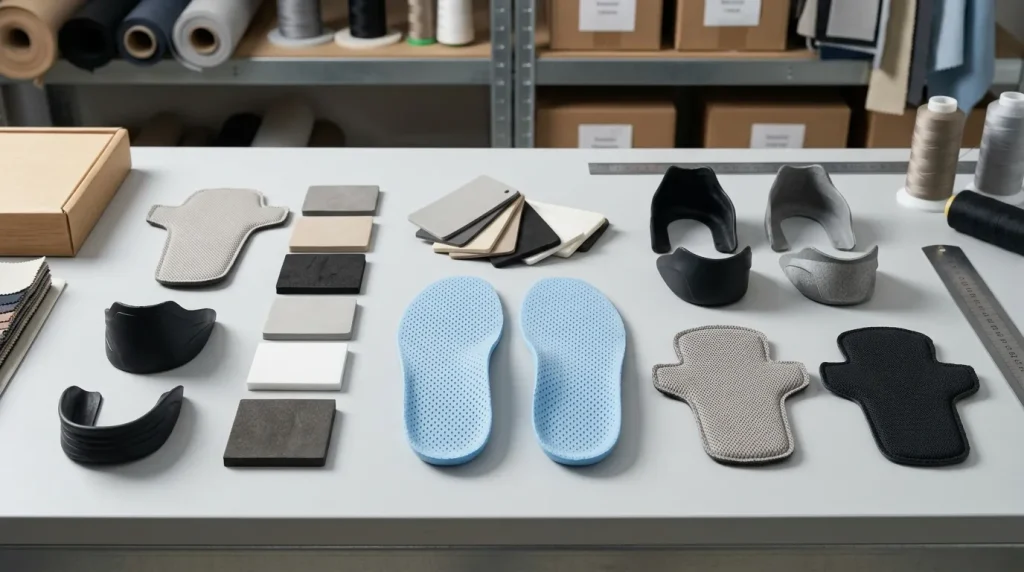
An open cell PU insole lets air and moisture pass through its foam structure instead of trapping heat against your foot. That single difference—open versus closed cells—determines whether a shoe stays dry after eight hours or turns into a swamp by lunch.
If you’re sourcing insoles for work boots, casual shoes, or any footwear that people wear for long stretches, breathability isn’t a nice-to-have. It’s the spec that drives repeat purchases, reduces returns, and keeps wearers from switching to a competitor’s product. Here’s how open-cell polyurethane foam achieves that, what it costs you in tradeoffs, and where it fits in a broader insole material strategy.
Open Cell vs. Closed Cell Structure
Open-cell PU foam has interconnected pores. Picture a kitchen sponge: air moves freely through the material because the cell walls have gaps. Closed-cell foam, by contrast, seals each tiny air pocket individually—think of a pool float. That sealed structure traps gas inside, which is great for buoyancy or insulation but terrible for letting sweat escape.
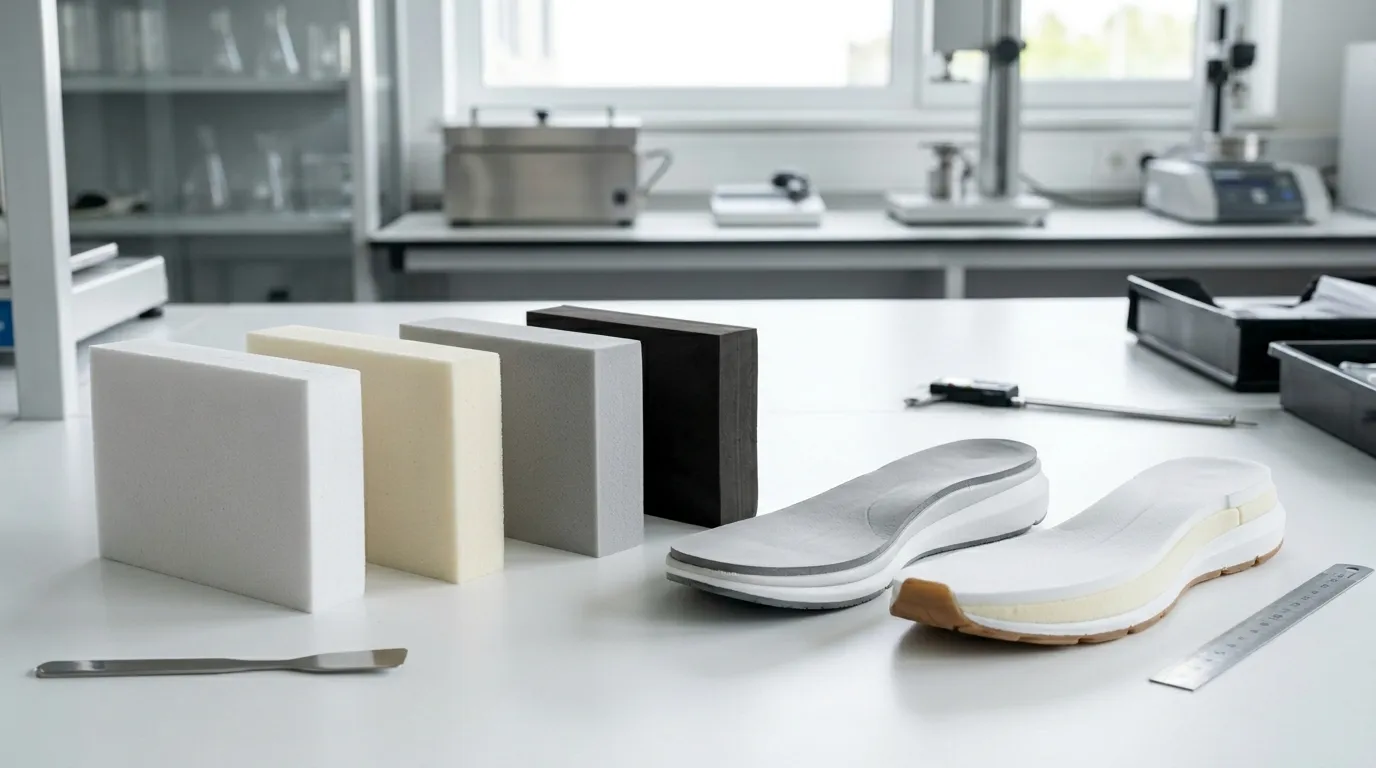
In insole applications, the distinction plays out like this:
| Property | Open Cell PU | Closed Cell Foam (e.g., standard EVA) |
|---|---|---|
| Air permeability | High — air passes through cell walls | Very low — cells are sealed |
| Moisture transport | Wicks and disperses moisture | Moisture sits on surface or pools |
| Compression resistance | Excellent long-term shape retention | Good initially, can compress permanently |
| Density | Typically 0.20–0.35 g/cm³ | Varies widely (EVA: 0.15–0.25 g/cm³) |
| Energy return | Moderate | Higher in EVA; highest in supercritical foams |
| Best use case | Extended wear, warm climates, occupational | Athletic performance, short-duration activity |
Here’s the practical reality: a warehouse worker wearing boots for a 10-hour shift generates roughly 125 mL of sweat per foot per day, according to the International Hyperhidrosis Society. Open-cell PU lets that moisture move laterally and downward instead of pooling on the insole surface. Closed-cell EVA? It’ll feel great at 7 a.m. and squishy-wet by 3 p.m.
That doesn’t mean closed-cell materials are bad. They’re just solving a different problem. If you’re building a running shoe insole where energy return and weight matter more than all-day moisture management, EVA or supercritical foams are the right call. Material selection should follow wear duration and environment, not a one-size-fits-all hierarchy.
Why PU Breathes Better Than EVA
EVA (ethylene-vinyl acetate) dominates the insole market for good reasons—it’s light, cheap, and easy to mold in a range of hardnesses from 20–45 Asker C. But its cell structure is predominantly closed. Even when manufacturers add perforations or channels to EVA insoles, they’re engineering around a material limitation rather than working with a naturally breathable structure.
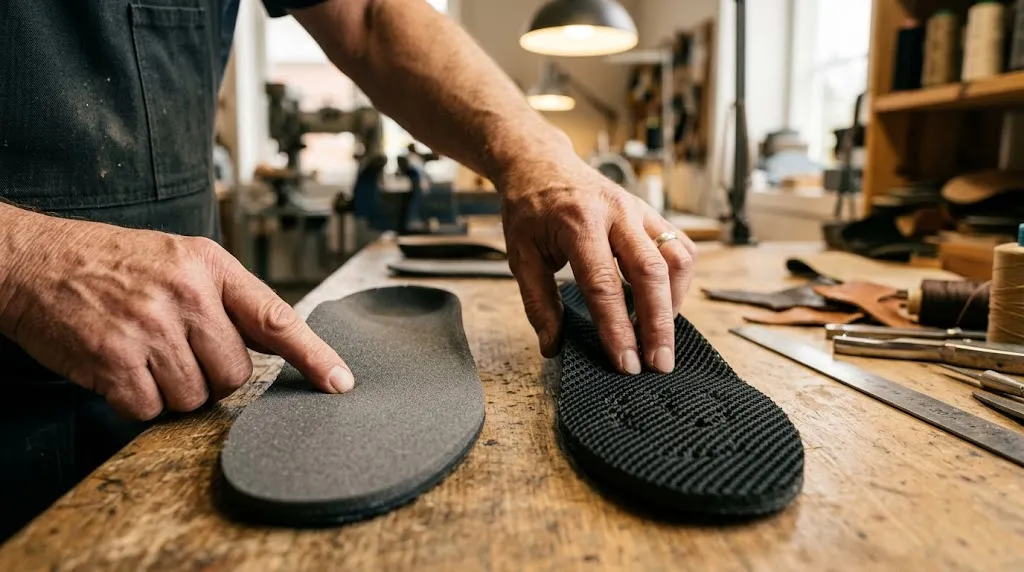
PU’s advantage is structural, not cosmetic. During the foaming process, polyurethane can be formulated to produce open, interconnected cells throughout the entire foam body. Air doesn’t just move across the surface; it moves through the insole. That means moisture wicking happens in three dimensions, not just where a perforation hole happens to be punched.
There’s a tradeoff worth calling out: open-cell PU is heavier than EVA. A standard PU insole at 0.28 g/cm³ weighs noticeably more than an EVA insole at 0.18 g/cm³. For a trail runner shaving grams, that’s a dealbreaker. For a nurse who just wants dry feet at hour nine, it’s irrelevant.
The energy return profile also differs. PU provides soft, consistent cushioning with excellent compression resistance over thousands of cycles—your insole at month six feels nearly identical to day one. But if raw energy return is the spec you’re optimizing for, supercritical CO₂ foams outperform both PU and EVA. FX Footwear’s PulseSport line uses supercritical foaming to achieve rebound rates that neither PU nor standard EVA can match. Different tools, different jobs.
One more thing most material guides skip: PU’s open-cell structure also reduces bacterial growth conditions. Bacteria thrive in warm, moist, stagnant environments—exactly what you get inside a closed-cell insole that traps sweat against a foot. Open-cell PU’s moisture dispersal disrupts that chain. It’s not antimicrobial on its own (you’d add treatments for that), but the foam architecture itself is less hospitable to odor-causing microbes.
Moisture Wicking Mechanics
“Moisture wicking” gets thrown around in marketing copy so loosely that it’s almost meaningless. Let’s be specific about what actually happens inside an open cell PU insole during wear.
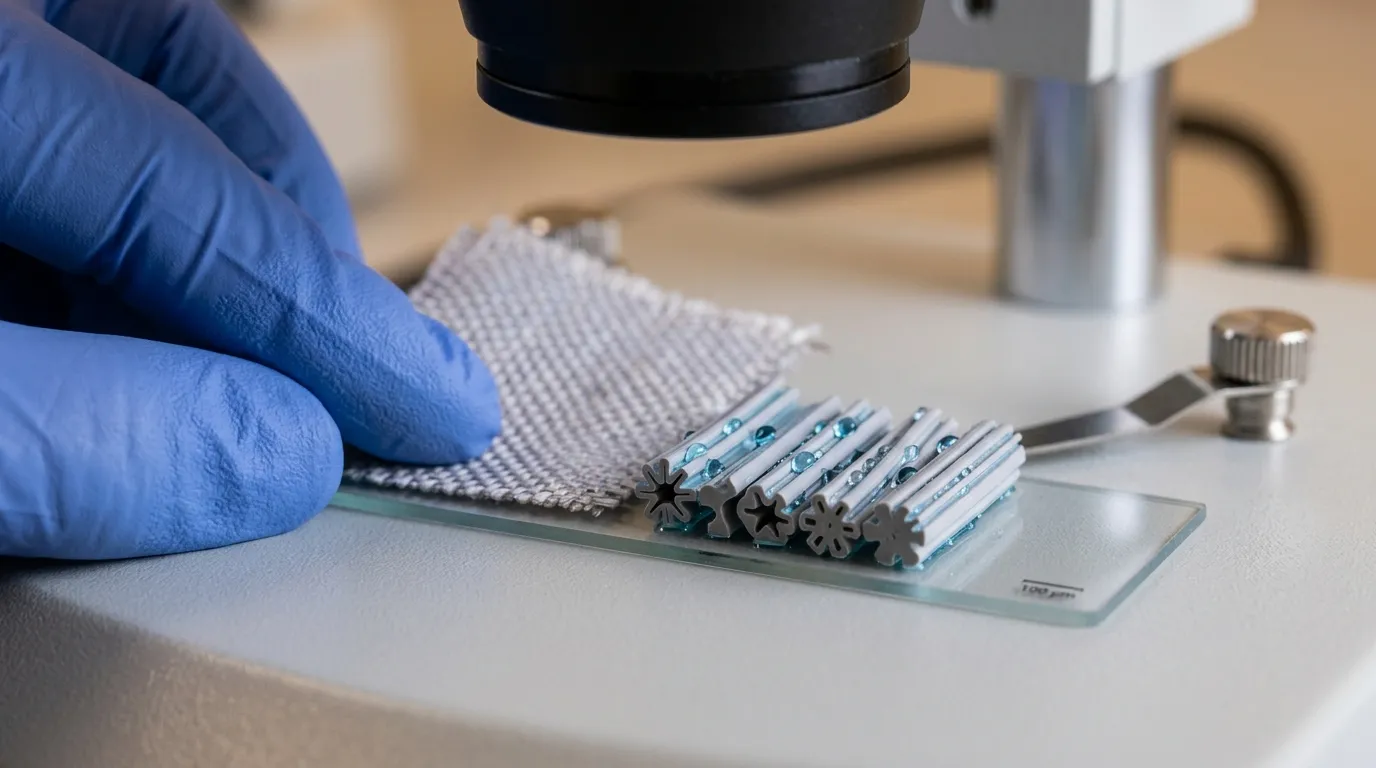
Step 1: Absorption. Sweat contacts the insole surface (usually a fabric top cloth—polyester, nylon, or a knit blend). The top cloth draws moisture downward via capillary action.
Step 2: Lateral dispersal. Once moisture reaches the PU foam layer, the interconnected open cells allow it to spread laterally across a larger surface area. Instead of a concentrated wet spot under the ball of the foot, you get distributed moisture across the full insole footprint.
Step 3: Evaporation. With moisture spread thin across a large internal surface area, evaporation happens faster. Each step compresses and releases the foam, acting like a pump that moves air through the cell structure—what materials scientists call “bellows effect.”
That pumping action is why open-cell PU works dramatically better in dynamic use (walking, standing with weight shifts) than in static applications. A pair of open-cell PU insoles in display shoes sitting in a warehouse? They’re not wicking anything. On a mail carrier’s feet covering 12 miles a day? The foam is working continuously.
> OEM sourcing note: When specifying moisture management for your insole program, don’t rely on foam alone. The top cloth selection matters as much as the foam substrate. A hydrophobic polyester top cloth paired with open-cell PU creates the most effective wicking system. Cotton top cloths actually work against you—they absorb and hold moisture instead of passing it down to the PU layer.
Best Applications for Open Cell PU
Not every shoe needs an open-cell PU insole. Here’s where the material actually earns its cost premium over EVA.
Work boots and occupational footwear. This is the sweet spot. Workers wearing boots 8–12 hours generate significant foot moisture. Closed-cell insoles in work boots are one of the top drivers of boot returns and negative reviews (“smells terrible after two weeks”). Open-cell PU addresses the root cause. Brands like Clarks and KEEN—both FX Footwear partners—understand that comfort perception in long-wear footwear tracks directly to moisture management, not just cushioning softness.
Casual and lifestyle shoes. Weekend sneakers? Probably overkill. Daily-wear commuter shoes worn 10+ hours across seasons? Absolutely. The spring and summer months in humid US markets (Southeast, Gulf Coast, Mid-Atlantic) make breathability the number-one insole complaint driver for casual footwear.
Therapeutic and orthotic footwear. Here’s where it gets interesting. FX Footwear holds ISO 13485:2016 certification for medical-device quality management, which matters when insoles are classified as therapeutic devices. Open-cell PU is a common substrate for orthotic insoles because it combines breathability with the long-term dimensional stability that orthotics require. An orthotic insole that compresses and deforms after 60 days is functionally useless, and EVA’s compression set characteristics make it a risk for this application.
Where open-cell PU is the wrong choice: lightweight athletic shoes where every gram matters, shoes designed for water exposure (open cells absorb water like a sponge—bad for boat shoes or rain boots), and ultra-budget programs where EVA’s cost advantage is the overriding constraint.
Sourcing Open Cell PU at Scale
If you’re evaluating PU insole suppliers for a branded footwear program, here are the specs and questions that separate serious manufacturers from trading companies reselling commodity product.

Compression set testing. Ask for ASTM D395 test data. Good open-cell PU insoles should show less than 30% compression set after 50% compression at 50°C for 6 hours. If a supplier can’t produce this data, they’re not testing—and you’re guessing.
Density consistency across batches. PU foaming is chemistry-sensitive. Ambient temperature and humidity during production affect cell structure. Ask how the supplier controls batch-to-batch density variation. At FX Footwear, our in-house lab runs density checks on every batch rather than relying solely on periodic external testing—which means we catch drift before it ships.
Branding options. For PU insoles, standard branding methods include heat transfer print and screen print on the top cloth surface, plus emboss or deboss on structural heel cup components. (Laser etching applies to TPU or rubber outsole components, not insole surfaces—if a supplier offers laser-etched insole logos as standard, question what material that top layer actually is.)
Lead times you should plan for. Custom PU insole sampling typically takes 7–14 days. Bulk production after sample approval runs approximately 30–40 days. Add 18–30 days for ocean freight from East Asia to US ports. First-time custom orders, spec to goods at your door, realistically take 65–100 days.
FX Footwear’s PowerFrame product line is built on PU construction optimized for B2B scalability—sustainable material options, consistent quality across large runs, and pricing that works within mainstream footwear cost structures. As a wholesale shoe insole manufacturer producing across facilities in China, Vietnam, and Indonesia, we’re positioned alongside the Tier 1 footwear manufacturing hubs where your shoes are already being assembled, which cuts coordination headaches and freight costs.
Payment reality for new programs: expect 30% deposit upfront with 70% due before shipment. Sampling costs are paid upfront. As volume grows and the relationship matures, terms become more flexible—but nobody in this industry offers net-60 on a first order, and anyone who does should make you nervous.
Open Cell PU vs. Other Foams
A quick reference for product managers comparing insole substrates across a multi-SKU line:

| Factor | Open Cell PU | Standard EVA | Supercritical CO₂ Foam |
|---|---|---|---|
| Breathability | ★★★★★ | ★★ | ★★ |
| Energy return | ★★★ | ★★★★ | ★★★★★ |
| Weight | ★★★ | ★★★★★ | ★★★★ |
| Compression resistance | ★★★★★ | ★★★ | ★★★★ |
| Long-term shape retention | ★★★★★ | ★★★ | ★★★★ |
| Cost (per unit) | ★★★ | ★★★★★ | ★★ |
| Best fit | Work, casual, orthotic | Athletic, casual, budget | Performance athletic |
The smart play for most brands isn’t picking one material for all SKUs. It’s matching foam type to the product’s primary use case and price tier. Your $180 performance runner gets supercritical foam. Your $90 all-day casual gets open-cell PU. Your $55 value athletic gets EVA. FX manufactures across all three categories—insoles, midsoles, and uppers—so brands can consolidate sourcing instead of managing separate suppliers for each material.
FAQ
What does open cell mean in PU foam?
Open cell means the foam’s internal air pockets are interconnected, allowing air and moisture to pass through the material. Closed-cell foam seals each pocket individually, blocking airflow.
Are PU insoles better than EVA?
PU insoles offer superior breathability and compression resistance, making them better for long-wear and work applications. EVA is lighter, cheaper, and provides higher energy return—better for athletic and budget programs.
How long do open cell PU insoles last?
Quality open-cell PU insoles maintain their cushioning and shape for 12–18 months of daily use, significantly outlasting EVA insoles which typically show noticeable compression set after 6–9 months.
Do open cell PU insoles absorb water?
Yes. Open-cell structures absorb and retain liquid water, which makes them unsuitable for waterproof boots or marine footwear. They manage vapor moisture (sweat) well but shouldn’t be submerged.
What certifications matter for PU insole sourcing?
For US-market footwear, prioritize CPSC compliance, California Prop 65, and ASTM test reports. For therapeutic applications, ISO 13485:2016 certification confirms medical-device quality management. GRS certification applies if using recycled content in PU formulations.
Ready to spec open-cell PU insoles for your next footwear program? FX Footwear (Fuxiang Group) manufactures PU, EVA, and supercritical foam insoles across facilities in China, Vietnam, and Indonesia—with in-house lab testing, GRS and ISO 13485 certifications, and initial quotations delivered within 48 hours for standard constructions. Reach out to our team to get PowerFrame PU samples into your hands.