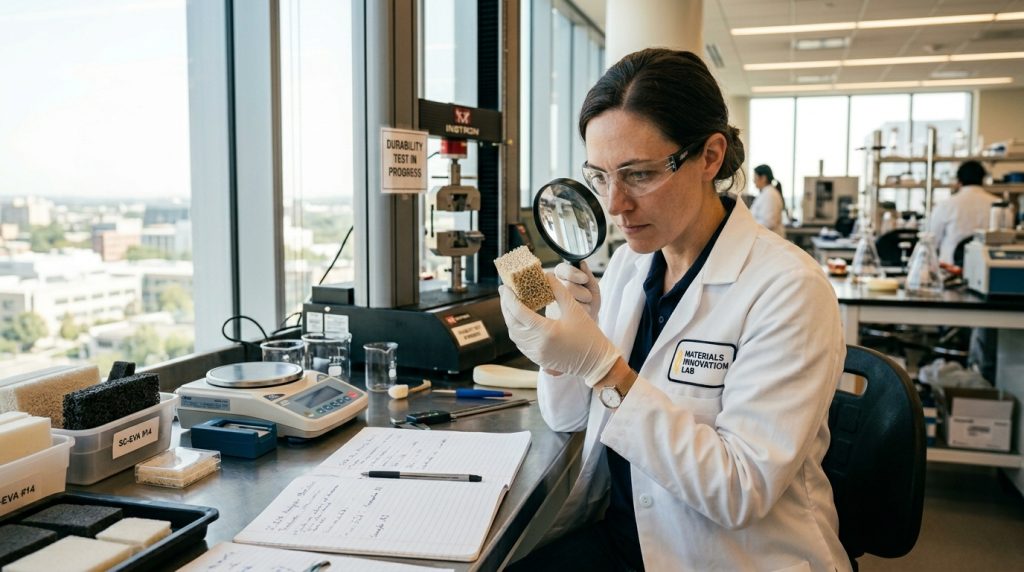
Supercritical EVA foam has quietly transformed the way footwear engineers think about midsole and insole construction. By using carbon dioxide in a supercritical state to expand EVA pellets into ultra-fine closed-cell foam, manufacturers can now dial in properties — firmness, rebound, weight — with a precision that traditional chemical foaming simply cannot match. If you’re sourcing footwear components or trying to understand what makes supercritical EVA foam perform the way it does, this technical deep-dive unpacks the science, the tradeoffs, and the practical implications for your product line.
Supercritical Foaming: The Core Process
Traditional EVA foaming relies on chemical blowing agents — compounds that decompose under heat and release gas bubbles inside the polymer matrix. The resulting cell structure is adequate for most applications, but it’s inherently variable. Cell sizes differ across a single slab, density gradients appear from edge to center, and the residual chemicals can affect long-term performance. Supercritical foaming eliminates most of those variables in one step.
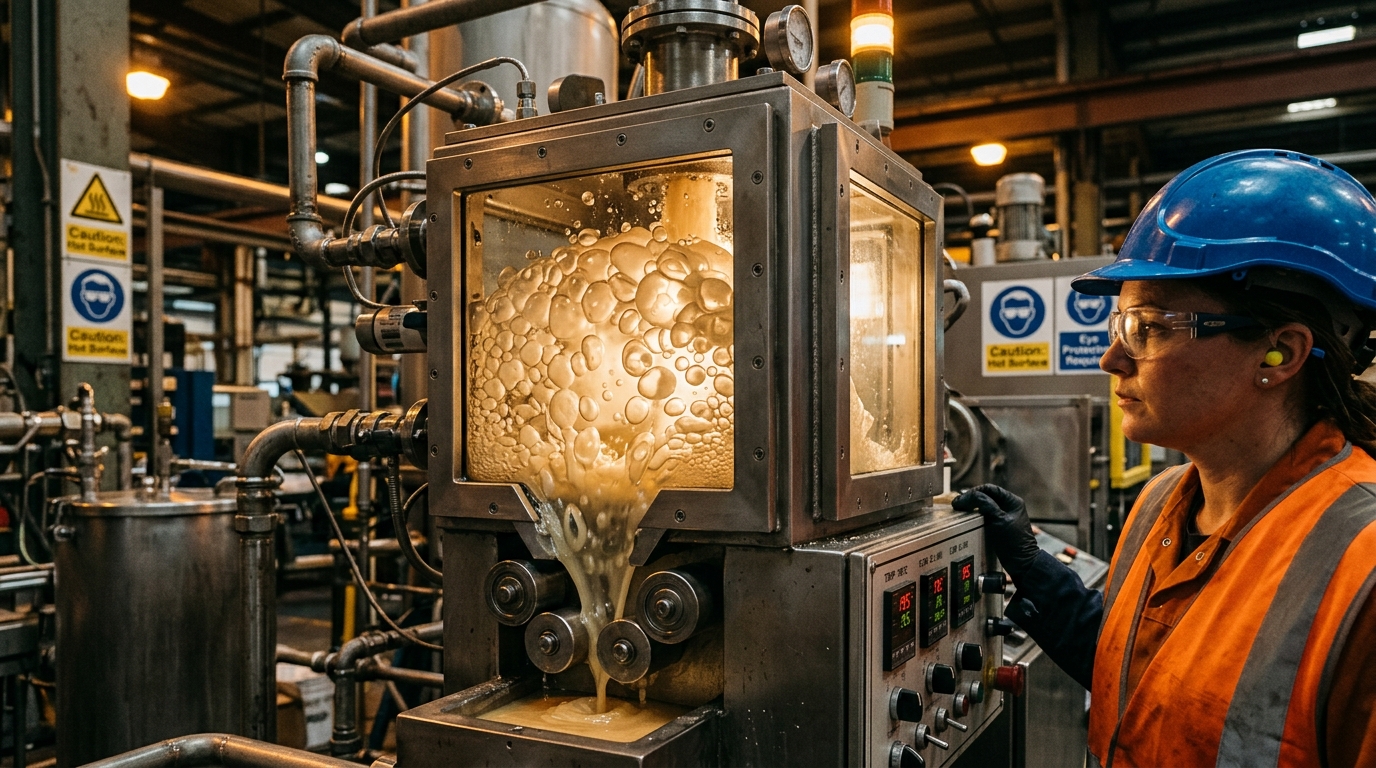
In the supercritical CO₂ process, EVA resin pellets are loaded into a pressurized vessel. Carbon dioxide is raised above its critical point — approximately 31°C and 73.8 bar — at which point it behaves simultaneously as a liquid and a gas. In this state, CO₂ saturates the polymer chains uniformly and completely. When pressure is released rapidly, the dissolved gas nucleates simultaneously throughout the entire pellet, producing an extraordinarily uniform closed-cell foam structure.
The practical result is a foam blank that starts with less variability than anything chemical foaming can produce. Cell diameters in supercritical-foamed EVA typically range from 10 to 30 microns — compared to 100 microns or more in conventional EVA — and that difference in cell architecture is what drives every downstream performance characteristic worth discussing.
Firmness: How Density Governs Feel
Firmness in foam is fundamentally a function of two interacting variables: the stiffness of the polymer walls between cells, and the density of those cells per unit volume. In supercritical EVA foam, both variables are more controllable than in chemical foam because the nucleation process is more uniform. Engineers can fine-tune the final expansion ratio — how much the pellet grows — by adjusting saturation pressure, release rate, and temperature profile during processing.
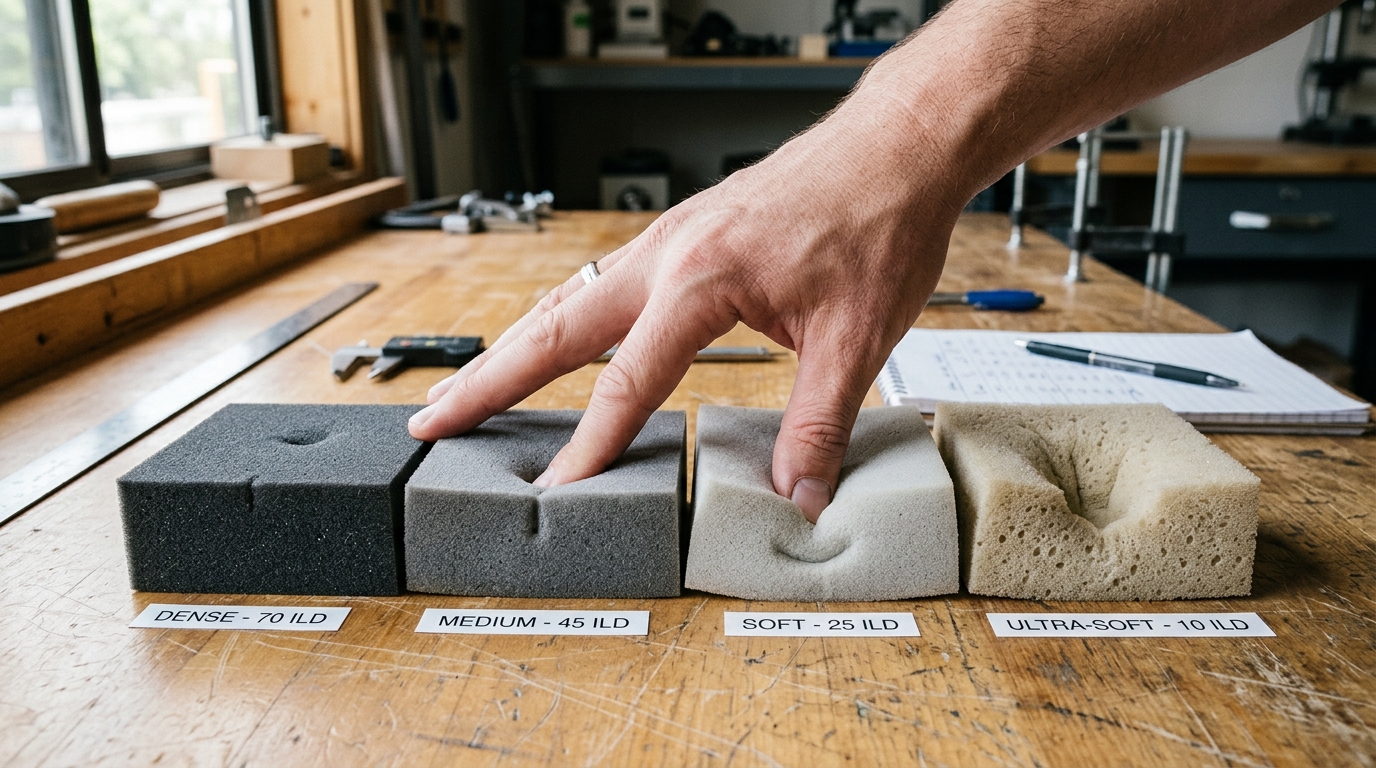
A lower expansion ratio produces a firmer, denser foam. A higher expansion ratio produces a softer, lighter foam. The critical advantage of supercritical processing is that these adjustments don’t introduce the density gradients that plague conventional foaming. The firmness you specify at the center of the component is, within tight tolerances, the firmness you get at the edge. That consistency has enormous downstream implications for shoe fit, feel, and performance repeatability across a production run.
It’s also worth noting that firmness in supercritical EVA doesn’t behave exactly like firmness in polyurethane or TPU foams. Because the cell walls in supercritical EVA are thin but numerous, the initial compression feel is progressive rather than abrupt — the foam yields gradually under load rather than bottoming out suddenly. Footwear brands describe this as a “tuned” or “controlled” underfoot sensation, which is particularly desirable in athletic and occupational footwear where fatigue over extended wear periods matters.
Durability: Closed-Cell Structure Advantages
Durability testing tells a clear story about supercritical foams. In our own published work on durable insoles — specifically the 10,000-step compression fatigue protocol — supercritical EVA components retained significantly more of their original thickness and rebound energy than conventional EVA counterparts tested under identical conditions. The structural reason comes back to cell architecture.
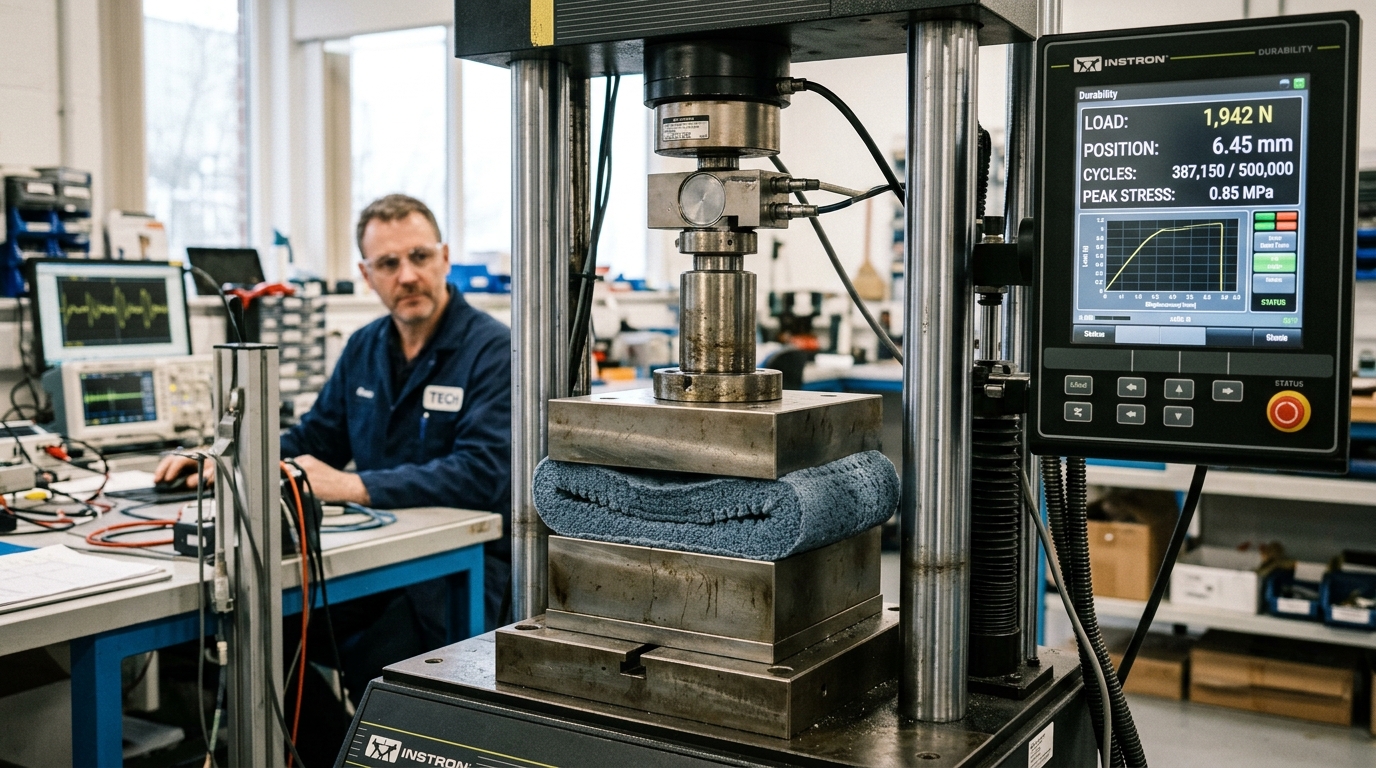
Closed-cell foams resist compression set — the permanent deformation that occurs after repeated loading — far better than open-cell foams because the sealed gas pockets distribute stress more evenly across the polymer matrix. In supercritical EVA, the exceptionally small and uniform closed cells mean there is less variance in how stress propagates through the material. High-stress zones, such as the heel strike area or the first metatarsal head, don’t develop localized fatigue pathways as quickly as they do in conventional foam with larger, irregular cells.
Moisture resistance is another durability dimension where the closed-cell structure wins. Water, sweat, and cleaning agents cannot penetrate the cell walls, so the foam’s mechanical properties don’t degrade with moisture exposure the way open-cell or semi-open-cell foams do. For footwear destined for athletic, outdoor, or occupational use — markets where insoles are subjected to sustained moisture — this characteristic translates directly into longer service life and more consistent cushioning throughout the product’s lifecycle.
Energy Return and Rebound Mechanics
Energy return is arguably the most commercially visible performance claim associated with supercritical EVA foam, and it deserves a rigorous explanation rather than marketing shorthand. Rebound energy — the fraction of input compression energy that the foam releases back to the foot — is a function of how quickly and completely cell walls recover their original geometry after deformation. Supercritical EVA’s fine, uniform cells recover faster and more completely than the coarser cells in conventional foam.

Measured using standardized drop-weight rebound tests, supercritical EVA foams typically achieve rebound percentages in the 55–70% range depending on formulation, compared to 45–58% for conventional EVA at similar hardness values. That gap may seem narrow, but across thousands of foot-strike cycles it accumulates into meaningfully less muscular effort for the wearer — a primary reason elite running brands have adopted this foam class aggressively over the past five years.
For brands evaluating components, our supercritical CO₂ foam insole delivers these rebound characteristics in a pre-molded insole format, meaning the energy-return benefits are available without requiring brands to redesign their entire midsole stack. This modular approach allows brands to upgrade the cushioning feel of an existing shoe platform cost-effectively, targeting specific performance metrics without committing to a full tooling overhaul.
Weight Reduction Without Stiffness Loss
One of the most counterintuitive properties of supercritical EVA foam is its weight-to-stiffness ratio. Conventional foam wisdom holds that a softer, lighter foam is inevitably a less supportive foam — reduce the density and you reduce the structural contribution. Supercritical processing challenges that assumption by changing what density actually means at the microstructural level.
Because the cells are far smaller and more numerous in supercritical EVA, the polymer matrix is more efficiently distributed. Fewer polymer molecules are wasted in thick cell walls; instead, material is spread thinly but consistently across a vastly larger number of cell boundaries. The result is a foam that can be 20–30% lighter than conventional EVA at equivalent hardness ratings. For a full insole or midsole unit, that weight reduction translates to several grams — modest in isolation, but significant in the context of footwear where every gram affects perceived agility and fatigue.
Working with an experienced shoe insole manufacturer is essential when specifying supercritical EVA components, because the lightweight density range of this foam amplifies small design decisions. Thickness variations, edge geometry, and surface texture all interact differently with supercritical foam than they do with conventional EVA, and a manufacturer with deep materials knowledge will help you optimize those parameters for your specific end use rather than defaulting to conventional EVA design conventions.
FAQ
FAQ: How does supercritical EVA differ from regular EVA?
Regular EVA foam uses chemical blowing agents that decompose under heat to create gas bubbles inside the polymer. This produces a relatively coarse, irregular cell structure with density variations across the component. Supercritical EVA foam uses carbon dioxide above its critical pressure and temperature to saturate the polymer uniformly before releasing pressure rapidly. The simultaneous nucleation throughout the material produces cells that are 3–10 times smaller and dramatically more uniform. The practical differences are measurable: better energy return, lower compression set, more consistent firmness across the component, and improved durability over repeated load cycles.
FAQ: Is supercritical EVA more expensive?
Yes, supercritical EVA foam components carry a higher unit cost than conventional EVA, primarily because of the pressurized processing equipment and longer cycle times involved. However, the cost premium needs to be evaluated against performance and lifecycle value. Supercritical foam components typically last longer before functional degradation, which reduces replacement frequency. For brands in the performance athletic, premium outdoor, or occupational safety segments, the value equation often favors supercritical EVA when total lifecycle cost — not just unit cost — is the basis of comparison.
FAQ: Can supercritical EVA be molded into custom shapes?
Yes, supercritical-foamed EVA pellets or blanks can be compression-molded into custom geometries using heat and pressure after the initial foaming step. This allows manufacturers to produce anatomically contoured insoles, zonal cushioning profiles, and branded surface textures from supercritical EVA stock. The molding step does slightly modify the foam’s properties — compression during molding increases local density — so experienced mold designers account for those changes when engineering performance targets. Pre-expanded pellets can also be molded directly in steam-chest molding systems to produce near-net-shape components with minimal post-processing.
FAQ: How does supercritical EVA handle cold weather?
EVA foam, including supercritical variants, does stiffen in cold temperatures because the polymer chains lose mobility below their glass transition range. However, supercritical EVA foam’s finer cell structure gives it a slight advantage in cold-weather performance compared to conventional EVA: the smaller cells distribute cold-induced stiffness more evenly, reducing the localized hard spots that conventional foam can develop. For applications in sub-zero environments, formulators often blend supercritical EVA with rubber or TPU modifiers to extend the comfortable temperature range. Brands designing for winter athletic or cold-storage occupational use should discuss temperature performance specifications explicitly during the component sourcing process.
FAQ: What sustainability advantages does supercritical EVA offer?
Supercritical foaming uses CO₂ as its primary blowing agent — a gas that can be sourced as an industrial byproduct, recovered, and recycled within a closed-loop system rather than released to atmosphere. Conventional chemical blowing agents, by contrast, decompose irreversibly and can produce residual compounds of environmental concern. Beyond the blowing agent, supercritical EVA’s durability advantages reduce the volume of foam components that enter the waste stream before the end of footwear service life. Some manufacturers are also developing bio-based EVA formulations compatible with supercritical processing, which would further reduce the carbon footprint of the base polymer. These characteristics are increasingly relevant to brands navigating sustainability commitments and consumer expectations around material transparency.
Technical Specification Reference
When briefing an OEM partner or drafting a material specification for supercritical EVA foam, having a clear reference range for key parameters prevents miscommunication and anchors sample evaluation against objective targets. The table below reflects typical production-grade specifications for supercritical EVA foam components across the metrics most commonly referenced in footwear development.
| Parameter | Typical Range (Supercritical EVA) | Notes |
|—|—|—|
| Shore C hardness | 35C–55C | Tunable via expansion ratio; softer = higher expansion |
| Density (g/cm³) | 0.10–0.18 | Lower density = lighter, softer; higher = firmer, more durable |
| Rebound (%) | 55–72% | Drop-weight test per ISO 8307 or equivalent |
| Compression set (%) after 72h/23°C | 8–18% | Measured per ISO 1856; lower is better |
| Water absorption (%) | <1.5% | Closed-cell structure resists moisture uptake |
| Operating temperature range | -15°C to 50°C | Moderate cold performance; specify if below -15°C |
These ranges are starting points, not absolutes. Supercritical EVA formulations can be pushed outside these ranges for specific applications — ultra-light racing platforms often target density below 0.10 g/cm³, while stability-focused insoles may spec harder toward 58C–62C — but doing so typically requires closer process control and may increase per-unit cost. Share your target consumer use case and performance priority with your manufacturing partner early; this allows the foam formulation to be optimized for your specific balance of weight, cushioning, and longevity rather than defaulting to a general-purpose spec.
Brand Applications by Shoe Category
Supercritical EVA foam is not a single-spec solution. The optimal density, hardness, and thickness profile varies meaningfully by end-use category. Understanding which specification approach fits your product category helps brands arrive at a performance brief that translates into a well-targeted sample rather than multiple rounds of reformulation.
Running footwear benefits most from the combination of high rebound and low compression set that supercritical EVA delivers. For road running, a density in the 0.12–0.15 g/cm³ range with a Shore C hardness of 38C–45C typically achieves the energetic, responsive underfoot feel that performance runners expect. Stack heights have increased substantially in this category, and supercritical EVA’s weight efficiency allows brands to build tall midsoles without the mass penalty that would accompany an equivalent conventional EVA stack.
Training and cross-training footwear requires a firmer, more laterally stable platform than pure running. Shore C hardness in the 45C–55C range with moderate density (0.14–0.18 g/cm³) provides the support and ground-feel needed for multi-directional movement, while still delivering meaningfully better rebound and compression resistance than conventional EVA at similar hardness targets.
Lifestyle and fashion-athletic footwear is the fastest-growing application for supercritical EVA, driven by consumer appetite for visually distinctive midsoles — the chunky, textured aesthetic that many bead-foam and expanded EVA constructions naturally produce. Spec priorities here shift toward visual consistency, colorability, and surface finish quality alongside basic cushioning performance. Density and hardness targets are often softer (0.10–0.14 g/cm³, 35C–42C) to maximize the plush, premium feel that lifestyle consumers associate with high-end footwear.
Outdoor and trail footwear emphasizes durability, temperature stability, and resistance to moisture and abrasion. Supercritical EVA’s closed-cell structure gives it a meaningful advantage over conventional EVA in wet or cold conditions. For this category, prioritize compression set performance (aim for <12% after 72h test) and confirm that the formulation maintains acceptable flexibility down to 0°C or lower depending on your target geography. Mid-density specs (0.14–0.18 g/cm³) with higher hardness (48C–55C) tend to perform best in demanding outdoor applications.
Sourcing FAQ
What MOQ applies to supercritical EVA tooling?
Tooling MOQs for supercritical EVA components depend on whether you’re using a proprietary mold or the manufacturer’s existing tooling library. For custom molds — your own last and insole geometry — most factories require a minimum order commitment of 500–1,000 pairs per SKU per production run to justify the tooling investment and autoclave scheduling overhead. Tooling costs for a single supercritical EVA insole mold typically range from $800–$2,500 depending on complexity and the number of size run cavities. If you’re using ODM stock shapes, MOQs can be lower, sometimes starting at 200–300 pairs. For brands committing to a new custom supercritical EVA program, it’s worth negotiating tooling cost amortization into the unit price over the first production run rather than paying tooling as a lump sum — many factories will accommodate this at qualifying volumes.
How does supercritical EVA differ from ETPU?
Supercritical EVA and ETPU (expanded thermoplastic polyurethane, often sold under brand names like Adidas Boost) are both supercritically foamed bead foams, but the base polymer is fundamentally different. Supercritical EVA uses an ethylene-vinyl acetate copolymer base, which produces a foam with good energy return, light weight, and cost-effectiveness — but with somewhat lower rebound ceiling and durability compared to TPU. ETPU uses a thermoplastic polyurethane base, delivering higher rebound (often 65–80%), better compression set resistance, and superior cold-weather performance, but at a substantially higher material cost and with different processing requirements. For most brands, supercritical EVA hits the optimal balance of performance uplift versus cost premium. ETPU makes sense for true elite performance platforms where no compromise on energy return or durability is acceptable and the retail price can absorb the premium.
What certifications does FX Footwear provide for supercritical EVA foam?
FX Footwear (Fuxiang Group) provides documentation to support brands’ compliance requirements across major markets. Standard certification and documentation support includes REACH compliance test reports (covering restricted substances relevant to EU market entry), OEKO-TEX Standard 100 testing for relevant foam and textile components, material safety data sheets (MSDS/SDS) for all foam compounds, and in-house QC data including density, Shore C hardness, and rebound measurements per production batch. For specific market requirements — California Prop 65 disclosure, RSL alignment with major US retailers, or ASTM-referenced performance testing — FX Footwear coordinates third-party testing through accredited laboratories and can provide test reports as part of the sampling and production documentation package. Brands should communicate their specific compliance requirements at the start of the development process rather than at the bulk production stage to avoid delays.
At FX Footwear (Fuxiang Group), we combine deep materials science expertise with full-service OEM and ODM capabilities, giving footwear brands access to supercritical EVA components precisely engineered to their performance specifications. Whether you’re developing a new athletic platform from the ground up or upgrading cushioning in an existing line, our team of engineers can guide you through foam selection, density specification, mold design, and durability validation — all under one roof. Reach out to explore how our supercritical EVA insole program can elevate your next product development cycle.